Monthly Update (September 2026):
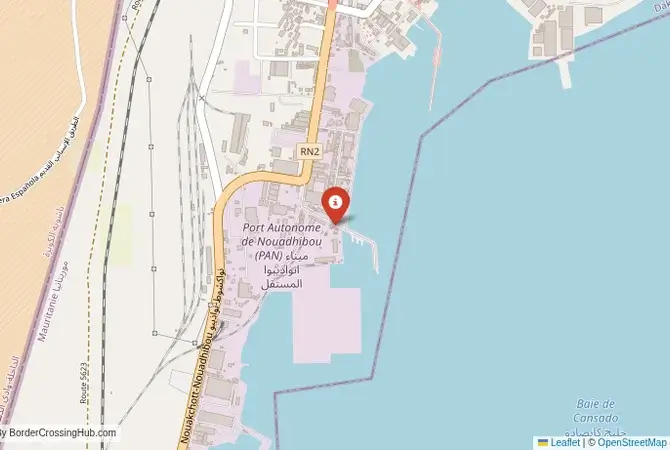
Fpolis & Nuadibú is not a normal direct Western Sahara-Mauritania road crossing. The established overland route between Western Sahara and Mauritania runs through the Guerguerat–Nouadhibou corridor, while Bir Gandouz is a settlement on the Western Sahara side rather than a separate international frontier. Travelers using the Atlantic route should therefore make sure they are following the official Guerguerat border crossing rather than treating this page's location as a standalone checkpoint.
About this crossing
A History of a No-Man's-Land
The history of this crossing is the history of the Western Sahara conflict. The border between what was then Spanish Sahara and French West Africa (Mauritania) was a vague line in the desert. After Morocco took control of most of the territory in 1975, it built a massive sand wall, or "Berm," to secure the area from the Polisario Front independence movement. The Guerguerat crossing is the southernmost point of the Moroccan-controlled territory. The area between the Moroccan Berm and the formal Mauritanian border post became a buffer strip, a no-man's-land that was technically part of the Polisario-controlled "Free Zone." For years, this strip was a source of tension, with the Polisario Front occasionally setting up checkpoints and Morocco launching operations to clear the road. The road through the no-man's-land remained an unpaved, sandy track, littered with the carcasses of old vehicles, a sort of informal graveyard for the Sahara. In late 2020, after the Polisario Front blockaded the road, the Moroccan army moved in to secure and pave the road, pushing the Polisario Front back. The situation is now calmer, but it remains a politically charged and heavily monitored frontier, a place where the frozen conflict can become hot at any moment.
The Border Crossing Procedure: A Three-Part Adventure
The border is open during daylight hours. The process is notoriously slow and bureaucratic, and you should budget most of a day for the crossing. You must have your visas sorted in advance. Exiting Moroccan-controlled territory (Guerguerat): You will arrive at the large and very modern Moroccan border post. This is a high-security facility. You will first go through the police check, where your passport will be stamped for exit. You will then proceed to a very thorough customs check. The officials will inspect your vehicle and all your luggage, and you will need to have your vehicle's temporary import permit processed for exit. The process is formal and can be very slow, often taking several hours. The No-Man's-Land: This is the main event. You will then drive out of the Moroccan post and onto the 4-kilometer-long road to the Mauritanian post. While the road is now largely paved, the area is still a strange, informal zone with various traders and vehicle repair shops. You must drive carefully and directly to the Mauritanian post. It is a surreal journey through a landscape of sand and rusting metal. Entering Mauritania: You will arrive at the Mauritanian border post, which is a more basic facility. You can obtain a Mauritanian visa on arrival here if not pre-arranged via e-visa. You will need to pay the fee in euros. The process can be slow and involves going to several different windows for immigration, customs, and vehicle permits. You will also need to purchase Mauritanian car insurance. "Facilitators" will offer their help for a fee. The process is bureaucratic but manageable with patience.
Nearby Border Crossings

Route, Onward Travel, and The Iron Ore Train
This crossing is the terminus of the N1 highway that runs the entire length of Morocco and Western Sahara. On the Mauritanian side, the road from the border to the main port city of Nouadhibou is now a good, paved highway, a journey of about an hour. From Nouadhibou, the main highway continues for several hundred kilometers across the desert to the capital, Nouakchott. For those without a car, there are shared taxis (often old Mercedes sedans) that run from the border to Nouadhibou. The main attraction in this region is the journey itself and the unique city of Nouadhibou, which is the terminus of the famous Iron Ore Train, one of the longest trains in the world. This crossing is the essential gateway for any overland traveler heading from Europe to West Africa. It is a challenging but unavoidable part of the journey. The sense of accomplishment upon successfully navigating this border and arriving in Nouadhibou is immense.
Final Planning Advice for the Sahara Gateway
The Guerguerat crossing is a true overland adventure, a legendary border for anyone driving across Africa. The key to a successful crossing is to be meticulously prepared and extremely patient. Have all your documents in perfect order, especially your vehicle papers. Have euros on hand for the Mauritanian visa on arrival. Be prepared for a long, slow, and bureaucratic process on both sides. The journey through the no-man's-land is a unique and unforgettable experience. This is not a border for the inexperienced traveler. It is a passage through a politically charged and physically demanding landscape. By being well-prepared and keeping a calm and patient attitude, you can successfully navigate this famous gateway and begin your adventure into the fascinating and beautiful country of Mauritania. It is a border that truly feels like the end of one world and the beginning of another.
View all border crossings between Western Sahara and MauritaniaPractical information
Fuel
Western Sahara: <1 km - Mauritania: <5 km
Currency
Limited near Guerguerat (MAD, MRU)
Safety information
Restricted, desert/security
Connectivity
Limited Wi-Fi, 2G
Have you crossed here?
Help other travelers by sharing your experience, wait times, and any updates.