Monthly Update (October 2026):
The Jimbolia & Srpska Crnja Border Crossing is currently moving well from Romania into Serbia, with October 6 monitoring showing about a 20-minute wait. That makes it one of the quicker options in the western part of the Romania-Serbia frontier at the moment, especially compared with the much longer queues reported at some smaller crossings later in the day. It remains a useful alternative to the heavier Vatin route for traffic between Timiș County and northern Serbia.
About this crossing
Operational Details
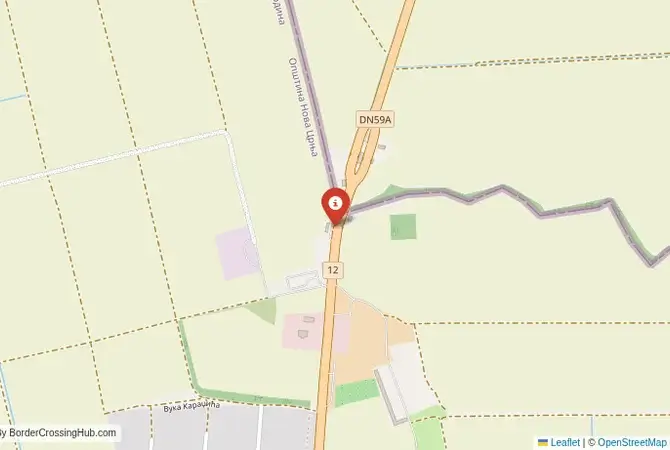
This checkpoint connects the Central Banat District of Serbia with Romania's Timiș County. Its round-the-clock operation provides a level of certainty and flexibility that is crucial for travelers. It serves as a major alternative to the Stamora Moravița–Vatin crossing to the south, particularly for those traveling between the Zrenjanin area in Serbia and the Timișoara area in Romania. The presence of a parallel railway line further emphasizes its long-standing role as a strategic corridor for both people and goods, a history that stretches back to the age of the Austro-Hungarian Empire.
A History of Multicultural Settlement
The history of this borderland is a fascinating story of multicultural settlement. After the Habsburg conquest of the Banat, the area was systematically colonized. Jimbolia (known as Hatzfeld in German and Zsombolya in Hungarian) was a prime example of this planned settlement, becoming a significant center for German-speaking Banat Swabians. The town's orderly street plan, impressive Catholic church, and numerous historical buildings are a testament to this legacy. Srpska Crnja also has a rich history, being the birthplace of the famous Serbian romantic painter and poet, Đura Jakšić, a key figure in 19th-century Serbian culture. The border, established after World War I, divided this once-unified region, but the strong cultural and economic ties have endured, facilitated by this very crossing.
Nearby Border Crossings


Border Crossing Procedure
The border crossing procedure is well-organized to handle a steady flow of traffic. As Serbia is not an EU member, you will undergo full customs and immigration checks. The process involves two separate checkpoints. You will first complete exit formalities on the Serbian side at Srpska Crnja. After a short drive, you will arrive at the Romanian checkpoint at Jimbolia for their entry inspection. You will need a valid passport, vehicle registration, and international insurance (Green Card). The checkpoint has separate lanes for cars and trucks, which helps to prevent passenger traffic from being delayed by freight queues. However, as a major 24/7 crossing, it can get busy, especially during peak holiday seasons, so it is always wise to allow for some buffer time in your travel plans. Recent reports show minimal waiting times for passenger vehicles.
The Towns of Jimbolia and Srpska Crnja
The towns on either side of the border are destinations in their own right. Jimbolia is particularly interesting for its collection of museums. The Stefan Jäger Museum is dedicated to the life and work of a prominent Banat Swabian painter, offering a glimpse into the world of the region's German community. The "Sever Bocu" Press Museum is unique in the region, and the Firefighters' Museum, founded in memory of Karl Florian, is another point of interest. The town's architecture reflects its prosperous past as a major agricultural center. On the Serbian side, Srpska Crnja has a memorial museum dedicated to Đura Jakšić, located in his former home. The nearby city of Zrenjanin, the regional capital, has a beautiful city center with impressive architecture from the Habsburg era. The entire region is a flat, fertile plain, part of the vast Pannonian Basin.
Practical Travel Information
Practical planning for this route is straightforward. The crossing is on a main international road. You will need the Romanian `rovinietă` vignette, which can be purchased online. Serbia uses a toll system for its main motorways, but the roads in this immediate area are generally toll-free. The official currencies are the Serbian Dinar (RSD) and the Romanian Leu (RON). As these are substantial towns, you will find all necessary services, including 24/7 petrol stations, banks, and currency exchange offices, readily available on both sides of the border. This makes it a convenient point to cross, as you can easily take care of any travel necessities before or after the border formalities.
Final Considerations
The Srpska Crnja–Jimbolia crossing is a practical and reliable choice for travel through the heart of the Banat. Its 24/7 operation and full-service capabilities make it suitable for all types of travelers. Beyond its functionality, it offers a direct entry into two towns with rich and distinct cultural histories, providing a fascinating glimpse into the multicultural heritage of this unique European borderland. It is a crossing that is both a convenient point of transit and a gateway to exploration, a dependable link between the Serbian and Romanian parts of the historic Banat region, with smooth passages reported in recent times.
View all border crossings between Serbia and RomaniaPractical information
Fuel
Romania: 500 m - Serbia: 500 m
Currency
Near Srpska Crnja (RON, RSD)
Safety information
Busy, low crime
Connectivity
Wi-Fi at site, 4G/5G
Have you crossed here?
Help other travelers by sharing your experience, wait times, and any updates.