Monthly Update (September 2026):
Csanádpalota & Nădlac Border Crossing remains open 24 hours and is currently handling relatively light traffic despite being one of the principal motorway crossings between Hungary and Romania. September 4 monitoring showed waits around 10–25 minutes, with the forecast falling toward roughly 15 minutes through much of the day. Routine Schengen border checks are no longer carried out, so current delays are primarily traffic-related rather than caused by passport processing.
About this crossing
Operational Details and the Two Nădlacs
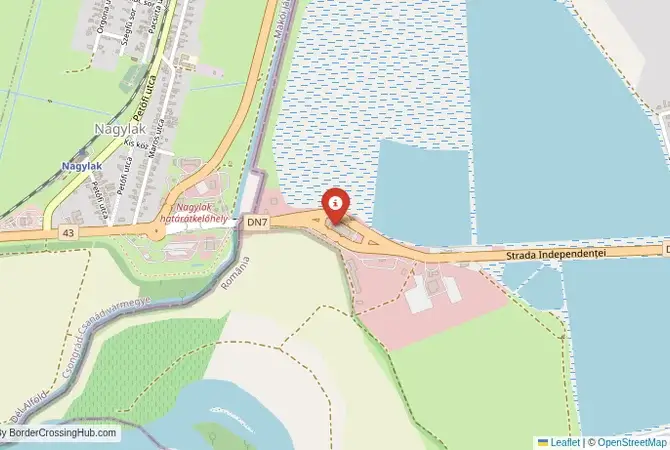
This crossing is, in fact, one of two at Nădlac. This one, often called Nădlac II, is the motorway crossing. The original crossing, Nădlac I (connecting to the Hungarian town of Nagylak), is on the old national road and still serves local and non-motorway traffic. The Nădlac II–Csanádpalota crossing is a modern, 24/7 facility built to handle immense traffic volumes, and it has fundamentally changed the nature of long-distance travel in the region. Its large, sweeping infrastructure, with a wide canopy and numerous lanes, is a clear statement of its importance as a key external border of the European Union.
The Crossing Procedure on the Motorway
Despite being a state-of-the-art facility, full document checks were previously required, as Romania had not yet fully implemented Schengen rules for its land borders. Since January 1, 2025, with Romania's full accession to the Schengen Area, systematic border controls have been lifted at land crossings with Hungary. Travelers now cross without stopping for routine passport or ID checks, exit/entry stamps, or queues at booths. Random checks may still occur in the border area. The checkpoint is a large, purpose-built complex spanning the motorway. You will first be checked by the authorities of the country you are leaving (either Romanian or Hungarian) if required under rare circumstances. You will then drive a short distance to the checkpoint of the country you are entering if applicable. The facility has numerous lanes for both passenger cars and freight, and traffic is usually channeled effectively. However, this is the busiest road crossing between the two countries, and queues, particularly for freight, can be very long, sometimes stretching for many kilometers. Car traffic can also build up significantly during peak holiday periods (e.g., summer, Christmas, Easter) when many Romanians working abroad travel home. It is highly recommended to check live traffic conditions before your journey. With Schengen integration, crossings are now seamless with minimal or no waiting times reported for passenger vehicles.
Nearby Border Crossings



A Major European Corridor
This crossing is more of a transit point than a destination. Its significance is purely logistical. It is the fastest way to get from the Timișoara and Arad regions in Romania to the Budapest region and onwards into Western Europe. The nearest towns are Nădlac on the Romanian side, known for having a large and historic Slovak community that has preserved its language and traditions, and the city of Makó on the Hungarian side, famous throughout the country for its high-quality onions and its unique thermal bath, the Hagymatikum, designed by the renowned organic architect Imre Makovecz. For most travelers on this route, however, these towns are simply points on a map passed on the way to more distant destinations like Vienna, Prague, or Bucharest.
Essential Travel Information
To use this crossing, you must be on the motorway, which means having the required vignettes is not optional. You must have the Romanian `rovinietă` and the Hungarian `e-matrica`. Both should be purchased online before you start your trip to avoid any issues or fines. The crossing complex has basic facilities, but for better services, you can stop at the large petrol station complexes located on either side of the border. These offer 24/7 fuel, restaurants, shops, and currency exchange. The official currencies are the Romanian Leu (RON) and the Hungarian Forint (HUF).
The Nădlac I Alternative
For those seeking to avoid potential long queues on the motorway, the old Nădlac I crossing is a viable alternative. It requires exiting the motorway and driving through the town of Nădlac. While the facility is smaller and older, if live traffic data shows a severe blockage on the motorway, this route can sometimes be a faster option, especially for passenger cars. It also offers a chance to see the town of Nădlac itself. However, it is essential to check traffic conditions for both crossings before making a decision, as Nădlac I can also become congested when the motorway is blocked.
Final Considerations
The Nădlac II–Csanádpalota crossing is the embodiment of modern, high-volume border transit. It is built for speed and function. While it can be subject to heavy traffic, it remains the most direct and logical choice for long-distance travel between Romania and Hungary. It is a critical piece of European infrastructure, a testament to the importance of seamless connections in the 21st century. It may lack the charm of a rural crossing, but for the millions of travelers and businesses that rely on it, its efficiency is its own form of beauty, a symbol of a connected continent, now enhanced by control-free Schengen travel.
View all border crossings between Romania and HungaryPractical information
Fuel
Romania: 500 m - Hungary: 500 m
Currency
Near Nădlac (RON, HUF)
Safety information
Busy, night caution
Connectivity
Wi-Fi checkpoints, 4G/5G
Have you crossed here?
Help other travelers by sharing your experience, wait times, and any updates.