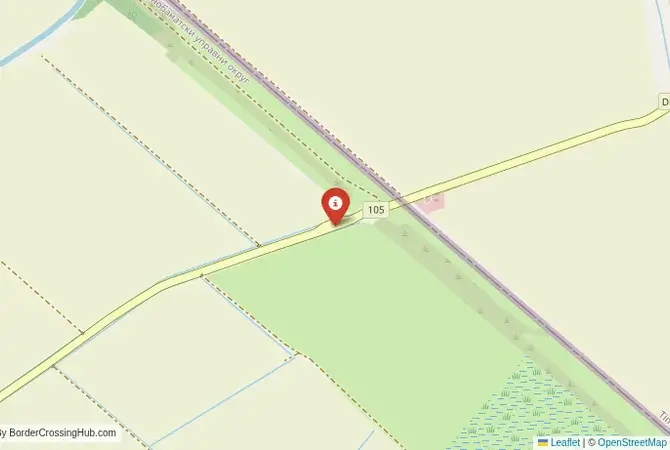
Monthly Update (September 2026):
Vălcani & Vrbica remains a small Romania-Serbia crossing with no significant September closure or disruption identified. The route is mainly useful for local and regional travel rather than as a major alternative to the larger motorway crossings. With Romania inside Schengen, there are no routine checks on the Romanian side, while Serbia remains the external border. Travelers should verify the opening hours before setting out, as smaller crossings can have more limited service than the main ports.
About this crossing
Operational Details and Location
This checkpoint connects Serbia’s North Banat District with Romania’s Timiș County. It is a minor, local crossing point with restricted operating hours, a critical piece of information for anyone planning a trip. The crossing is typically open only during daylight hours, often from 8:00 AM to 8:00 PM, and may have even more limited schedules during the winter months. It is designed exclusively for passenger cars, cyclists, and pedestrians. The complete absence of heavy freight traffic is what defines its tranquil character. Before setting out, it is essential to verify the current operational hours through an official channel, as schedules for such small crossings can change with little notice.
Historical Context of the Banat Region
The history of the Banat region is fundamental to understanding the context of this crossing. After the area was reconquered from the Ottoman Empire by the Habsburgs in the early 18th century, it was a sparsely populated, marshy plain. The Habsburg authorities initiated a massive colonization effort, inviting settlers from across the empire, most notably Germans (known as Banat Swabians), but also Hungarians, Serbs, Slovaks, and others, to drain the marshes and turn the land to agriculture. This created a multicultural, multi-confessional society that was unique in Europe. The villages on both sides of the modern border are a legacy of this planned settlement. The Treaty of Trianon in 1920 divided the Banat between Romania, the Kingdom of Serbs, Croats and Slovenes (later Yugoslavia), and a small part to Hungary. This act drew a line through a previously unified economic and cultural space, separating communities and families. The Vrbica–Vălcani crossing, therefore, serves as a small bridge reconnecting this divided land.
Nearby Border Crossings



Border Crossing Procedure
The border crossing procedure here is as simple and low-key as its surroundings. As Serbia is not a member of the European Union, you will undergo full customs and immigration checks. The process involves two distinct stops. First, you will arrive at the Serbian checkpoint, a modest building staffed by border police and customs officers. They will check your passport and vehicle documents (registration and proof of insurance, or "Green Card"). Once cleared, you will drive a short distance through a neutral zone to the Romanian checkpoint. Here, the Poliția de Frontieră will conduct their entry check. As Romania is an EU member, this check is also a point of entry into the EU customs union. Despite the international status, the low traffic volume means the entire process is usually completed in under 15 minutes.
Regional Attractions and Landscape
The surrounding landscape is one of immense, flat agricultural fields, punctuated by small villages. This is a region for slow travel. On the Romanian side, Vălcani is a small communal village. The nearby town of Sânnicolau Mare is more significant, known as the discovery site of the Treasure of Nagyszentmiklós, a magnificent collection of early medieval gold vessels of uncertain origin, now housed in Vienna. The city of Timișoara, the regional capital, is a major attraction with its stunning Secessionist and Baroque architecture and its history as the starting point of the 1989 Romanian Revolution. On the Serbian side, the nearest major town is Kikinda, known for its annual pumpkin festival and as a wintering ground for thousands of long-eared owls that take up residence in the town's central square.
Practical Travel Information
Practical preparation is crucial for this route. The roads leading to the crossing are rural and can be narrow in places. They are paved but not designed for high-speed travel. You will need the required road vignettes for Romania (the `rovinietă`), which can be purchased online or at petrol stations. Serbia uses a toll system for its motorways, but none are near this crossing. The official currencies are the Serbian Dinar (RSD) and the Romanian Leu (RON). Currency exchange services are not available at the border, so you must acquire local currency in a larger town beforehand. Similarly, ensure you have enough fuel, as petrol stations are infrequent in the immediate border area.
Final Considerations
Choosing the Vrbica–Vălcani crossing is an act of deliberate exploration. It is a route for the patient traveler who is more interested in the subtle textures of a region than in reaching a destination quickly. Its limited hours and rural location make it impractical for long-distance transit, but for those exploring the historic Banat, it offers a peaceful, uncomplicated, and authentic border experience. It is a journey back to a time when borders were just lines across fields, and life flowed across them with the quiet rhythm of the seasons.
View all border crossings between Romania and SerbiaPractical information
Fuel
Romania: <1 km - Serbia: <1 km
Currency
Near Vrbica (RON, RSD)
Safety information
Rural, low crime
Connectivity
Basic 3G coverage
Have you crossed here?
Help other travelers by sharing your experience, wait times, and any updates.