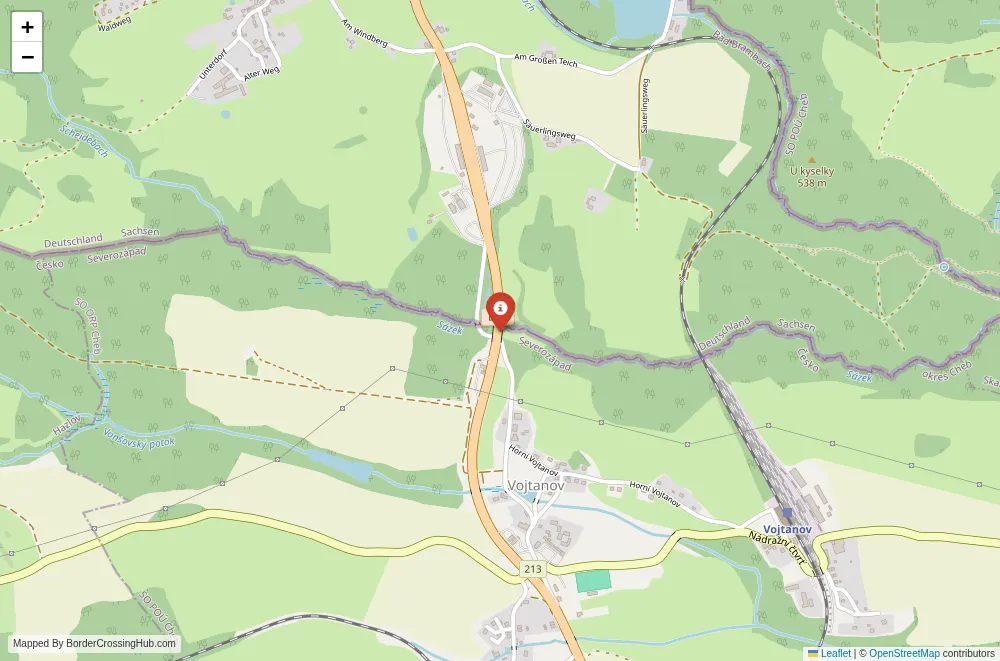
Monthly Update (September 2026):
Schönberg & Vojtanov remains a practical regional Germany–Czech Republic road crossing, with no significant September closure reported. Germany's border checks with Czechia continue throughout the month, shifting from the current period ending September 15 to a renewed period starting September 16. The crossing remains usable, but travelers should expect that police may stop vehicles for document checks.
About this crossing
Location and Connections
You reach this point where Schönberg, a small district of Bad Brambach in Saxony, Germany, meets Vojtanov in Czechia's Karlovy Vary Region. The road follows Bundesstraße 92 (B92, part of E49) on the German side, becoming Silnice I/21 in Czechia. From Bad Brambach, Schönberg lies a short drive south, about 10 to 15 minutes. On the Czech side, Vojtanov sits roughly 10 minutes from Františkovy Lázně or 20 to 30 minutes from Cheb. Rail line 147 (Plauen-Cheb) crosses here, with the border between the former Schönberg station (closed 1945) and Vojtanov station. Cars, regional trains, buses, cyclists, and pedestrians use it; the route supports local traffic, spa visitors to Františkovy Lázně, and connections toward Zwickau or Cheb.
Alternative Names
It appears as Schönberg-Vojtanov border crossing, Vojtanov-Schönberg, or Voitersreuth-Schönberg from historical German naming (Vojtanov was once Voitersreuth).
Nearby Border Crossings


Historical Background
The rail line dates to 1856, part of the Plauen-Cheb connection that carried passengers and freight across what became a tense frontier. Post-WWII, the Iron Curtain sealed it from the late 1940s, with the German intermediate station at Schönberg abandoned in 1945 and never revived. Controls eased after 1989, and Schengen in 2007 removed permanent checks. The road crossing gained importance for regional ties, while the rail section electrified on the Czech side supports through services. The area reflects Vogtland-Bohemian links through mining, spas, and trade routes.
Geopolitical Context
Schengen since late 2007 normally allows free passage. Germany continues temporary controls on all Czech land borders due to migration and security. As of February 10, 2026, these extend at least through March 15, 2026, with Bundespolizei random spot checks possible. This crossing sees occasional inspections rather than constant presence. No fixed booths operate. Check German Federal Police or Czech Interior Ministry for updates, as extensions depend on assessments.
Practical Crossing Procedures
You drive or ride across with a border marker indicating the shift. Temporary measures may prompt a police stop shortly after entering Germany for ID checks, travel purpose questions, or vehicle review. EU citizens present passport or national ID. Non-EU nationals need valid passports, visas/residence permits if applicable, and basics like accommodation proof. Rail passengers face rare onboard checks. Carry vehicle insurance; Czech vignette required for highways beyond I/21. Pedestrians and cyclists cross on the road or paths.
Typical Wait Times
Normal conditions mean seconds to cross. Random checks add time: most clear fast, but detailed stops run 10 to 45 minutes depending on questions or queues. Local traffic keeps things lighter than motorways, though weekends or spa season might see slight increases.
Operating Hours
The road and rail run 24/7 year-round. Schengen ended fixed hours. Winter weather can slow mountain approaches briefly, but the crossing remains open.
Transportation Options and Road Conditions
Regional trains on line 147 connect Bad Brambach/Plauen to Vojtanov/Cheb several times daily, offering a scenic descent through valleys. Cars work well on B92/I/21 with good pavement but curves and gentle hills. Buses link from Cheb or Františkovy Lázně. The route features wooded slopes, small valleys, and open farmland views. Watch for local traffic or wildlife in rural parts.
Scams & Warnings
Scams remain uncommon at this quieter crossing. No frequent touts or fake services reported. Border shops near Vojtanov sell cheaper fuel, groceries, tobacco, alcohol, or Asian goods to Germans; occasional notes mention aggressive vendors or poor informal rates. Secure belongings in cars during stops. Drive attentively on winding sections.
Nearby Attractions
Vojtanov provides basic services and proximity to Františkovy Lázně's spas, mineral springs, and historic colonnades. Schönberg offers quiet village access near Bad Brambach's spa facilities and nature trails. The Vogtland-Czech border zone includes hiking paths, cross-border routes, and sites like the Ohře viaduct farther along the rail line. It suits spa visitors, walkers, or those exploring regional history over major cities.
Seasonal Variations and Weather Impacts
Winter snow December to March requires winter tires; roads ice in shaded areas. Summer draws more spa tourists and hikers with clearer conditions. Autumn foliage enhances the hills with moderate crowds. Rain slicks curves occasionally, but closures stay rare.
Travel Tips and Preparation
Carry passport or ID for possible checks. Buy Czech vignette online if using highways. Refuel or shop in Czechia for lower costs. Offline maps help in hilly spots with variable signal. Pack layers for elevation changes. Check police sites or apps for border updates before departure. Follow marked trails for hikes.
Cultural and Economic Significance
Cross-border shopping and spa tourism drive local trade: Germans visit Czech outlets or spas, while Czechs head to Vogtland markets. Rail and road links tie economies from Plauen to Cheb, preserving shared Vogtland-Bohemian heritage through joint events and conservation.
Before You Cross
Verify temporary control status from official sources near your travel date. With prep for spot checks and regional roads, you manage this low-key crossing and continue into spa country or Vogtland hills. Safe travels.
View all border crossings between Germany and Czech RepublicPractical information
Fuel
Germany: <1 km - Czech Republic: <1 km
Currency
EUR; CZK in Cheb/Hof; ATMs
Safety information
Low risk; occasional checks
Connectivity
Wi-Fi points; 4G
Have you crossed here?
Help other travelers by sharing your experience, wait times, and any updates.