Monthly Update (October 2026):
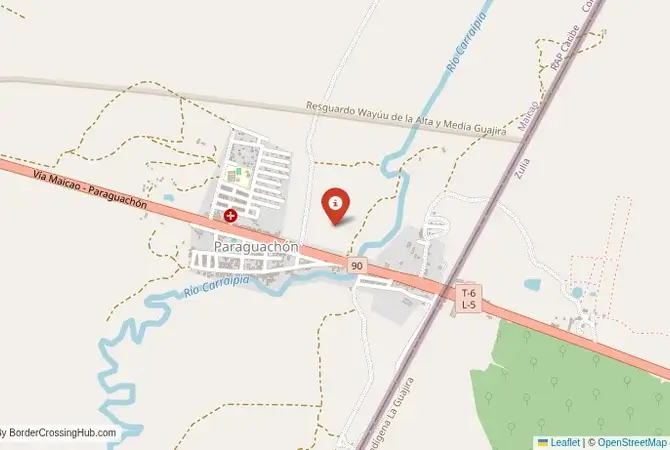
Guarero & Paraguachón has a more complicated status than the other major Colombia–Venezuela crossings. Colombian authorities have previously reported that the Paraguachón migration post did not have an active authorized passage because of a Venezuelan decision, while the larger border system remains under close security and humanitarian monitoring. Travelers should therefore verify the status immediately before attempting this route rather than assuming the crossing is available simply because the road reaches the frontier.
Driving there, or sending a driver? Send them this guide.
For reports and websites
Cite this page
Border Crossing Hub (2026). Guarero & Paraguachón Border Crossing. Updated October 2026. https://bordercrossinghub.com/paraguachon-guarero-border-crossing/<a href="https://bordercrossinghub.com/paraguachon-guarero-border-crossing/">Guarero & Paraguachón Border Crossing (Border Crossing Hub)</a>Put this crossing's card on your website
Free. It updates on its own when our information changes.
<iframe data-bch-card src="https://bordercrossinghub.com/paraguachon-guarero-border-crossing/?bch_view=card" width="100%" height="980" scrolling="no" style="border:0;max-width:480px;display:block" loading="lazy" title="Guarero & Paraguachón border crossing information"></iframe>
<p style="font-size:12px;margin:4px 0 0">Crossing information: <a href="https://bordercrossinghub.com/paraguachon-guarero-border-crossing/">Border Crossing Hub</a></p>
<script src="https://bordercrossinghub.com/?bch_embed_js=1" async></script>Paste it where you want the card. The last line (a script) only adjusts the height and can be left out.
About this crossing
Operational Details
This checkpoint connects the La Guajira Department of Colombia with the Zulia state of Venezuela. It is a major international crossing, and under normal circumstances, would be open 24/7. However, its operational status is often subject to the political climate. The Venezuelan government has closed the border on several occasions for long periods. The crossing is a vital artery for the limited formal trade that still exists and for the movement of people, particularly the binational Wayuu community. It is also a major corridor for the flow of Venezuelan migrants heading towards Colombia and other parts of Latin America.
A History of the Wayuu Homeland
The history of this region is the history of the Wayuu people, a large and resilient indigenous group with a strong matrilineal culture. For centuries, they have moved freely across the Guajira Peninsula, their territory long predating the modern states of Colombia and Venezuela. The border, established in the 19th century, divided their ancestral lands. The Wayuu, however, have largely ignored the border in their daily lives, and the region is known for a massive informal economy based on the smuggling of cheap, subsidized Venezuelan gasoline and other goods into Colombia. This informal trade is a fundamental part of the regional economy and a constant challenge for the authorities on both sides.
Nearby Border Crossings
The Border Crossing Procedure
The border crossing procedure is chaotic and subject to constant change. When the border is open, there are formal immigration and customs offices on both sides. However, the area is also known for its hundreds of illegal crossing points (trochas), which are controlled by armed criminal groups and are extremely dangerous. For those crossing legally, the process involves a standard two-part check. You will need a valid passport and any required visas. The atmosphere can be tense and chaotic, with a huge amount of informal activity happening all around the official checkpoint.
The Surrounding Region: Colombia Side
On the Colombian side, the city of Maicao is a bustling commercial hub, often called the "Commercial Showcase of Colombia." It is the main center for the cross-border trade, both legal and illegal. The capital of the department is Riohacha. The Guajira Peninsula is a stunning destination for adventurous tourism, known for its dramatic desert landscapes that meet the turquoise Caribbean Sea at places like Cabo de la Vela and Punta Gallinas, the northernmost point of South America. It is a region of incredible beauty but also of extreme poverty and complex social challenges.
The Surrounding Region: Venezuela Side
On the Venezuelan side, the crossing is the gateway to the state of Zulia and the major city of Maracaibo, the center of Venezuela's oil industry. The region is known for the Catatumbo lightning, a unique atmospheric phenomenon of constant, silent lightning. However, the security situation in Zulia is extremely precarious, and the region has been severely affected by the economic collapse, with major failures in the electricity and water supply. Travel in this region is extremely dangerous.
Practical Travel Information
Travel to this region is strongly discouraged. The security situation is extremely precarious, with the presence of numerous armed groups. The official currencies are the Colombian Peso (COP) in Colombia and the Venezuelan Bolívar (VES) in Venezuela. Any travel must be undertaken with extreme caution and a deep understanding of the risks involved. The Wayuu people often do not recognize the authority of either state, and the region operates under its own complex set of rules.
Final Considerations
The Paraguachón–Guarero border crossing is a journey into a unique and complex world. It is a place where a modern international border is superimposed on an ancient indigenous territory, and where formal state control is constantly challenged by informal economies and traditional ways of life. It is a symbol of the Venezuelan crisis and the resilience of the Wayuu people. It is a beautiful, dangerous, and unforgettable frontier, a true borderland in every sense of the word.
View all border crossings between Colombia and VenezuelaHeading to Guarero & Paraguachón? Take this with you.
One page with the hours, waits, emergency numbers and coordinates. Works without signal.
Practical information
Fuel
Colombia: <1 km - Venezuela: <1 km
Currency
Limited near Paraguachón (COP, VES)
Safety information
High security risk: crime, armed groups, extortion
Connectivity
Basic 3G coverage
Have you crossed here?
Help other travelers by sharing your experience, wait times, and any updates.