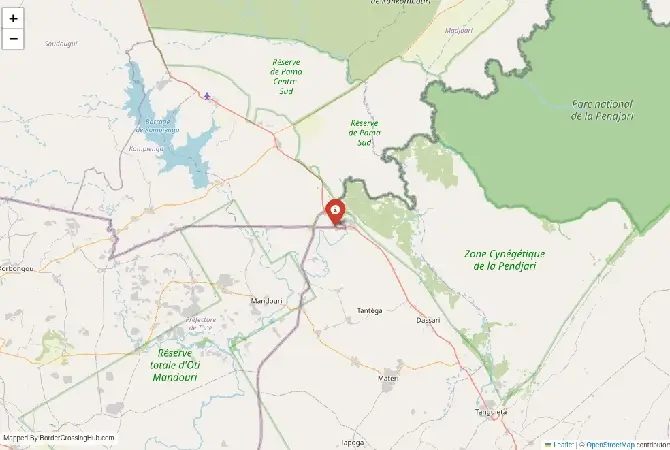
Monthly Update (September 2026):
Madjoari and Porga remains a highly sensitive Benin-Burkina Faso frontier route. Current travel guidance continues to warn against travel in northern Benin near the Burkina Faso border because of terrorism, banditry and kidnapping risks, while the Porga area has previously experienced attacks. There is no reliable evidence of a September reopening or normal tourist operation at this remote crossing. Travelers should therefore not treat Porga as an ordinary alternative to the safer southern Benin-Togo routes.
About this crossing
Alternative names are not widely standardized here, but you may hear it referred to simply as the Madjoari–Porga border or the Burkina Faso–Benin crossing near Pendjari.
A Border Shaped by Geography and Conservation
This crossing exists largely because of geography rather than heavy trade demand. The nearby Pendjari National Park and Arly National Park have shaped movement in the region for decades. Historically, the area has been more about wildlife corridors than commercial routes, and that still shows today in the low traffic levels.
Nearby Border Crossings



Colonial-era boundaries between French West African territories created this border, but it never developed into a major transit point. Instead, it has remained a secondary crossing, primarily used by locals, aid workers, and the occasional overland traveler.
Security Situation: Proceed With Caution
This is not a standard crossing for casual travel. The eastern regions of Burkina Faso, including Madjoari, have experienced significant security challenges linked to extremist activity in recent years. You should treat this crossing as high-risk unless you have up-to-date, verified information from official sources.
Travel advisories from multiple governments strongly discourage travel in this region. Military presence, checkpoints, and sudden closures are possible. Even if the border appears open on maps, conditions on the ground can change quickly. You should only consider this route if you have a compelling reason and proper guidance.
Border Facilities and Operating Conditions
Facilities at both Madjoari and Porga are basic. You should not expect modern infrastructure, consistent electricity, or clearly marked procedures. Immigration offices may be small buildings with minimal signage, and processing can depend heavily on who is on duty that day.
Operating hours are not always strictly enforced. While daytime crossings are generally expected, there is no guarantee that officials will be present outside standard hours. Arriving early in the day is your safest option.
You should also carry printed copies of your documents, including passport, visa, and any permits, as digital-only documentation may not be accepted.
Visa and Entry Requirements
For Burkina Faso, most foreign travelers need a visa obtained in advance. Visa-on-arrival options are extremely limited and unreliable at remote crossings like Madjoari.
For Benin, you will likely need an eVisa, which must be arranged before arrival. Benin has streamlined its eVisa system in recent years, but you should ensure all approvals are printed and ready.
Yellow fever vaccination certificates are required for entry into both countries. Border officials may check this carefully, especially in rural crossings.
Crossing Process and Wait Times
Wait times here are unpredictable. On a quiet day, you might pass through in under 30 minutes. On other days, delays can stretch beyond an hour due to staffing shortages or additional checks.
You should expect a manual process: passports stamped by hand, details written into ledgers, and occasional questioning about your route and purpose of travel. There is little consistency, so patience is essential.
If you are traveling with a vehicle, customs procedures can take longer. Temporary import permits may need to be arranged, and not all officers are familiar with foreign vehicle documentation.
Roads and Transport Options
Reaching this crossing is often the most difficult part. Roads on both sides can be rough, especially during the rainy season. Dirt tracks may become muddy and difficult to pass, particularly near Madjoari.
Public transport is extremely limited. You may find shared taxis or minibuses heading toward larger towns, but direct routes to the border are rare. Most travelers who attempt this crossing use private vehicles or arranged transport.
Fuel stations are scarce in the immediate area, so you should plan ahead and carry enough fuel for the journey.
Scams & Warnings
While this is not a heavily trafficked crossing, you should still be alert. Requests for unofficial fees can occur, especially if officials assume you are unfamiliar with local procedures. These may be framed as “facilitation” charges.
You should remain polite but firm. Ask for receipts when payments are requested and avoid handing over money without clear justification. Keeping small denominations of local currency can help manage legitimate fees without complications.
Another issue is misinformation. You may receive conflicting instructions from different officers. Staying calm and asking for clarification usually resolves the situation.
Nearby Attractions and Context
If security conditions allow, the surrounding region is known for its wildlife and natural landscapes. Pendjari National Park is one of West Africa’s best places to see elephants, lions, and other large animals. On the Burkina Faso side, Arly National Park offers similar ecosystems.
However, access to these parks has been affected by regional instability. You should verify current conditions before planning any այցել.
Seasonal Factors
The rainy season, typically from May to October, can significantly affect travel. Roads may become impassable, and river crossings can be more challenging. During the dry season, dust and heat are the main concerns, with temperatures often exceeding 35°C.
Wildlife movement also varies by season, which can impact road conditions and accessibility near the parks.
Practical Preparation Tips
You should approach this crossing with thorough preparation. Carry enough water, food, and fuel, as services are minimal. Mobile network coverage may be weak or nonexistent near the border.
Language can also be a factor. French is widely used on both sides, so basic knowledge or a translation tool can make interactions easier.
Having a flexible schedule is important. Delays, route changes, or even last-minute cancellations are all possible here.
Final Notes
This crossing between Madjoari and Porga is one of the quieter and more isolated links between Burkina Faso and Benin. It appeals mostly to experienced overland travelers or those with specific reasons to be in the region.
Closing Thoughts
You should treat this route as a specialized option rather than a standard crossing. With careful planning, verified security information, and realistic expectations, it can be navigated. Without those, it is better to consider alternative border points in safer regions.
View all border crossings between Benin and Burkina FasoPractical information
Currency
XOF,CFA limited
Safety information
Wildlife area, basic control
Connectivity
2G/3G mobile coverage; Limited signal
Have you crossed here?
Help other travelers by sharing your experience, wait times, and any updates.