Monthly Update (September 2026):
Hamzabeyli & Lesovo is currently the most problematic of the three main Bulgaria-Türkiye crossings for passenger cars heading toward Türkiye. On September 4, the reported wait at Lesovo reached about 3 hours 15 minutes with 17 cars in the queue, while the forecast expected the queue to ease later in the afternoon. The Turkish side was considerably lighter in the latest available reading, at around 45 minutes. Travelers heading into Türkiye should compare Hamzabeyli with Kapıkule and Dereköy before choosing their route.
About this crossing
Operational Details
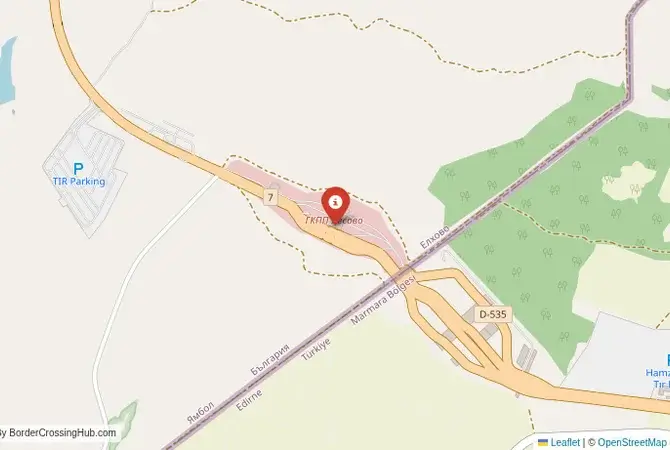
This checkpoint connects the Haskovo Province of Bulgaria with the Edirne Province of Turkey. It is a full-service international crossing, open 24/7 to all passenger cars, buses, and, most importantly, commercial freight. The facility was opened in 2005 with the specific goal of providing an alternative for the endless lines of trucks heading to and from Istanbul. The facility is large and modern, but as more traffic has been diverted here to avoid Kapıkule, it too can experience significant congestion, especially for freight. For passenger cars, however, it is often a significantly faster and less stressful alternative to the main highway; recent 2025-2026 reports from border authorities indicate passenger car waits typically 30 minutes to 2 hours outside peaks, with freight delays variable but generally shorter than Kapıkule.
A History of a Wild Frontier
The history of this region is the history of the Strandzha mountains, a wild and sparsely populated area that has been a refuge and a frontier for centuries. This was the heartland of the ancient Thracian tribes, and the area is dotted with their megalithic tombs and sanctuaries. During the Ottoman era, it was a remote and often rebellious region. The modern border, established in the early 20th century, cut through this unique mountain ecosystem. During the Cold War, this was a heavily militarized and almost inaccessible part of the Iron Curtain. The opening of this new, modern crossing in the 21st century was a major step in reintegrating this historic region and unlocking its potential for tourism and trade.
Nearby Border Crossings


The EU External Border Procedure
The border crossing procedure is a rigorous, multi-stage process. You will first complete exit formalities at one country's checkpoint and then proceed to the other country's checkpoint for entry inspection. As an EU external border, the checks by the Bulgarian Border Police are very thorough. The Turkish checks are equally meticulous. You will need a valid passport, a visa for Turkey (if required for your nationality), vehicle registration, and international insurance (Green Card). Customs inspections, particularly for goods, are very detailed. While the queues are generally shorter than at Kapıkule, you should still be prepared for a potentially slow and methodical process, especially during peak travel times; no major procedural changes reported in 2025-2026.
The Surrounding Region: Bulgaria Side
On the Bulgarian side, the crossing is in the heart of the Strandzha Nature Park, the largest protected area in Bulgaria. The park is a paradise for nature lovers, with a unique ecosystem where Central European and Mediterranean flora and fauna meet. The nearby town of Elhovo has a good ethnographic museum. The road from the border leads towards the city of Yambol and connects to the main Trakia motorway, which leads to the Black Sea coast and the capital, Sofia. The region is known for its unique fire-dancing rituals (Nestinarstvo), a UNESCO-listed intangible cultural heritage.
The Surrounding Region: Turkey Side
On the Turkish side, the crossing is in the Yıldız (Istranca) mountains, the Turkish part of the Strandzha range. The road from the border leads directly to the magnificent historic city of Edirne. As a former Ottoman capital, Edirne is home to some of the most spectacular examples of Ottoman architecture, including the Selimiye Mosque, a UNESCO World Heritage site and the masterpiece of the great architect Mimar Sinan. The city has a beautiful historic center with numerous other mosques, bridges, and covered bazaars. It is an essential stop for any traveler crossing this border. The road from Edirne is a modern motorway that leads directly to Istanbul.
Practical Travel Information
Practical planning is essential for this route. The most important thing is to have the required motorway vignettes or toll payments for both countries. You will need to purchase an electronic vignette for your vehicle for Bulgaria and the HGS electronic toll system for Turkey. The official currencies are the Bulgarian Lev (BGN) in Bulgaria and the Turkish Lira (TRY) in Turkey. Currency exchange facilities are available. Ensure your vehicle's Green Card insurance is valid for both countries. Always check live traffic information for both this crossing and Kapıkule to make an informed decision about which route is faster; use gdd.gov.tr (Turkey) and mvr.bg (Bulgaria) for real-time updates showing current queues.
Final Considerations
The Lesovo–Hamzabeyli border crossing is a vital and strategic alternative to the main Europe-Asia gateway. It is a modern, efficient checkpoint that offers a journey through a wilder and more scenic landscape than the main highway. For passenger cars, it is almost always the better choice, offering a less stressful and faster passage. It is a border that is defined by its functionality, a successful example of modern infrastructure designed to solve a major logistical problem, and a gateway to the rich history and nature of the ancient land of Thrace.
View all border crossings between Bulgaria and TurkeyPractical information
Fuel
Bulgaria: <1 km - Turkey: <1 km
Currency
Nearby exchange; BGN, TRY
Safety information
Heavy flow; monitored
Connectivity
Wi-Fi, 4G/5G
Have you crossed here?
Help other travelers by sharing your experience, wait times, and any updates.