
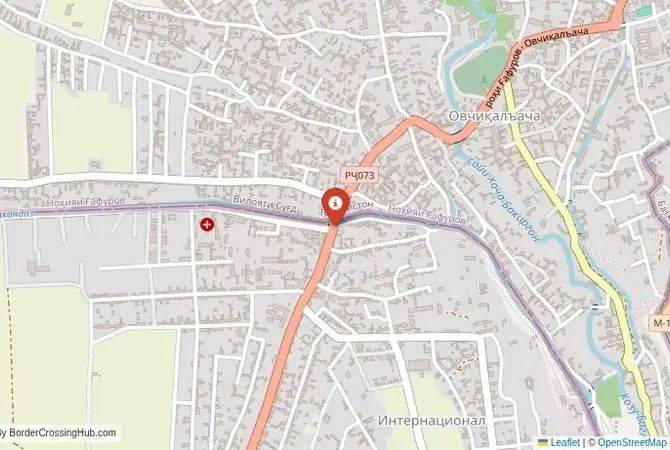
Monthly Update (September 2026):
Kulundu & Ovchi-Kalacha remains a daylight international Kyrgyzstan-Tajikistan crossing, but its status has been less reliable than the main Kyzyl-Bel route. Current border information still lists Ovchi-Kalacha–Kulundu as an international highway crossing operating during daylight hours. There is no significant September closure announcement to report, but travelers should confirm that the checkpoint is accepting their nationality before making the trip, particularly because reopening and access arrangements on the Kyrgyz-Tajik frontier have changed considerably in recent years.
About this crossing
A History of Enclaves and Local Dependence
The geography around this crossing is a prime example of the challenges created by Soviet border demarcation. The road it serves is a key access route for residents of Tajikistan's large Vorukh exclave, a piece of Tajik territory completely surrounded by Kyrgyzstan. While the crossing itself is on the main border, the political status of the roads leading to and from it, especially those that pass near the exclave, has been a source of constant tension and periodic conflict. The Kulundu-Ovchi-Kalacha crossing's primary historical and modern function is to serve these divided communities. Its operational status has often been a barometer of the state of Kyrgyz-Tajik relations; in times of tension, it has been one of the first to close, causing immense disruption for the local population who depend on it for their daily lives. Its continued operation is a sign of stability, but it exists within a fragile and politically charged environment.
The Border Crossing Procedure: A Basic and Uncertain Affair
The facilities at Kulundu and Ovchi-Kalacha are modest and functional, not designed for large volumes of traffic. The key challenge for a foreign traveler is the uncertainty of its status for non-local citizens. It is essential to confirm that it is open to your nationality before attempting to use it. Exiting Kyrgyzstan (Kulundu): Assuming you are permitted to cross, the process will be straightforward due to the lack of queues. You will arrive at the small Kyrgyz post. A border guard will check your passport and provide an exit stamp. The customs check on your vehicle and luggage is likely to be brief but professional. The officials may be unaccustomed to seeing foreign tourists, so patience and clear communication are helpful. Entering Tajikistan (Ovchi-Kalacha): After leaving the Kyrgyz post, you will proceed to the Tajik facility, which will also be a basic setup. You must meet Tajikistan's visa requirements for your nationality. An immigration officer will check your passport and provide an entry stamp. Be aware of the 10-day rule for OVIR registration if you are planning a longer stay in Tajikistan. The customs check is likely to be minimal for a tourist with standard luggage. The main challenge is not the border procedure itself, but the logistics of getting to and from this remote post. There will be no organized taxi stand, and you will need to rely on finding a local driver for onward travel, likely to the city of Khujand.
Nearby Border Crossings


Route, Road Conditions, and Major Caveats
The crossing is on a secondary road that winds through the agricultural plains of the Fergana Valley. The road quality can be variable, with some sections being rough or in poor repair. The primary caveat, which cannot be overstated, is the question of whether this border is open to all nationalities. There is a high risk that you would be turned away and directed to the main international crossing at Kyzyl-Bel. Information on the status of such minor crossings is notoriously difficult to find online and is often inaccurate. The only reliable way to know is to ask local sources with recent experience, such as a guesthouse owner or a reliable taxi driver in Khujand or Batken. Furthermore, the political situation around the nearby Vorukh exclave can be volatile, and roads in the area can be subject to sudden closures or checkpoints. It is not a region for casual, uninformed travel. For these reasons, this crossing is generally not recommended for most tourists.
Final Contextual Note: A Local Lifeline, Not a Tourist Route
The Kulundu-Ovchi-Kalacha crossing is a perfect example of a border that serves a vital local function but is not equipped for or intended for international tourism. It is a lifeline for the communities divided by the complex Fergana Valley borders. For the overland traveler, however, the uncertainties surrounding its operational status for foreigners, the lack of public transport, and the underlying political sensitivities of the region make it a risky and impractical choice. The designated international crossing at Kyzyl-Bel/Guliston is the more reliable and secure option for traveling between the Batken and Sughd regions. Kulundu remains a fascinating point on the map for understanding the intricate human geography of the Fergana Valley, but it is a route best left to the locals who depend on it.
View all border crossings between Kyrgyzstan and TajikistanPractical information
Fuel
Kyrgyzstan: <1 km - Tajikistan: <1 km
Currency
Exchange near Kulundu (KGS, TJS)
Safety information
Generally safe, traffic buildup
Connectivity
4G coverage from local networks
Have you crossed here?
Help other travelers by sharing your experience, wait times, and any updates.