Monthly Update (October 2026):
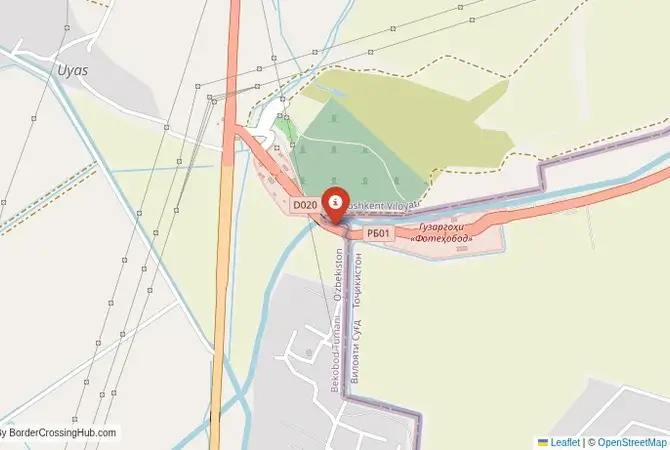
Fotehobod & Sughd region is closely tied to the same growing Tashkent–Khujand corridor as Oybek. A new Uzbekistan–Tajikistan cross-border health-security initiative has chosen Oybek–Fotehobod as its main pilot area, covering coordinated health surveillance and safer movement of people and goods. That is a useful sign of increasing institutional cooperation at a crossing that already handles substantial regional traffic.
About this crossing
A History of Industrial Towns and Sealed Borders
The city of Bekobod in Uzbekistan is a major center for steel production and was a significant industrial hub in the Soviet era. The border here was drawn in a way that separated the city from its natural hinterland and agricultural suppliers in Tajikistan. The Patarkul crossing was a local lifeline, allowing workers and farmers to move between the interconnected communities. The deterioration of Uzbek-Tajik relations after 1991, and particularly after the Tajik civil war, led to the sealing of this and many other smaller crossings. Uzbekistan was deeply concerned about security and sought to channel all movement through a few easily controlled chokepoints like Oybek. The closure of Patarkul caused significant economic and social disruption for the local population, forcing them to make long and costly detours. The decision to reopen the crossing was therefore a major local event, celebrated by the communities who depend on it. It symbolizes the restoration of local, everyday connections that were severed by high-level politics.
The Border Procedure: A Quieter, More Basic Experience
If you confirm that this crossing is open and available for your nationality, you should expect a much quieter and more basic experience than at Oybek. The facilities will be smaller, and the officials may be less accustomed to dealing with foreign tourists. This can result in a process that is either very quick due to the lack of queues or somewhat slow due to the novelty of your presence. The procedural steps, however, are the same. Exiting Uzbekistan (Patarkul): You will arrive at the Uzbek post, which will likely be a small building. An immigration officer will check your passport and your hotel registration slips. Do not assume that officials at a smaller post will be less strict about registration; they often adhere to the rules even more closely. After receiving your exit stamp, you will go through a customs check of your luggage. As a foreigner at a minor crossing, you may attract more detailed scrutiny than a local. Entering Tajikistan (Fotekhobod area): After crossing the short distance to the Tajik post, you will find a similarly small facility. You must meet Tajikistan's visa requirements for your nationality (many countries have visa-free access for up to 30 days). An immigration officer will stamp your passport. The customs check is likely to be brief for a tourist with standard luggage. The main challenge at this crossing is not the procedure itself but what comes after. There will not be a large, organized rank of shared taxis waiting. You will need to rely on finding a local private driver or walking to the nearest village to find onward transportation to a larger town like Istaravshan or Khujand.
Nearby Border Crossings

Route and Accessibility for Travelers
This crossing is not on a major highway. It is located on a secondary road south of the main Tashkent-Khujand route. Its main appeal would be for a traveler with their own vehicle looking to explore the back roads or for someone who has been visiting the industrial city of Bekobod. For the typical overland traveler, getting to and from this crossing requires more effort than using the main Oybek post. You would need to hire a private taxi to take you from a major Uzbek city to Patarkul, and then you would need to be confident in your ability to arrange onward transport on the Tajik side in a rural area. The uncertainty surrounding its operational status for foreigners is the biggest obstacle. It is highly recommended to seek reliable, current information from local sources before attempting to use this route.
Final Considerations for a Minor Crossing
The Patarkul border crossing is a testament to the importance of local connections in the densely populated regions of Central Asia. It serves a vital function for the communities living on the border, but it is not designed for international tourism. While it offers the allure of an off-the-beaten-path experience, it comes with significant logistical challenges and uncertainties. For 99% of travelers, the main Oybek crossing is the more sensible, reliable, and efficient choice. Using Patarkul would be a deliberate adventure, requiring a flexible schedule, a willingness to problem-solve transportation, and a prior confirmation that it is indeed open to you. It is a border that reminds you of the granular, local reality that exists beyond the major international highways.
View all border crossings between Uzbekistan and TajikistanPractical information
Fuel
Uzbekistan: <1 km - Tajikistan: <1 km
Currency
Exchange near Fotehobod (UZS, TJS)
Safety information
Safe, traffic moderate
Connectivity
Wi-Fi at checkpoints, 4G
Have you crossed here?
Help other travelers by sharing your experience, wait times, and any updates.