Monthly Update (September 2026):
Kodari & Zhangmu has been heavily affected by the catastrophic flooding along the Nepal-Tibet frontier. China is moving the Zhangmu customs inspection site to a new location from September 5, with restrictions on the road approaching the new facility during the transition. The wider disaster also disrupted the Kodari-Tatopani route, although Nepal reported that the crossing remains open to tourists while cargo movement has been badly affected by landslides. Travelers should expect unusual access arrangements and should verify the latest road and border situation before setting out.
About this crossing
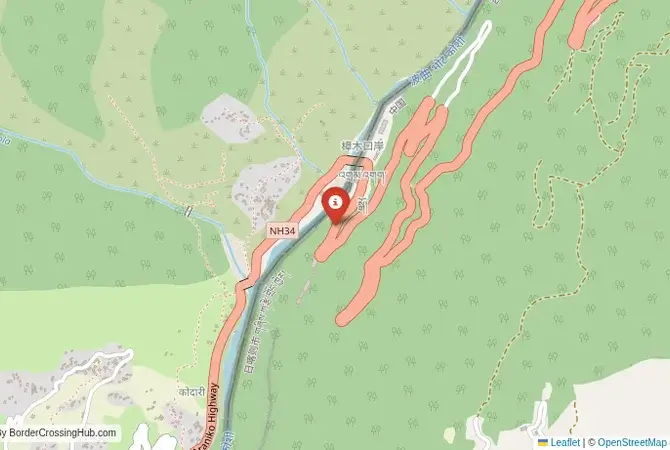
The Kodari-Zhangmu Crossing: The Friendship Bridge
The Kodari-Zhangmu crossing served for half a century as the premier overland route to Tibet. It marks the terminus of the Araniko Highway, the first modern road linking Kathmandu to the Chinese border, constructed with Chinese assistance in the 1960s. The border itself is the “Sino-Nepal Friendship Bridge,” a sturdy structure spanning the Bhote Koshi river as it surges through a deep, subtropical gorge. On the Nepali side lies the small village of Kodari. On the Chinese side, the town of Zhangmu rises along the steep canyon walls, a vibrant hub that acts as the entry point to the high Tibetan plateau. For thousands of travelers, crossing the Friendship Bridge and climbing the winding road from the lush green gorge of Zhangmu to the arid, high-altitude plains of Tibet remains one of the most dramatic and unforgettable journeys in the world. It is a physical and cultural passage of immense significance, now accessible again after years of anticipation.
A History of an Ancient Route and a Modern Highway
The route through the Kodari gorge has been a traditional trade path between Nepal and Tibet for centuries. It was a key channel for the exchange of salt from Tibet for grain from Nepal. The construction of the Araniko Highway in the 1960s transformed this ancient footpath into a major strategic and economic artery. It was a project of immense geopolitical importance, providing China with its first all-weather road access to a friendly southern neighbor and giving Nepal a vital link for trade. The crossing boomed. Zhangmu grew from a tiny village into a sprawling town of hotels, restaurants, and shops, all catering to the flow of tourists, pilgrims, and traders. It became the primary gateway for overland tours to Lhasa and Mount Everest. The Friendship Bridge was more than just a name; it was a symbol of the close and pragmatic relationship between Nepal and China. This era paused in April 2015 due to catastrophe, but reconstruction has brought it back to life.
Nearby Border Crossings



The 2015 Earthquake, Closure, and 2025 Reopening
The massive earthquake that struck Nepal in 2015 had a devastating impact on the Kodari-Zhangmu border region. The steep, unstable geology of the gorge could not withstand the seismic shock. The earthquake triggered enormous landslides that completely wiped out sections of the Araniko Highway on the Nepali side and, critically, destroyed much of the town of Zhangmu on the Chinese side. The town was deemed geologically unsafe and was evacuated by Chinese authorities, leading to an indefinite border closure. This was a massive blow to the economies of both regions and completely altered the landscape of overland travel. In the interim, the Chinese government developed the Rasuwagadhi-Gyirong crossing to the west as the primary international gateway. However, extensive rebuilding efforts, including road reinforcements and town reconstruction, culminated in the border's reopening to travelers in March 2025. Zhangmu has been revitalized with improved infrastructure, safer building standards, and enhanced facilities for trade and tourism, signaling a new chapter for this historic route.
Current Crossing Procedure: What to Expect
With the border now open, the procedure echoes its pre-2015 adventure while incorporating modern efficiencies. From Nepal, obtain your exit stamp at the immigration office in Kodari. Walk or drive across the refurbished Friendship Bridge into Zhangmu. Chinese immigration and customs are now handled at a streamlined facility near the base of the town, minimizing the steep ascents of old. Though a short jeep ride up switchbacks remains an option for those seeking the classic experience. The entry process involves standard passport and visa checks, with added digital verification for smoother flow. Once cleared, connect with your pre-arranged Tibetan guide and vehicle for the ascent to the plateau. The dramatic shift in landscape from the misty, green gorge to the vast, high-altitude Tibetan plains continues to define this journey, now bolstered by better roads and safety measures. Always confirm current requirements with official sources, as hours and procedures can vary.
Final Note: A Gateway Reborn
The Kodari-Zhangmu crossing tells a powerful story of resilience, where human ingenuity triumphs over nature's fury. It was, for generations, the most important link between Nepal and China, a place of vibrant exchange and the starting point for countless adventures. After a decade as a closed frontier, its 2025 reopening restores that legacy, fostering renewed cultural and economic ties across the Himalayas. It serves as a reminder of the region's enduring spirit and the fragility and recoverability of its infrastructure. For travelers planning an overland journey to Tibet from Nepal, the Kodari-Zhangmu route now offers a compelling alternative to Rasuwagadhi-Gyirong, blending history with fresh possibilities. The Friendship Bridge at Kodari stands ready once more, inviting adventurers to cross into the unknown.
View all border crossings between Nepal and ChinaPractical information
Fuel
Nepal: <1 km - China: <1 km
Currency
Exchange near Kodari (NPR, CNY)
Safety information
Altitude-related risks
Connectivity
Limited Wi-Fi, 3G
Have you crossed here?
Help other travelers by sharing your experience, wait times, and any updates.