Monthly Update (November 2026):
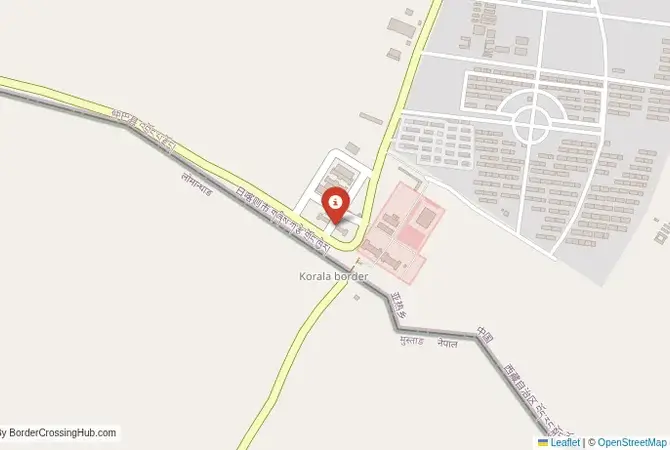
Heavy snowfall has caused serious disruption at the Korala crossing in Upper Mustang this November, with large numbers of imported vehicles stranded near the Nepal–China border. Snow-clearing work was still underway on November 17, making the high-altitude route difficult even for commercial traffic. Korala has taken on greater importance since flooding disrupted Nepal's other main crossings with China, but the extra freight movement has not made it a regular tourist gateway. For travelers considering the Mustang route, winter road access is currently the main problem.
Driving there, or sending a driver? Send them this guide.
For reports and websites
Cite this page
Border Crossing Hub (2026). Burang Yari & Korala Border Crossing. Updated November 2026. https://bordercrossinghub.com/burang-yari-tibet-korala-mustang-border-crossing/<a href="https://bordercrossinghub.com/burang-yari-tibet-korala-mustang-border-crossing/">Burang Yari & Korala Border Crossing (Border Crossing Hub)</a>Put this crossing's card on your website
Free. It updates on its own when our information changes.
<iframe data-bch-card src="https://bordercrossinghub.com/burang-yari-tibet-korala-mustang-border-crossing/?bch_view=card" width="100%" height="980" scrolling="no" style="border:0;max-width:480px;display:block" loading="lazy" title="Burang Yari & Korala border crossing information"></iframe>
<p style="font-size:12px;margin:4px 0 0">Crossing information: <a href="https://bordercrossinghub.com/burang-yari-tibet-korala-mustang-border-crossing/">Border Crossing Hub</a></p>
<script src="https://bordercrossinghub.com/?bch_embed_js=1" async></script>Paste it where you want the card. The last line (a script) only adjusts the height and can be left out.
About this crossing
The Korala Pass: A Lost Salt Trade Route
The Korala Pass, at an altitude of 4,660 meters (15,290 feet), is one of the lowest and most direct passes through the main Himalayan range. For centuries, this made it the most important trade route between Tibet and the kingdoms of central Nepal. The route was famous for the "salt trade." Tibetans would bring salt from the high-altitude lakes of the plateau down to Mustang, where they would trade it for grain, textiles, and other goods from the fertile lowlands of Nepal and India. The Thakali people of the Kali Gandaki valley became wealthy middlemen in this trade. The entire culture and economy of the Mustang region were built around this vital connection to Tibet. The capital of the Kingdom of Lo, the walled city of Lo Manthang, is a direct product of this era. The pass was a bustling artery of commerce, a lifeline for the people of the high Himalayas.
A History of Closure and Isolation
The vibrant trade over the Korala Pass came to an abrupt end in the 1950s and 60s. After the Chinese annexation of Tibet, the border was gradually sealed. The situation was exacerbated by the presence of Tibetan Khampa guerilla fighters, supported by the CIA, who used Mustang as a base for raids into Tibet. This led China to seal the border completely. The closure of the Korala Pass had a devastating economic impact on the people of Mustang. Their primary source of income vanished overnight, and the region, which was already remote, became even more isolated. The Kingdom of Lo went into a long period of decline. For decades, the border has remained closed. In recent years, a twice-yearly cross-border trade fair has been permitted, where traders from both sides can meet at the border for a few days, a small echo of the great trade of the past. There have been extensive high-level talks between Nepal and China about formally reopening the pass as a full-time commercial and tourist gateway, but progress has been slow due to the immense logistical and political challenges.
The Current Situation: A Road to a Closed Gate
In anticipation of the border reopening, the Nepali government has been constructing a road from Jomsom, the main town in Lower Mustang, all the way to the Korala Pass. This road is now largely complete, making it physically possible to drive to the border from the Nepali side. This journey is a spectacular adventure in itself, a rough 4x4 track that passes through the otherworldly, high-altitude desert landscapes of Upper Mustang. Many trekking and jeep tour itineraries in Mustang now include a day trip to the Korala Pass. At the pass, you can walk up to the fenced border line, look across into the vast, empty expanse of the Tibetan plateau, and see the Chinese military post in the distance. However, this is as far as you can go. There are no facilities for crossing. There are no immigration or customs officials. It is simply a road that ends at a closed gate on a very remote and sensitive frontier.
The Future of the Korala Pass
The potential reopening of the Korala Pass is a subject of great hope and debate. For Nepal, it would create a third major trade route with China, boosting the economy of the entire region. It would also create a new, spectacular tourist circuit, linking the Annapurna and Mustang regions of Nepal with Mount Kailash and the holy lakes of western Tibet. For China, it would be another strategic link into Nepal as part of its Belt and Road Initiative. However, the challenges are immense. The infrastructure on both sides, particularly on the remote Tibetan plateau, would require massive investment. The political and security implications of opening a new border into Tibet are also complex. While the reopening may happen one day, it is a long-term prospect and not something that travelers can plan for in the near future.
Final Contextual Note: A Journey to the Brink
The Korala Pass is a destination, not a crossing. A jeep trip to the pass from Lo Manthang or Jomsom is one of the great adventures in the Himalayas, a journey through a unique and culturally rich landscape to the very edge of the Tibetan world. It is a powerful experience to stand at the border fence and contemplate the centuries of history that have passed through this high, lonely place. It is a journey into the past and a glimpse of a potential future. But for now, and for the foreseeable future, the gate remains closed. Any overland travel between Nepal and China must be routed through the single official crossing at Rasuwagadhi-Gyirong.
Nearby Border Crossings



Heading to Burang Yari & Korala? Take this with you.
One page with the hours, waits, emergency numbers and coordinates. Works without signal.
Practical information
Currency
Limited exchange (NPR, CNY)
Safety information
Restricted, altitude risks
Connectivity
Limited Wi-Fi, 3G
Have you crossed here?
Help other travelers by sharing your experience, wait times, and any updates.