Monthly Update (November 2026):
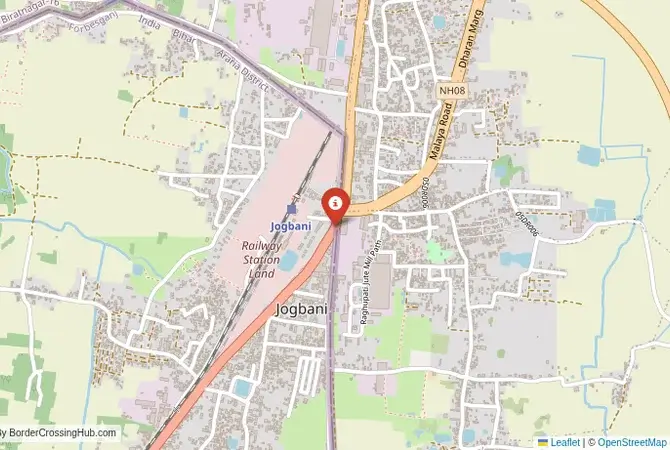
There has been little confirmed change to passenger movement at Jogbani–Biratnagar this November, although the crossing continues to play an important role in eastern Nepal's trade. Recent discussions have focused on improving freight connections and making better use of the railway infrastructure serving Biratnagar. These developments have not yet produced a noticeable change for ordinary travelers, and no major new border closure has been reported. The main practical distinction remains between commercial traffic and people crossing independently.
Driving there, or sending a driver? Send them this guide.
For reports and websites
Cite this page
Border Crossing Hub (2026). Jogbani Border Crossing (India–Nepal). Updated November 2026. https://bordercrossinghub.com/biratnagar-jogbani-border-crossing/<a href="https://bordercrossinghub.com/biratnagar-jogbani-border-crossing/">Jogbani Border Crossing (India–Nepal) (Border Crossing Hub)</a>Put this crossing's card on your website
Free. It updates on its own when our information changes.
<iframe data-bch-card src="https://bordercrossinghub.com/biratnagar-jogbani-border-crossing/?bch_view=card" width="100%" height="980" scrolling="no" style="border:0;max-width:480px;display:block" loading="lazy" title="Jogbani Border Crossing (India–Nepal) border crossing information"></iframe>
<p style="font-size:12px;margin:4px 0 0">Crossing information: <a href="https://bordercrossinghub.com/biratnagar-jogbani-border-crossing/">Border Crossing Hub</a></p>
<script src="https://bordercrossinghub.com/?bch_embed_js=1" async></script>Paste it where you want the card. The last line (a script) only adjusts the height and can be left out.
About this crossing
What to expect at the crossing
This is a working trade border more than a tourist one. Biratnagar is the economic centre of eastern Nepal and calls itself Nepal's industrial capital, after the Biratnagar Jute Mill, the country's first large factory. Goods move through the customs checkpoint on the Indian side and the Rani Bhansar customs checkpoint on the Nepali side, so lorries are the usual source of congestion. Indian and Nepali nationals cross freely. For third-country nationals, no published source describes the counters, the exit stamp or the Nepali entry procedure step by step.
Opening hours are not officially published. Sources give different windows, and cargo vehicles follow separate timings, so passenger hours cannot be pinned down. Arriving well before the end of the working day is the safe approach.
In May 2026 Nepali security personnel at the Jogbani entry point began letting people through only after checking identity documents, after social media rumours that Rohingya refugees and undocumented Bangladeshi nationals were being expelled from India (People's Review, 10 May 2026). Joint Nepal Police and Armed Police Force inspections were reported on days when the Kolkata to Jogbani train runs, with routine checks by the Armed Police Force on other days. Security officials called a large influx unlikely.
Visas for foreign travellers
Indian citizens do not need a visa for Nepal. For everyone else, the answer is less clear. The Nepal Tourism Board's list of visa-on-arrival land entry points names Kakarbhitta, Birgunj, Bhairahawa, Nepalgunj and Gaddachauki on the Indian border, and does not name Biratnagar, while some listings include it. So a visa on arrival at Biratnagar cannot be counted on, and the safer route is to get one in advance from a Nepali mission abroad, or to enter at Kakarbhitta, which is on the list and about 108 km east.
The Indian side
Jogbani is a municipal council area in Araria district, near Forbesganj, with about 39,000 people at the 2011 census. The town is the Indian railhead for the crossing, which is why travellers coming from Bihar and West Bengal use it to reach Biratnagar.
Getting here and onward
Jogbani is the last station on the railway lines from Katihar and Purnia, and trains also run to Delhi and Kolkata. Many people from the Biratnagar area use the station, because eastern Nepal has had no railway of its own. By road, National Highway 527 links Jogbani to Forbesganj and onward connections to Purnia, Katihar and Patna.
An 8 km line from Jogbani to Biratnagar, phase 1 of the India–Nepal rail connectivity project, is under construction. It does not replace the road crossing today.
Once you are across
Biratnagar is a city of about 245,000 people and the capital of Koshi Province, roughly 6 km north of Jogbani. Its airport is the busiest domestic airport in Nepal after Pokhara, with about 10 daily flights to Kathmandu, which is 544 km away by road. That makes the flight the practical option for most travellers heading west. By road, Dharan lies about 46 km to the north, and Kakarbhitta, Nepal's easternmost border point with India, is about 108 km east, with frequent buses from the Biratnagar bus park.
Two regional draws lie in the same province. Ilam, in the hills to the north-east, is the largest tea-producing region in Nepal, with daily buses running to Biratnagar, and Kangchenjunga, the world's third-highest mountain at 8,586 m, has its western peaks in Taplejung district.
A short history
The city's industrial role goes back a long way. Morang district's headquarters moved to Biratnagar in 1914, and the town took its present name in 1919. In 1947 a strike at the jute mills became the first big labour action against the Rana regime, and it helped spark the movement that ended Rana rule.
Nearby Border Crossings

Heading to Jogbani Border Crossing (India–Nepal)? Take this with you.
One page with the hours, waits, emergency numbers and coordinates. Works without signal.
Practical information
Fuel
India: <1 km - Nepal: <1 km
Currency
Exchange near Jogbani (INR, NPR)
Safety information
Generally safe, busy roads
Connectivity
Wi-Fi coverage, 4G
Have you crossed here?
Help other travelers by sharing your experience, wait times, and any updates.