Monthly Update (September 2026):
Banglabandha & Phulbari remains an important northern Bangladesh-India gateway, particularly because of its wider role in connecting Bangladesh with India, Nepal and Bhutan. The crossing and land port received attention this month when the US ambassador visited the port and zero point on September 1, highlighting its continuing importance for regional trade and connectivity. There is no significant September closure or new passenger restriction to report, so the main practical consideration remains the commercial nature of the crossing and the traffic generated by freight movements.
About this crossing
A History of a New Beginning
For most of its history, this was a quiet, undeveloped frontier. The main lines of trade and travel flowed east-west between Bengal and Assam. The idea of a north-south corridor connecting the port of Mongla in Bangladesh with Nepal and Bhutan was a more recent one, born of new geopolitical and economic realities. The formal opening of the Banglabandha-Phulbari crossing for international trade and transit in the late 1990s and early 2000s was a major diplomatic achievement. It was a key part of various sub-regional cooperation initiatives (like SAARC and BBIN) aimed at boosting trade and connectivity. The development of the "Banglabandha Land Port" on the Bangladeshi side and the corresponding infrastructure at Phulbari on the Indian side has been a priority for both governments. The crossing is a symbol of a new, more integrated vision for the region, one that seeks to overcome the barriers of colonial-era borders and create a seamless economic space. It is a young border, a place whose history is still being written by the flow of trucks and the implementation of ambitious transit agreements.
The Border Crossing Procedure: A Functional Trade Port
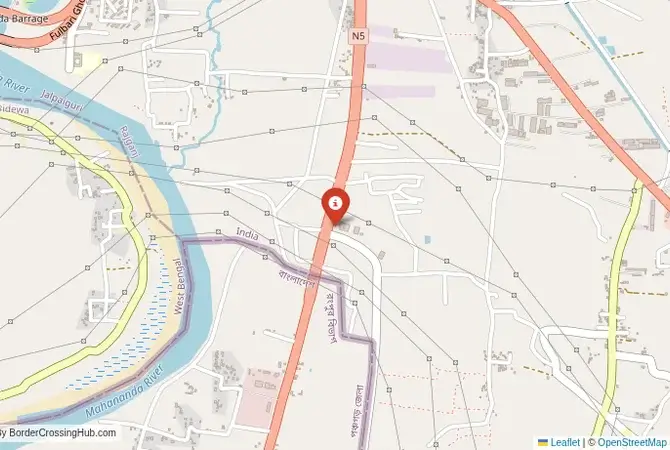
The border is open during daylight hours. The facilities are modern and functional, designed primarily to handle commercial freight, but they are also equipped to process passengers. The process is generally straightforward, but you must have all your visas sorted in advance. Exiting Bangladesh (Banglabandha): You will arrive at the Banglabandha Land Port, a large, formal facility. You will go to the immigration building, present your passport and your Indian visa, and get your exit stamp from Bangladesh. You will then go through a customs check. The process is professional and orderly. The No-Man's-Land: After clearing the Bangladeshi post, you will cross a short no-man's-land to the Indian side. This can be done on foot or by rickshaw. Entering India (Phulbari): You will then enter the Indian customs and immigration facility at Phulbari. You will present your passport and your Indian visa to the immigration officer and receive your entry stamp. The customs check is usually a quick formality for tourists. Once you are cleared, you are officially in the state of West Bengal, India.
Nearby Border Crossings





Route, Onward Travel, and Regional Connectivity
This crossing is all about regional connectivity. On the Bangladeshi side, Banglabandha is the northernmost point of the country. There are bus services from major cities in northern Bangladesh, like Rangpur and Dinajpur, to the border. On the Indian side, from Phulbari, the major transport hub of Siliguri is only a short drive away (about 30-45 minutes). Siliguri is the gateway to everything in the region. From Siliguri, you can: Travel to the India-Nepal border at Panitanki/Kakarbhitta (about another 45 minutes) to continue your journey into Nepal. Take a jeep or the famous toy train up to the hill station of Darjeeling. Arrange for travel into the state of Sikkim. Travel to the India-Bhutan border at Jaigaon/Phuentsholing. This makes the Banglabandha-Phulbari crossing the essential link for any traveler wanting to do a multi-country tour of Bangladesh, Nepal, and the Indian Himalayas.
Final Planning Advice for the Transit Corridor
The Banglabandha-Phulbari crossing is a modern and strategically vital gateway. For the traveler, it is the key that unlocks the entire Eastern Himalayan region. The most important part of your planning is to have the correct visas for all the countries you intend to visit (India, Nepal, etc.) before you start your journey. The crossing process itself is relatively straightforward. The real advantage of this border is its location. It places you directly into the transport hub of Siliguri, from where all the wonders of the region are accessible. It is a border that feels like a true crossroads, a place where different cultures and landscapes converge, and a testament to the growing connectivity that is transforming the face of travel in this fascinating part of the world.
View all border crossings between Bangladesh and IndiaPractical information
Fuel
Bangladesh: <1 km - India: <1 km
Currency
Exchange near Banglabandha (BDT, INR)
Safety information
Safe, moderate traffic
Connectivity
Limited Wi-Fi, 4G
Have you crossed here?
Help other travelers by sharing your experience, wait times, and any updates.