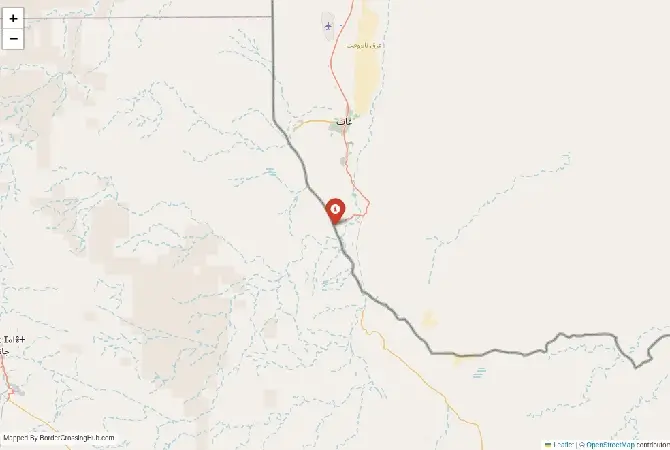
Monthly Update (September 2026):
Djanet & Ghat region remains an extremely remote Algeria-Libya frontier route, and there is no reliable evidence of normal tourist crossing activity in September. Algeria has maintained a heavy security presence across its far-southern border areas, with recent military operations in Djanet targeting smuggling activity and other cross-border crime. The remoteness of the Sahara and security controls make this very different from a conventional road border crossing. Travelers should not assume that an overland route between Djanet and Ghat is available simply because the two settlements are relatively close geographically.
About this crossing
This route is sometimes referred to as the Djanet Border on the Algerian side and the Ghat Crossing or Ghat Region Border on the Libyan side. It lies within vast desert terrain, far from major المدن and standard infrastructure.
A border shaped by Tuareg routes and colonial divisions
Long before modern borders existed, this region was part of trans-Saharan trade and migration routes used by Tuareg communities. Caravans once moved salt, gold, and other goods across what is now a tightly controlled frontier.
Nearby Border Crossings

Colonial-era boundaries later divided these routes between French-controlled Algeria and Italian-controlled Libya. Today, while cultural ties remain, official movement is heavily restricted.
The Ghat region in Libya and Djanet in Algeria still share Tuareg heritage, which you may notice in language, clothing, and traditions if you spend time in either area.
What the crossing looks like today
This is not a conventional border crossing. There is no open, public checkpoint where you can simply arrive and pass through. Instead, the area is controlled by military and security forces on both sides.
On the Algerian side, Djanet is a small desert town with an airport and limited tourist infrastructure, mainly serving visitors to the Tassili n’Ajjer National Park. However, access beyond certain نقاط requires permits and often an escort.
On the Libyan side, the Ghat region is even more restricted. Due to ongoing instability in Libya, access for foreign travelers is highly controlled and often not possible without official authorization.
Border procedures and legal restrictions
For most travelers, crossing here is not an option. Both Algeria and Libya impose strict controls, and overland movement across this section of the border is generally closed to independent travel.
Even if you hold valid visas for both countries, you will not be allowed to cross without special permits. In many cases, these permits are issued only for official, humanitarian, or highly organized expeditions.
Attempting to approach or cross the border without authorization can lead to serious consequences, including detention.
Transport and access to the region
Reaching Djanet itself is possible by air from Algiers or via long overland routes across the Sahara. Roads exist, but distances are vast, and travel requires planning.
From Djanet toward the border, movement is limited and usually requires coordination with local authorities. You cannot simply hire a vehicle and drive to Libya.
On the Libyan side, access to Ghat is typically by air or controlled الداخلي travel, depending on current conditions. Infrastructure has been affected by years of instability.
Environmental challenges in the Sahara
Even without security concerns, the environment here presents serious challenges. Temperatures can exceed 40°C, and water sources are scarce.
Sandstorms are a regular occurrence, reducing visibility and making travel dangerous. Navigation requires experience and proper equipment, as landmarks can be difficult to distinguish in open desert.
Distances between settlements are vast, and breakdowns or delays can quickly become critical situations.
Safety risks and current realities
This region is considered high-risk due to a combination of factors: political instability in Libya, limited state presence in remote desert areas, and the potential for smuggling routes.
Kidnapping risks and military sensitivity are real concerns. Governments regularly advise against all travel to border areas in southern Libya and parts of southeastern Algeria.
You should always check official government travel advisories before considering any travel near this border. Conditions can change without notice.
Nearby destinations and what is accessible
While crossing the border is not feasible, you can still explore areas near it on each side independently.
Djanet is known for its proximity to Tassili n’Ajjer National Park, a UNESCO-listed site famous for prehistoric rock art and dramatic sandstone formations. Access typically requires a guide and permits.
The Ghat region in Libya has similar landscapes and cultural heritage, but travel there is currently restricted for most foreign visitors.
These areas reflect the shared history of the central Sahara, even though the border itself is closed.
Cultural and geopolitical importance
Despite restrictions, this border represents a meeting point of cultures and histories. Tuareg communities continue to maintain connections across national lines, even as official crossings are limited.
The region also plays a role in broader geopolitical concerns, including migration routes and security operations. This adds another layer of complexity to any travel plans.
You will not experience this as a typical border crossing. Instead, it exists more as a controlled frontier than a transit point.
Practical advice before considering travel
You should not plan to cross here under normal circumstances. If your itinerary involves both Algeria and Libya, you will need to travel via other routes, typically by air.
If you visit Djanet, ensure you have all required permits and work with authorized local guides. Do not attempt to approach restricted zones.
Carry sufficient supplies, including water and fuel, if traveling in the desert. Preparation is critical even for permitted areas.
Final note
A closed route in a vast landscape
The Djanet–Ghat region border is defined more by restriction than movement. While historically part of active trans-Saharan routes, it is now a tightly controlled and largely inaccessible frontier.
For most travelers, this is not a viable crossing. However, understanding its context adds depth to any journey through the Sahara, where history, culture, and modern realities intersect in complex ways.
View all border crossings between Algeria and LibyaPractical information
Currency
DZD,LYD none
Safety information
Remote desert risks
Connectivity
Limited 3G; satellite signal
Have you crossed here?
Help other travelers by sharing your experience, wait times, and any updates.