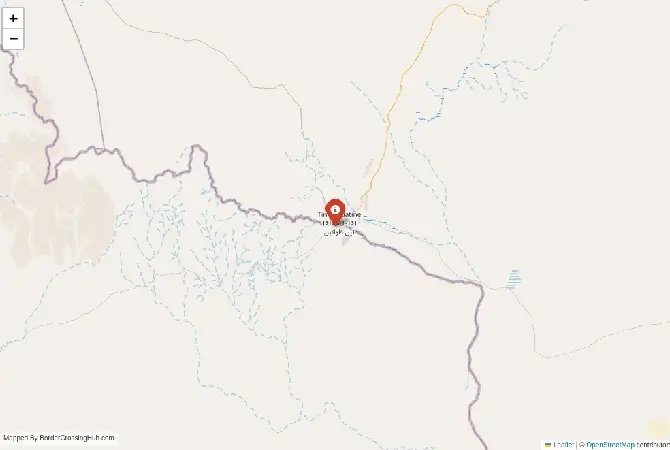
Monthly Update (September 2026):
Bordj Badji Mokhtar & Tinzaouaten remains a highly security-sensitive Algeria-Mali frontier crossing. Algeria's army reported on September 2 that weapons and ammunition had been recovered in the southern border strip around Bordj Badji Mokhtar during operations covering August 26 to September 1. Earlier operations in the area also resulted in the surrender of an armed militant at Bordj Badji Mokhtar and arrests linked to terrorist groups. There is no September development suggesting that this has become a normal tourist crossing, so travelers should treat security controls and access restrictions as the main issue.
About this crossing
This route is commonly referred to as the Tinzaouaten Border on the Malian side and the Bordj Badji Mokhtar Crossing on the Algerian side. Despite its historical importance, it is not a practical option for most travelers today.
A historic trans-Saharan corridor divided by modern borders
Tinzaouaten has long been a waypoint for Tuareg caravans moving between the Sahel and North Africa. These routes connected trade networks that predate colonial boundaries by centuries.
Nearby Border Crossings


The modern border, drawn during French rule, split these routes between what later became Mali and Algeria. Bordj Badji Mokhtar developed as a remote Algerian outpost, while Tinzaouaten remained a small settlement tied to nomadic movement.
Today, these historical connections still exist culturally, but official movement across the border is heavily restricted.
What the crossing looks like now
You will not find a standard border facility open to travelers. Both sides are under strong military oversight, and access to the immediate border zone is limited.
Tinzaouaten in Mali is a small, isolated settlement with minimal infrastructure. The surrounding region has been affected by instability, and movement is often controlled or discouraged.
Bordj Badji Mokhtar on the Algerian side functions as a remote administrative and military post. Entry into this part of Algeria requires special permits, and travel is closely monitored.
There is no clear, accessible checkpoint where you can simply arrive and complete immigration procedures.
Border procedures and legal reality
For most travelers, this crossing is effectively closed. Even if you hold valid visas for both Mali and Algeria, you will not be allowed to cross without special authorization.
Permits, when issued, are typically reserved for official purposes, such as government missions or coordinated operations. These are arranged in advance and involve strict oversight.
Attempting to approach or cross the border independently can result in detention or being turned back long before reaching the frontier.
Transport and reaching the المنطقة
Reaching Tinzaouaten is already a major undertaking. The journey involves long distances across desert terrain, often requiring specialized vehicles and local knowledge.
From the Malian side, routes from cities like Kidal are affected by security concerns and are not considered safe for regular travel.
On the Algerian side, Bordj Badji Mokhtar can be accessed from deeper within Algeria, but travel permits are required, and movement is controlled.
Public transport does not operate in any meaningful way here. Travel is limited to authorized convoys or local movement under specific conditions.
Environmental challenges of the Sahara
The desert environment adds another layer of difficulty. Temperatures can be extreme, especially during the day, while nights may be unexpectedly cold.
Sandstorms are common and can disrupt visibility and movement. Navigation is difficult without experience, as the landscape offers few reliable reference points.
Water scarcity and long distances between settlements mean that even minor مشکلات can quickly become serious.
Security risks and current situation
This region is considered high-risk due to armed group activity, smuggling routes, and limited state presence in certain areas. Military forces monitor the border closely, but conditions remain unpredictable.
Kidnapping risks and attacks on vehicles have been reported in broader northern Mali, and parts of southern Algeria are also under strict security control.
Governments typically advise against all travel to this region. You should consult official advisories before considering any travel near the border.
Nearby areas and what is accessible
While crossing the border is not feasible, you may encounter references to Tinzaouaten or Bordj Badji Mokhtar when studying trans-Saharan routes.
In practice, visiting these locations is extremely difficult for foreign travelers. Access requires permits, coordination, and a clear purpose.
More accessible destinations in southern Algeria, such as Tamanrasset, offer a safer way to experience Saharan landscapes and Tuareg culture, though even these require planning.
Cultural and geopolitical importance
Despite restrictions, this border represents a continuation of long-standing cultural ties among Tuareg communities. Languages, traditions, and التجارة networks extend across national boundaries.
At the same time, the region is shaped by modern geopolitical realities, including security concerns and efforts to control movement across the Sahara.
You will not experience this as a typical crossing. It exists primarily as a controlled frontier rather than a transit point.
Practical advice before planning anything
You should not plan to cross at Bordj Badji Mokhtar–Tinzaouaten under normal circumstances. If your itinerary includes both Mali and Algeria, you will need to use alternative routes, usually involving air travel.
Avoid attempting to approach restricted areas without authorization. Always respect local regulations and military controls.
If you are traveling in the Sahara more broadly, ensure you have adequate supplies, reliable transport, and up-to-date information about conditions.
Final note
A closed and controlled desert frontier
The Bordj Badji Mokhtar–Tinzaouaten border reflects the complexities of the modern Sahara. While historically part of active trade routes, it is now shaped by security concerns and strict controls.
For most travelers, it remains inaccessible. Understanding its context is useful, but practical travel plans should focus on safer and officially open crossings.
View all border crossings between Mali and AlgeriaPractical information
Currency
XOF,DZD none
Safety information
Desert risks, restricted
Connectivity
Limited 2G; Satellite
Have you crossed here?
Help other travelers by sharing your experience, wait times, and any updates.