Staying near the crossing? Places to stay around Aguas Blancas & Bermejo on Booking.com Partner link: we may earn a commission, at no extra cost to you.
Monthly Update (October 2026):
Aguas Blancas & Bermejo is seeing an unusual increase in cross-border demand linked to fuel shortages in Bolivia. Recent reports describe buyers coming from Bermejo into the Argentine side to purchase fuel, creating longer lines at service stations along Route 50. The queues are not necessarily border queues, but travelers passing through Aguas Blancas should be aware that the fuel situation is adding activity to the immediate frontier area.
Driving there, or sending a driver? Send them this guide.
For reports and websites
Cite this page
Border Crossing Hub (2026). Aguas Blancas & Bermejo Border Crossing. Updated October 2026. https://bordercrossinghub.com/aguas-blancas-bermejo-border-crossing/<a href="https://bordercrossinghub.com/aguas-blancas-bermejo-border-crossing/">Aguas Blancas & Bermejo Border Crossing (Border Crossing Hub)</a>Put this crossing's card on your website
Free. It updates on its own when our information changes.
<iframe data-bch-card src="https://bordercrossinghub.com/aguas-blancas-bermejo-border-crossing/?bch_view=card" width="100%" height="980" scrolling="no" style="border:0;max-width:480px;display:block" loading="lazy" title="Aguas Blancas & Bermejo border crossing information"></iframe>
<p style="font-size:12px;margin:4px 0 0">Crossing information: <a href="https://bordercrossinghub.com/aguas-blancas-bermejo-border-crossing/">Border Crossing Hub</a></p>
<script src="https://bordercrossinghub.com/?bch_embed_js=1" async></script>Paste it where you want the card. The last line (a script) only adjusts the height and can be left out.
About this crossing
Operational Details
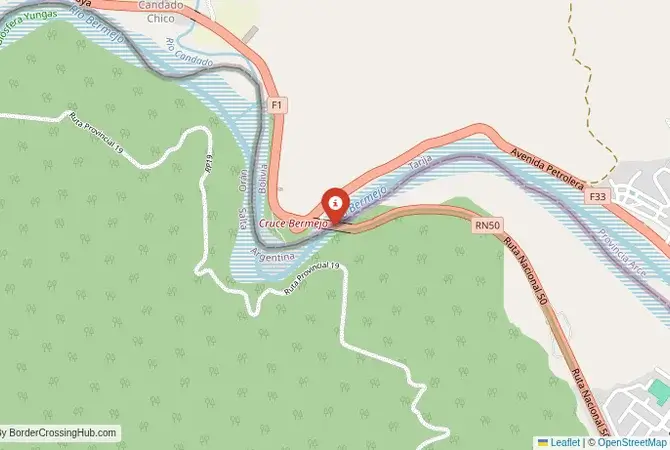
This checkpoint connects the Salta Province of Argentina with the Tarija Department of Bolivia. It is a major international crossing, open 24/7. The crossing is on a bridge over the Bermejo River. The facility is a hub of activity, with a constant stream of pedestrians, local traders, and international travelers, as well as a significant volume of freight traffic. The crossing can be crowded and the procedures slow, but it is a vital economic link for southern Bolivia, providing access to the Argentine road network.
A History of a Lowland Frontier
The history of this region is the history of the Gran Chaco, a vast, sparsely populated plain. The Bermejo River has long been a natural boundary. The modern border was established in the early 20th century, following the Chaco War between Bolivia and Paraguay. The towns of Aguas Blancas and Bermejo grew up as customs posts and service centers for the surrounding agricultural region, which is known for its production of sugarcane, soybeans, and citrus fruits. The discovery of oil and gas in the region has increased its strategic and economic importance.
Nearby Border Crossings


Border Crossing Procedure
The border crossing procedure is a standard two-part process that can be chaotic due to the high volume of local foot traffic. You must first complete exit formalities at the Argentine immigration and customs office in Aguas Blancas. You then walk or drive across the bridge to the Bolivian checkpoint in Bermejo for their entry inspection. You will need a valid passport. Visa requirements for Bolivia vary by nationality, and it is essential to check them in advance. Vehicle registration and international insurance are also necessary. The process can involve long queues and a degree of bureaucracy, so patience is key. A yellow fever vaccination certificate is required for entry into Bolivia at this subtropical crossing.
The Surrounding Region: Argentina Side
On the Argentine side, Aguas Blancas is a small border town. The main road from the border leads through a beautiful subtropical landscape towards the major cities of Orán and Salta. The Calilegua National Park, a stunning area of cloud forest (yungas), is also in this region and is a paradise for birdwatchers. The city of Salta, with its beautiful colonial architecture, is the main tourist hub of northwestern Argentina.
The Surrounding Region: Bolivia Side
On the Bolivian side, Bermejo is a bustling commercial city and the main gateway to southern Bolivia. The road from the border is a spectacular journey, climbing steeply from the lowlands into the Andes towards the beautiful city of Tarija. Tarija is the center of Bolivia's wine country, known for its high-altitude wines and its pleasant, Mediterranean-like climate. The region has a unique culture and is famous for its music and dance. The road to Tarija is a dramatic and beautiful drive.
Practical Travel Information
Practical planning is essential for this route. The climate is hot and humid. The official currencies are the Argentine Peso (ARS) in Argentina and the Bolivian Boliviano (BOB) in Bolivia. Currency exchange facilities are widely available. Be aware of your personal security in the crowded border towns. The road on the Bolivian side is a winding mountain road that requires careful driving. Ensure you have all necessary vehicle documents and insurance.
Final Considerations
The Aguas Blancas–Bermejo border crossing is a journey into the vibrant, tropical heart of South America. It is a bustling, chaotic, and colorful gateway to the beautiful wine country of Tarija and the southern part of Bolivia. The journey through it can be a test of patience, but it is a rite of passage for many travelers. It is a border that is defined by its tropical heat, its lively atmosphere, and its role as a vital economic link. It is a passage from the dry Chaco of Argentina into the lush, green, and beautiful landscape of southern Bolivia.
View all border crossings between Argentina and BoliviaHeading to Aguas Blancas & Bermejo? Take this with you.
One page with the hours, waits, emergency numbers and coordinates. Works without signal.
Practical information
Fuel
Argentina: <1 km - Bolivia: <1 km
Currency
Local ARS/BOB
Safety information
Market area; touting risk
Connectivity
Wi-Fi; 4G
Have you crossed here?
Help other travelers by sharing your experience, wait times, and any updates.