Monthly Update (October 2026):
In October 2026, renovation work on the Länderbrücke continues until about mid-month, with one lane open and short delays during working hours. Germany has renewed its controls on the Austrian border until 15 March 2027, so spot checks into Bavaria remain possible. Carry your passport or ID card.
About this crossing
Location and Basic Connections
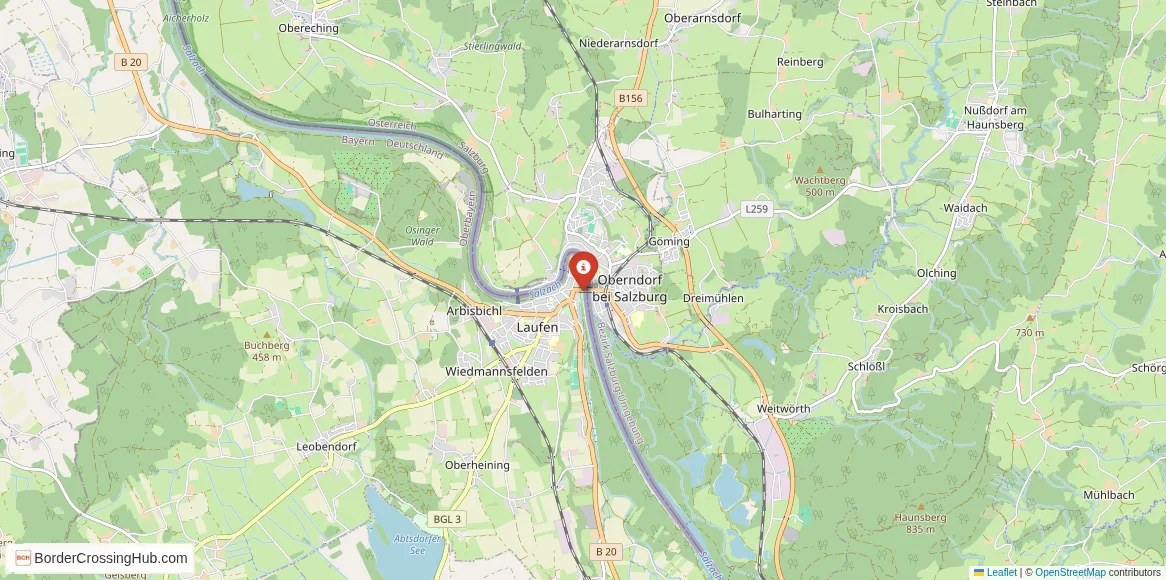
Oberndorf lies about 20 km north of Salzburg on the B156, on the inside of a wide loop of the Salzach. Laufen sits on the opposite bank, its old town packed into the river bend. The Länderbrücke joins the two town centres, and on the German side roads lead on to Freilassing, Tittmoning and Traunstein. Both towns have railway stations: the Salzburger Lokalbahn runs from Salzburg Hauptbahnhof to Oberndorf, and Laufen is on the regional line from Freilassing towards Mühldorf.
Two Bridges: Länderbrücke and Europasteg
The Länderbrücke, also called the Salzachbrücke, was built between 1901 and 1903 and carries road traffic, pedestrians and cyclists. A few hundred metres away, the Europasteg footbridge, about 131 m long, was built in 2006 as a joint project of both towns with EU funding. It is open to pedestrians and cyclists only and is the easiest way to walk between the two old towns.
Nearby Border Crossings


Bridge Works in Autumn 2026
From 7 September 2026, the Länderbrücke is being renovated, with new lighting and electrical systems. Work runs from 8:00 to 16:00 daily, weather permitting, until about mid-October. One lane stays open throughout, and one of the footpaths is closed at a time, so expect short delays during working hours.
Border Checks Entering Germany
Germany's temporary controls cover its whole border with Austria, currently until 15 March 2027. The fixed checkpoints in the area are on the A8 at Walserberg and the Saalbrücke at Freilassing, but federal police also carry out spot checks at smaller crossings like this one, sometimes in plain clothes. Most people cross without stopping. Traffic heading into Austria is not routinely checked.
Documents to Carry
Carry a valid passport or, for EU, EEA and Swiss citizens, a national ID card, also when walking across the Europasteg. Other travellers need a passport and, where required, a Schengen visa or residence permit. Drivers should carry their licence, vehicle registration and insurance papers.
Waits and Opening Hours
Both bridges are open 24 hours a day. Waits are normally short, but during the bridge works and at commuter peaks, cars may have to wait a few minutes to pass the works. Spot checks can add a few minutes more.
Silent Night and the Old Towns
Oberndorf is where "Silent Night" was first sung, on Christmas Eve 1818, by the priest Joseph Mohr and the schoolteacher Franz Xaver Gruber in the church of St Nicholas. The church was later demolished after floods, and the Silent Night Chapel was built on its site in 1937. Across the river, Laufen's compact old town has arcaded streets and a large Gothic collegiate church. In the Advent season, Christmas markets and services at the chapel bring many visitors, and parking in Oberndorf fills up quickly.
One Town, Two Countries
Until 1816, Oberndorf was Laufen's suburb on the right bank of the river, home to the boatmen who carried salt down the Salzach. When the border between Bavaria and Austria was drawn along the river after the Napoleonic Wars, the town was divided. Today the two towns work together again, and many people cross the bridges every day.
Final Planning Notes
Carry your passport or ID card, allow a little extra time while the bridge works last, and consider leaving the car on one side and walking across the Europasteg. In December, arrive early if you plan to visit the Silent Night Chapel.
View all border crossings between Austria and GermanyPractical information
Fuel
Austria: <2 km - Germany: <2 km
Currency
EUR on both sides; cards widely accepted
Safety information
Quiet small-town crossing; occasional German police spot checks
Connectivity
Austrian and German 4G/5G; EU roaming
Have you crossed here?
Help other travelers by sharing your experience, wait times, and any updates.