Monthly Update (October 2026):
In October 2026, German federal police continue to check traffic entering Germany on the Saalbrücke. Germany has renewed its controls on the Austrian border until 15 March 2027. Expect slower traffic towards Freilassing at commuter peaks, and carry your passport or ID card.
About this crossing
Location and Basic Connections
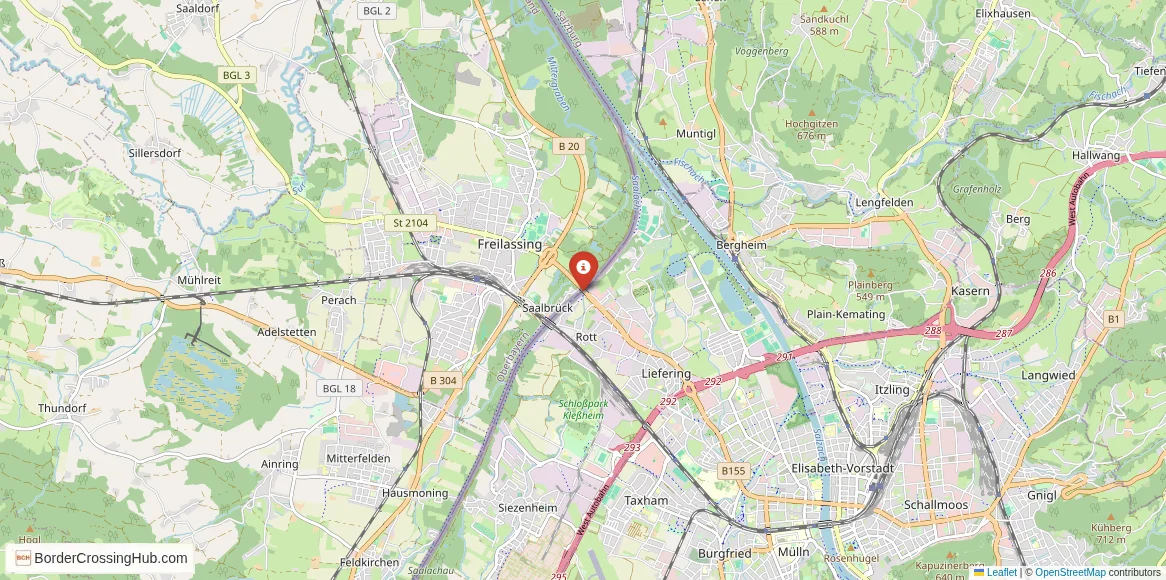
The bridge sits on the north-western edge of Salzburg, where Münchner Bundesstraße leaves the city through Liefering and crosses the Saalach into Freilassing. On the German side the road meets the B20 and B304, which lead towards Bad Reichenhall, Laufen and Traunstein. Salzburg's old town is about 15 minutes away by car in normal traffic, and the centre of Freilassing is a few minutes from the bridge. Separate footpaths and cycle paths run along both sides of the bridge, so you can also cross on foot or by bike. The railway bridge between Salzburg Hauptbahnhof and Freilassing station crosses the Saalach just upstream.
Border Checks Entering Germany
Germany has run temporary controls on its border with Austria for several years, and its current notification to the EU runs until 15 March 2027. The federal police (Bundespolizei) operate a checkpoint on the Saalbrücke for traffic heading into Germany, and checks continued through 2026, day and night. Not every vehicle is stopped, but you should expect to slow down and be ready to show documents. Traffic heading from Freilassing into Austria is not routinely checked.
Nearby Border Crossings
Documents to Carry
Austria and Germany are both in the Schengen Area, but because of the checks you must carry a valid travel document. EU, EEA and Swiss citizens can use a passport or national ID card. Other travellers need a passport and, where required, a Schengen visa or residence permit. A driving licence is not a travel document. Drivers should also carry their licence, vehicle registration and insurance papers.
Typical Waits and Peak Times
Outside rush hour, most drivers pass in a few minutes. Queues build on weekday mornings and late afternoons, when thousands of people commute between Salzburg and the Berchtesgadener Land, and on Saturdays with shopping traffic. When checks are stepped up, queues have reached back along Münchner Bundesstraße into Liefering. The A8 motorway at Walserberg is also checked, so switching routes rarely saves time. Check traffic reports before you set off at peak times.
By Train
Freilassing is one stop from Salzburg Hauptbahnhof. Salzburg S-Bahn lines S2 and S3, REX trains and Bavarian regional trains run several times an hour, and some long-distance trains stop at Freilassing too. Federal police can also check passengers on trains and at Freilassing station, so keep your ID to hand on the train as well.
Tolls and Driving
No vignette is needed to drive from Salzburg to the bridge on Münchner Bundesstraße. If you join the Austrian A1 or A10 motorways you need a valid Austrian vignette (digital or sticker). Cars use German roads free of charge. In winter, Austria and Germany both require tyres suitable for the conditions.
Fuel, Money and Shopping
Both countries use the euro, and cards are widely accepted. Fuel is often a little cheaper in Austria, so many Bavarian drivers fill up in Salzburg, while Freilassing's shops and supermarkets draw shoppers from Salzburg. Filling stations are close to the bridge on both sides.
A Border on the Saalach
Freilassing, called Salzburghofen until 1923, belonged to the Prince-Archbishopric of Salzburg for centuries. After the Napoleonic Wars, in 1816, the border between Bavaria and Austria was drawn along the Saalach and Salzach rivers, and the town became Bavarian. Today Freilassing and Salzburg form one urban area, with many people living on one side of the river and working on the other.
Final Planning Notes
Carry your passport or ID card, allow extra time on weekday mornings and Saturday afternoons, and consider the train if you are heading into Freilassing or Bavaria at peak times. German controls are renewed every six months, so check the current situation before you travel.
View all border crossings between Austria and GermanyPractical information
Fuel
Austria: <1 km - Germany: <1 km
Currency
EUR on both sides; cards widely accepted
Safety information
Safe urban crossing; German police checkpoint for traffic into Germany
Connectivity
Austrian and German 4G/5G; EU roaming
Have you crossed here?
Help other travelers by sharing your experience, wait times, and any updates.