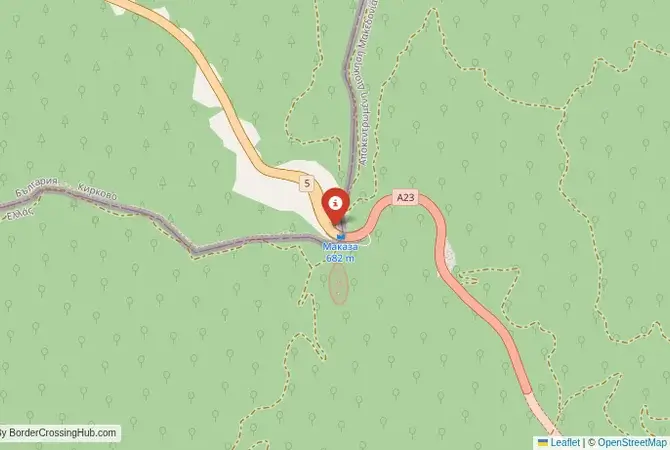
Monthly Update (September 2026):
Makaza & Nymfaia remains an important Bulgaria-Greece passenger crossing, but September traffic is still capable of producing noticeable waits. On September 4, live monitoring showed around 35 minutes toward Greece around midday, with forecasts keeping waits around 30 minutes through much of the day. Bulgarian authorities continue to allow passenger cars and minibuses up to 3.5 tonnes through Makaza, while heavier vehicles must use other crossings. The crossing remains open, with no significant September closure identified.
About this crossing
Operational Details
This checkpoint connects the Kardzhali Province of Bulgaria with the Rhodope regional unit of Greece. It is a major international crossing, open 24/7. It was opened in 2013 after many years of construction. The crossing is intended for passenger cars and buses, with a weight restriction that currently excludes the heaviest freight traffic. The facility is state-of-the-art, with a modern, streamlined design. The road on both sides is a modern highway, with tunnels and viaducts that cut through the mountainous terrain. It is the most direct route for travelers from central Bulgaria to the beaches of Western Thrace; following full Schengen land integration in Oct 2025, no systematic controls or queues reported, with seamless high-speed passage typical per official sources.
A History of a New Connection
The history of this crossing is a modern one. For decades, there was no major road through this part of the Rhodope Mountains. The project to build the Makaza Pass highway was a long-held dream, a strategic goal for both Bulgaria and Greece to improve regional connectivity and boost their economies. The construction was a major engineering challenge, involving the boring of long tunnels through the mountains. The opening of the crossing was a major event, hailed as a new chapter in the relationship between the two countries and a key step in the integration of the Balkan region into the wider European transport network.
Nearby Border Crossings
The Seamless Border Procedure
Today, there is no border procedure for travelers. You simply drive along the modern highway. There are no passport checks and no customs inspections. This is the reality of the Schengen Area since full land integration in Oct 2025. However, it is important to remember that both Greek and Bulgarian police and customs authorities can and do perform random checks on vehicles anywhere in their territory, including near the former border. You are still required to carry a valid passport or national ID card with you at all times. The journey through the pass is smooth, fast, and offers spectacular views.
The Surrounding Region: Bulgaria Side
On the Bulgarian side, the crossing is in the heart of the Eastern Rhodopes. The nearby city of Kardzhali is the main regional center, situated on a large reservoir. The area is known for the ancient Thracian city of Perperikon, a major archaeological site, and the beautiful Utroba (Womb) Cave, a Thracian sanctuary. The region has a large Turkish minority and is known for its unique culture and cuisine. The "Stone Mushrooms" near the village of Beli Plast are a unique natural rock formation.
The Surrounding Region: Greece Side
On the Greek side, the crossing is in the region of Western Thrace. The road descends from the mountains to the coastal plain. The nearby city of Komotini is the administrative capital of the region and a center of the Muslim minority of Greece. The crossing is the gateway to the beautiful coast of the northern Aegean Sea, with numerous beaches and the port city of Alexandroupoli, which has ferry connections to the island of Samothrace. The Nestos River delta, a major national park and wetland, is also in this region.
Practical Travel Information
Practical planning for this route is very simple. The most important thing is to have the required motorway vignettes if your journey involves motorways in either country. Both Bulgaria and Greece use a toll or vignette system for their main highways. The official currencies are the Bulgarian Lev (BGN) in Bulgaria and the Euro (EUR) in Greece. Services are available in the towns on both sides of the border. The highway is modern and in excellent condition, making for a fast and safe journey; with internal Schengen status, no border queues or checks typical.
Final Considerations
The Makaza–Nymfaia border crossing is a powerful symbol of modern infrastructure and European integration. It is a fast, efficient, and scenic route that has transformed travel between central Bulgaria and the Aegean coast. It is a border that you cross at high speed, a testament to the power of modern engineering to overcome the barriers of nature and to the success of the Schengen project in creating a truly connected Europe. For the modern traveler, it is the best and fastest way to get from the mountains to the sea.
View all border crossings between Bulgaria and GreecePractical information
Fuel
Bulgaria: 500 m - Greece: 500 m
Currency
Small exchange; BGN, EUR
Safety information
Low traffic; rural
Connectivity
Basic data
Have you crossed here?
Help other travelers by sharing your experience, wait times, and any updates.