Staying near the crossing? Places to stay around Gradina & Kalotina on Booking.com Partner link: we may earn a commission, at no extra cost to you.
Monthly Update (September 2026):
Gradina & Kalotina remains the main Bulgaria-Serbia road gateway, but September traffic is already producing substantial queues toward Serbia. Bulgarian Border Police reported intensive passenger-car traffic at Kalotina on the morning of September 4, while live monitoring later recorded a queue of about 105 minutes. By comparison, Strezimirovci was around 20 minutes and Vrashka Chuka was around 10 minutes at the latest available readings. Travelers heading into Serbia should check the alternatives before committing to Kalotina, especially on Friday and weekend travel days.
Driving there, or sending a driver? Send them this guide.
For reports and websites
Cite this page
Border Crossing Hub (2026). Gradina & Kalotina Border Crossing. Updated September 2026. https://bordercrossinghub.com/kalotina-gradina-border-crossing/<a href="https://bordercrossinghub.com/kalotina-gradina-border-crossing/">Gradina & Kalotina Border Crossing (Border Crossing Hub)</a>Put this crossing's card on your website
Free. It updates on its own when our information changes.
<iframe data-bch-card src="https://bordercrossinghub.com/kalotina-gradina-border-crossing/?bch_view=card" width="100%" height="980" scrolling="no" style="border:0;max-width:480px;display:block" loading="lazy" title="Gradina & Kalotina border crossing information"></iframe>
<p style="font-size:12px;margin:4px 0 0">Crossing information: <a href="https://bordercrossinghub.com/kalotina-gradina-border-crossing/">Border Crossing Hub</a></p>
<script src="https://bordercrossinghub.com/?bch_embed_js=1" async></script>Paste it where you want the card. The last line (a script) only adjusts the height and can be left out.
About this crossing
Operational Details
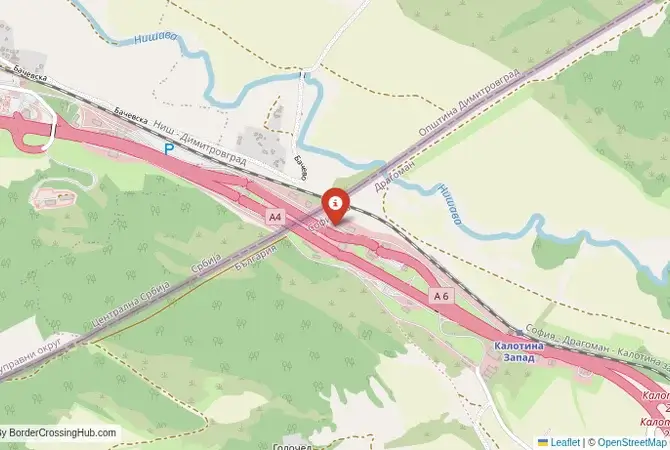
This checkpoint connects the Sofia Province of Bulgaria with the Pirot District of Serbia. It is a full-service international crossing, open to all passenger cars, buses, and commercial freight. The facility is vast, but it is notoriously and chronically congested. During the summer months, when millions of Turkish guest workers from Western Europe drive to and from Turkey, the wait times here can be legendary, often lasting for many hours, sometimes even more than a day. The queues of trucks heading to and from Turkey and the Middle East are a permanent feature year-round. It is one of the most challenging and stressful border crossings in Europe; however, recent BorderAlarm reports from January 2026 show typical waits of 5-15 minutes outside peaks, with ongoing modernization and EES implementation from late 2025 contributing to variable but often shorter delays in non-peak periods.
A History of a Great Highway
The history of this route is the history of the connection between Europe and Asia. This has been the main military and trade route since antiquity. The modern border was established in the late 19th century after the liberation of Bulgaria and Serbia from the Ottoman Empire. During the Cold War, this was a major crossing on the Iron Curtain, a tense frontier between a Warsaw Pact country (Bulgaria) and a non-aligned but communist state (Yugoslavia). After the fall of communism, it became the main route for the massive annual migration of Turkish workers. Bulgaria's accession to the EU has turned this into a major external border of the Union.
Nearby Border Crossings


The EU Border Procedure
The border crossing procedure is a rigorous and often extremely slow process, reflecting its status as a primary entry point into the EU. You will first complete exit formalities at one country's checkpoint and then proceed to the other country's checkpoint for entry inspection. As an EU entry point, the checks by the Bulgarian Border Police and customs authorities are very thorough. You will need a valid passport, vehicle registration, and international insurance (Green Card). Customs inspections, particularly for goods coming from Turkey, are meticulous. The sheer volume of traffic, combined with the strict EU protocols, is the reason for the extreme delays; EES rollout since October 2025 has added initial processing but stabilized with shorter average times in early 2026 reports.
The Surrounding Region: Bulgaria Side
On the Bulgarian side, the crossing is the gateway to the capital city, Sofia. Sofia is one of the oldest cities in Europe, with a rich history visible in its Roman ruins, Ottoman mosques, and grand 19th-century architecture. The magnificent, golden-domed Alexander Nevsky Cathedral and the ancient Church of St. George are major landmarks. The Vitosha mountain, which rises directly from the city's suburbs, is a national park and a popular spot for hiking and skiing.
The Surrounding Region: Serbia Side
On the Serbian side, the crossing is in the Pirot District. The road passes through the spectacular Sićevo Gorge. The nearby city of Pirot is famous for its unique, handmade kilims (carpets), which are a protected geographical indication. The city of Niš, the third-largest in Serbia, is a major crossroads with its own ancient fortress, the unique Skull Tower, and the birthplace of the Roman emperor Constantine the Great.
Practical Travel Information
Practical planning is absolutely essential for this route. You must be prepared for extreme wait times, especially from June to September. Have a full tank of fuel, and ample food, water, and any necessary medications. The official currencies are the Bulgarian Lev (BGN) in Bulgaria and the Serbian Dinar (RSD) in Serbia. Large service stations are available on the motorway on both sides of the border. To avoid the worst of the queues, try to travel overnight or outside of the peak summer weekends. Always check live traffic information and official border police websites before you travel; use BorderAlarm or alltrafficcams.com for real-time queues showing current short waits.
Final Considerations
The Kalotina–Gradina border crossing is the busiest and most important land border in the Balkans. It is a place of immense logistical strain, a symbol of the region's position as a great crossroads of the world. The journey through it can be a grueling test of endurance, but it is a direct encounter with the pulse of the continent. It is a border that is defined by movement, a critical artery that, despite the long waits, continues to connect the economies, cultures, and peoples of Europe and Asia.
View all border crossings between Bulgaria and SerbiaHeading to Gradina & Kalotina? Take this with you.
One page with the hours, waits, emergency numbers and coordinates. Works without signal.
Practical information
Fuel
Bulgaria: 300 m - Serbia: 300 m
Currency
Exchange offices; BGN, RSD
Safety information
Congestion possible; controlled
Connectivity
Wi-Fi, 4G/5G
Have you crossed here?
Help other travelers by sharing your experience, wait times, and any updates.