Monthly Update (September 2026):
Brest & Terespol remains the main passenger crossing between Belarus and Poland, but queues can be substantial when traffic builds. On September 4, live monitoring showed around 15 minutes toward Belarus but several hours for vehicles entering Poland, with the queue toward Poland reaching roughly 5½ hours in the morning. Later data showed the Poland-bound queue fluctuating sharply, confirming that conditions can change considerably during the day. Travelers entering Poland should therefore build in a substantial buffer and check the live queue before setting out.
About this crossing
Operational Details
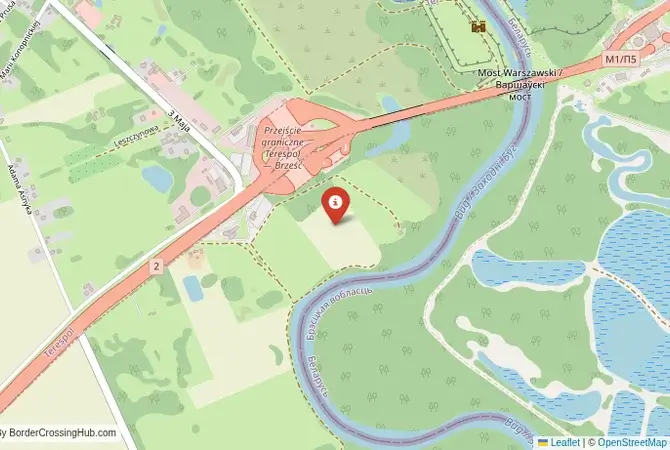
This checkpoint connects the Brest Region of Belarus with the Lublin Voivodeship of Poland. It is a major international crossing, open to passenger cars, buses, and pedestrians. It is important to note that commercial freight traffic is generally redirected to the nearby Kukuryki–Kazłovičy crossing to ease congestion. Despite this, the Brest-Terespol crossing, known locally as "Varshavsky Most" (the Warsaw Bridge), is notoriously busy, and wait times can be exceptionally long, often stretching for many hours, sometimes even days.
Historical Context
The history of this location is profound. Brest, formerly Brest-Litovsk, has been a strategic city for centuries. It was here that the Treaty of Brest-Litovsk was signed in 1918, taking Russia out of World War I. The city is also home to the heroic Brest Fortress, a 19th-century Russian fortification that became a symbol of Soviet resistance during the German invasion in 1941. The Bug River has long been a border, separating the Russian Empire from Poland. During the Cold War, this was one of the most heavily fortified points on the Iron Curtain, the dividing line between the Warsaw Pact and the West. The bridge you cross today is a direct successor to the one that symbolized that division.
Nearby Border Crossings
Border Procedure
The border crossing procedure is a complex and often lengthy process, reflecting its status as a primary entry point into the EU and the Schengen Area. The process involves two separate, large checkpoint complexes. You will first complete exit formalities on the Belarusian side in Brest. This involves checks by border guards and customs officials. After crossing the bridge over the Bug River, you will arrive at the Polish checkpoint in Terespol. Here, you will undergo a rigorous EU entry inspection by the Polish Border Guard (Straż Graniczna) and Customs Service (Służba Celna). You will need a valid passport, a visa for the Schengen Area (if required for your nationality), vehicle registration, and international insurance (Green Card). Customs inspections can be very thorough. Patience is not just a virtue here; it is an absolute necessity. Recent official reports indicate average wait times of several hours for passenger vehicles, with longer delays possible during peak periods or political tensions.
Regional Attractions
The main attraction on the Belarusian side is the city of Brest itself. The Brest Fortress memorial complex is a vast and moving site that is a must-see for anyone interested in World War II history. The city also has a pleasant pedestrian street (Sovetskaya Street) and a railway museum. On the Polish side, Terespol is a small border town. The crossing serves as a gateway to the rest of Poland and Europe. The capital city, Warsaw, is about a two-hour drive away. The region of Podlasie, where the crossing is located, is known for its pristine nature, including the Białowieża Forest, a UNESCO World Heritage site.
Practical Information
Practical planning is absolutely critical for this route. Due to the extreme political sensitivities and potential for long waits, you must be well-prepared. Ensure your vehicle is in good condition and has a full tank of fuel. Have ample food, water, and any necessary medications with you. The official currencies are the Belarusian Ruble (BYN) and the Polish Złoty (PLN). Currency exchange facilities are available, but it is wise to have some local currency before arriving at the border. Be aware of the strict limits on goods like alcohol and tobacco that can be brought into the EU. Always check the latest official information on queue lengths and any new travel restrictions before heading to the border.
Final Considerations
The Brest–Terespol border crossing is more than just a checkpoint; it is a journey through the deep and often difficult history of Eastern Europe. It is one of the few remaining passenger gateways between Belarus and the EU, making it a critical, if challenging, point of transit. The experience can be stressful and time-consuming, but for the patient and well-prepared traveler, it offers a direct and powerful encounter with a major geopolitical frontier. It is a place that demands respect for the history it represents and the complex present it embodies.
View all border crossings between Belarus and PolandPractical information
Fuel
Belarus: 500 m - Poland: 500 m
Currency
Near Brest (BYN, PLN)
Safety information
Busy, low crime
Connectivity
Wi-Fi stations, 4G/5G
Have you crossed here?
Help other travelers by sharing your experience, wait times, and any updates.