Monthly Update (September 2026):
Brest & Terespol Border Crossing remains active for passenger rail traffic, but it is closely tied to the same heavily controlled Belarus-Poland frontier as the road crossing. Current information lists the Brest-Terespol connection as an international rail crossing, while road passenger traffic is also operating through Terespol. Travelers should expect full external-border procedures when entering Poland, including the EU's Entry/Exit System for eligible third-country nationals; current crossing data reports EES as active at Brest. There is no indication of a normal unrestricted rail journey comparable to travel within the Schengen area.
About this crossing
Operational Details
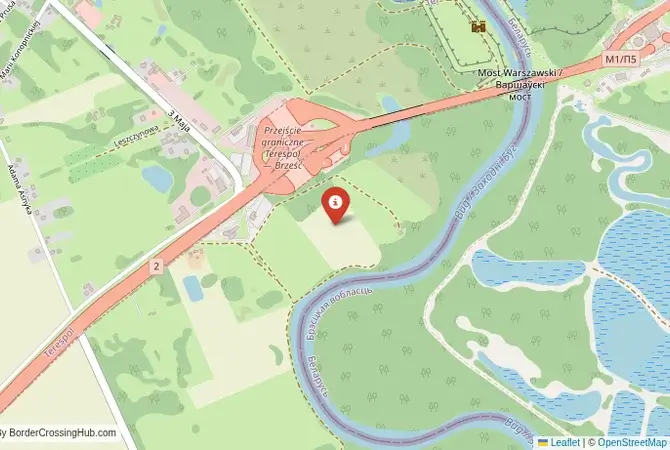
This checkpoint connects Poland's Lublin Voivodeship with the Brest Region of Belarus. Its operation for passenger services is currently suspended, with freight rail continuing. The crossing is over the Bug River on a dedicated railway bridge that runs parallel to the road bridge. The main railway station on the Polish side is in Terespol, but the key operational hub is the massive Brest Central Station on the Belarusian side. It is here that the complex procedure of changing the wheelsets (bogies) of the train carriages takes place, a ballet of heavy engineering that is a spectacle in itself. Though now limited to freight contexts.
A History of Different Gauges
The history of this crossing is a history of European railways. The difference in gauge (1435 mm for standard gauge, 1520 mm for Russian broad gauge) was a deliberate strategic choice by the Russian Empire in the 19th century to make it more difficult for a potential invader to use its rail network. This created a permanent logistical barrier. For decades, passengers had to disembark at Brest and change trains. To create a more seamless journey, particularly for prestigious services like the Moscow-Paris express, a system was developed to lift each individual carriage and swap its standard-gauge bogies for broad-gauge ones, or vice versa. The Brest Central Station was equipped with massive "bogie-changing sheds" to perform this task, a solution as impressive as the problem it solved.
Nearby Border Crossings


The Bogie-Changing Procedure
The border crossing procedure for a train passenger is a unique experience when services operate. The train will typically stop first at the Terespol station on the Polish side. Polish Border Guards (Straż Graniczna) and Customs officers will board the train and move through the carriages, checking passports and making any necessary inspections. This is the exit point from the EU and the Schengen Area. The train will then slowly cross the bridge over the Bug River and pull into the Brest Central Station. Here, the main part of the process begins. First, Belarusian border guards and customs officials will board the train to conduct their entry checks. After this is complete, the train is shunted into the bogie-changing facility. Passengers remain on board as the entire train is lifted by giant jacks, the old bogies are rolled out from underneath, and the new ones are rolled in. The process is noisy, slow, and utterly fascinating, a piece of living industrial history. The entire stop at Brest, including both immigration and the technical procedure, can easily take two hours or more. Though passenger operations remain suspended as of early 2026.
Attractions of the Journey
The main attraction is the journey itself. For rail enthusiasts, witnessing the bogie change at Brest is a bucket-list experience. The city of Brest itself is a major point of interest, with its heroic Brest Fortress memorial complex being the primary attraction. On the Polish side, Terespol is a small border town, but it serves as the gateway to Warsaw and the rest of the Polish rail network. Direct sleeper trains have historically connected Moscow with major European capitals like Paris, Berlin, Prague, and Vienna, and all of them passed through this crucial checkpoint at Brest, making it a crossroads of Europe.
Practical Travel Information
Practical planning for this route is entirely dependent on the availability of international passenger trains, which are currently not running. You must check with the official railway operators (such as Polish State Railways - PKP, or Belarusian Railways - BCh) to see if any services are currently running. Tickets must be booked in advance when available. You will need a valid passport and any necessary visas for Belarus. The official currencies are the Polish Złoty (PLN) and the Belarusian Ruble (BYN). Services on the train are limited during the border stop, so having some snacks and water is advisable.
Final Considerations
The Terespol–Brest railway crossing is a journey back in time and a lesson in engineering. It is a route for the patient traveler and the railway enthusiast. While the future of direct passenger services is uncertain due to the political climate, the crossing remains a critical point for freight traffic and a place of immense historical importance. It is a powerful symbol of the challenges and the ingenious solutions involved in connecting the two halves of the European continent, a frontier defined not just by a river, but by 85 millimeters of steel.
View all border crossings between Belarus and PolandPractical information
Fuel
Belarus: 500 m - Poland: 500 m
Currency
Near Terespol (BYN, PLN)
Safety information
Busy, low crime
Connectivity
Wi-Fi access, 4G
Have you crossed here?
Help other travelers by sharing your experience, wait times, and any updates.