Monthly Update (October 2026):
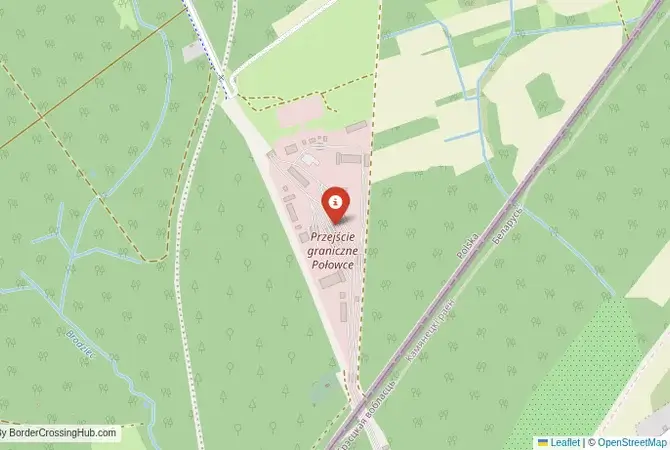
The Peschatka & Połowce Border Crossing remains closed this October. Poland's official border information explicitly lists Połowce among the crossings where traffic is temporarily suspended, while Belarusian border information also lists Peschatka-Połowce as closed. There is therefore no October reopening to report, and travelers should use one of the currently functioning Poland-Belarus crossings instead.
About this crossing
Operational Details
This checkpoint connected the Brest Region of Belarus with Poland's Podlaskie Voivodeship. It operated with limited daylight hours and was intended for passenger cars and pedestrians. A key feature was that it had a weight restriction, meaning heavy freight trucks were not permitted. This ensured that the crossing remained relatively quiet and that the local roads were not overwhelmed by commercial traffic. Its closure has forced all remaining traffic onto the single, heavily congested crossing at Brest-Terespol area equivalents, though most are now suspended.
A History of Local Connections
The history of this region is one of a cultural borderland. The area has been shaped by Polish, Lithuanian, Belarusian, and Ukrainian influences for centuries. It is a land of both Catholic and Orthodox traditions, and this heritage is visible in the architecture of the local churches and villages. The border, solidified after World War II, cut through this culturally mixed landscape. The Peschatka-Połowce crossing, when it was open, served as an important link for families and communities who found themselves on opposite sides of the new political line. It was a place that helped to maintain the human connections that transcended the international frontier.
Nearby Border Crossings
Former Border Procedure
The border crossing procedure, when it was operational, was a standard two-part process. As an entry point into the EU and the Schengen Area, it involved full customs and immigration checks. Travelers would first complete exit formalities at the Belarusian checkpoint at Peschatka. This involved checks by border guards and customs officials. After a short drive, they would arrive at the Polish checkpoint at Połowce for a full entry inspection by the Polish Border Guard (Straż Graniczna) and Customs Service. A valid passport and, if required, a Schengen visa were necessary. Because it was a smaller crossing, the process could sometimes be faster and more personal than at the major checkpoints, but it was still subject to thorough EU entry protocols.
The Surrounding Region
The surrounding region is known for its natural beauty and cultural heritage. On the Polish side, the crossing is located near the eastern edge of the Białowieża Forest. The area is part of the Podlaskie Voivodeship, a region famous for its pristine nature, traditional wooden architecture, and multicultural atmosphere. The nearby town of Hajnówka is known as the "gateway to the Białowieża Forest" and is a center of the Belarusian minority in Poland. On the Belarusian side, Peschatka is a small village. The crossing provided access to the western parts of the Brest Region and the Belarusian section of the Białowieża Forest (Belovezhskaya Pushcha). The historic town of Kamianiec, with its impressive 13th-century residential tower, is also in this region.
Closure Due to Geopolitical Tensions
The closure of the Peschatka-Połowce crossing is a direct result of the severe deterioration in the political relationship between Belarus and Poland. The migrant crisis that began in 2021, which the EU accused Belarus of engineering, led Poland to declare a state of emergency along the border. This was followed by the construction of a high-tech border wall and the closure of most of the border crossings, including this one, to enhance security and control the flow of people, with suspensions renewed in early 2026.
Final Considerations
The Peschatka and Połowce border crossing was once a vital local link, a quiet gateway that served the communities of the Polish-Belarusian borderland. Its closure is a stark symbol of the deep political freeze that has descended upon the region. The once-peaceful checkpoint now stands silent, a casualty of geopolitical conflict. Its story is a poignant reminder of how quickly political tensions can sever the human and economic connections that have been built over generations, turning a bridge between communities into a fortified and closed frontier.
View all border crossings between Belarus and PolandPractical information
Fuel
Belarus: <1 km - Poland: <1 km
Currency
Near Peschatka (BYN, PLN)
Safety information
Rural, low crime
Connectivity
Basic 3G signal
Have you crossed here?
Help other travelers by sharing your experience, wait times, and any updates.