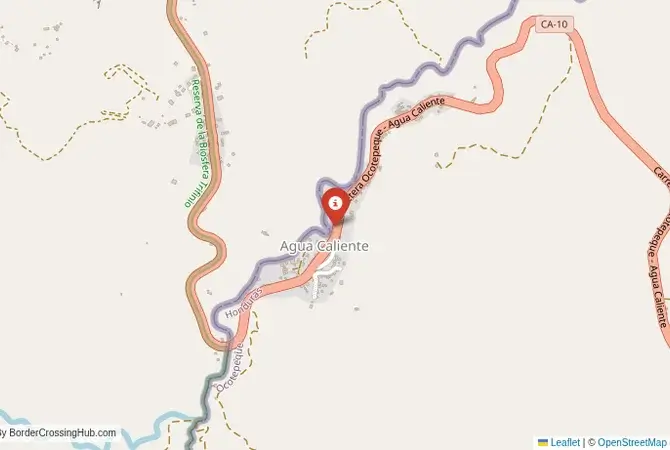
Monthly Update (September 2026):
Agua Caliente & Santa Rita Border Crossing remains a quieter Guatemala-Honduras route with no significant September closure identified. The crossing is useful for travelers moving between western Honduras and eastern Guatemala, particularly those heading toward Copán and Santa Rosa de Copán. September rains can make the surrounding mountain roads slower, so road conditions may be more relevant to the journey than the border itself.
Driving there, or sending a driver? Send them this guide.
For reports and websites
Cite this page
Border Crossing Hub (2026). Agua Caliente & Santa Rita Border Crossing. Updated September 2026. https://bordercrossinghub.com/agua-caliente-santa-rita-border-crossing/<a href="https://bordercrossinghub.com/agua-caliente-santa-rita-border-crossing/">Agua Caliente & Santa Rita Border Crossing (Border Crossing Hub)</a>Put this crossing's card on your website
Free. It updates on its own when our information changes.
<iframe data-bch-card src="https://bordercrossinghub.com/agua-caliente-santa-rita-border-crossing/?bch_view=card" width="100%" height="980" scrolling="no" style="border:0;max-width:480px;display:block" loading="lazy" title="Agua Caliente & Santa Rita border crossing information"></iframe>
<p style="font-size:12px;margin:4px 0 0">Crossing information: <a href="https://bordercrossinghub.com/agua-caliente-santa-rita-border-crossing/">Border Crossing Hub</a></p>
<script src="https://bordercrossinghub.com/?bch_embed_js=1" async></script>Paste it where you want the card. The last line (a script) only adjusts the height and can be left out.
About this crossing
Historical and Geopolitical Context
The Guatemala-Honduras border, spanning 256 km, was established by the 1859 Wyke-Aycinena Treaty, with 1,028 boundary markers set in 1933. Agua Caliente, located in Santa Fe, Ocotepeque, is a key trade point for coffee and electronics, with Honduras importing 15% of its goods from Guatemala. The 2017 Customs Union introduced integrated customs processes, including the DUCA-F electronic declaration, streamlining trade. Migrant movements, like those reported in July 2025, have occasionally disrupted operations, underscoring the crossing’s geopolitical weight. The nearby Basílica del Cristo Negro in Esquipulas adds cultural significance, drawing pilgrims and boosting regional tourism.
Crossing Procedures and Wait Times
The crossing operates from 6:00 AM to 9:00 PM daily, with a juxtaposed system and shared customs building on Guatemala’s side. At Guatemala’s immigration, get your passport stamped for exit; no official fee applies, but some travelers report unofficial “charges”. Walk 200 meters to Honduras’ immigration in Santa Rita, where you’ll pay a $3 USD (75 HNL) entry fee, accepted in USD, quetzales, or lempiras. A passport with six months’ validity and proof of onward travel are required; most nationalities get a 90-day visa-free stay under the CA-4 agreement. Wait times are 30-60 minutes in the early morning, stretching to 1-2 hours in the afternoon or during holidays. For vehicles, Guatemala requires a $20.78 USD import permit and $2.34 USD fumigation fee; Honduras charges 800 HNL ($32 USD) for a temporary import permit, needing copies of your passport, license, and registration. The entire process typically takes 45-120 minutes, with recent reports noting helpful staff and streamlined flow.
Nearby Border Crossings



Route Details and Transportation
From Esquipulas, Guatemala, colectivos to Agua Caliente take 30 minutes (Q10, ~$1.30 USD), departing frequently from the bus terminal. From Nueva Ocotepeque, Honduras, buses to Santa Rita cost 40 HNL ($1.60 USD) and take 45 minutes. The CA-10 highway is paved, offering views of coffee plantations and the Merendón mountains, but fog at night can slow travel. The border area is lively with comedores selling baleadas for $0.50 USD and a copy shop charging Q4 per document. Avoid touts offering “express” services, as they may charge $10 for nothing. Public buses to Guatemala City or San Pedro Sula are available just past immigration, but evening options are scarce. A recent traveler noted a 1-hour crossing thanks to the DUCA-F system.
Scams & Warnings
Exchange money in Esquipulas or Nueva Ocotepeque, as border changers give poor rates (e.g., $1:22 HNL vs. $1:24 HNL). Scams include unofficial “exit fees” or overpriced shuttles; politely refuse and insist on receipts. Carry USD or lempiras for Honduras’ fees, and have proof of onward travel and accommodation ready. Cross before noon to beat crowds and secure transport. For vehicles, use Honduras’ migration app for pre-registration and bring document copies. Check for closures, as migrant surges in July 2025 disrupted nearby borders. A Honduran SIM card ($5 USD) from Nueva Ocotepeque keeps you connected. Keep valuables secure near busy comedores, as pickpocketing has been reported.
Nearby Attractions and Cultural Significance
Esquipulas, 10 km away, is home to the Basílica del Cristo Negro, a major pilgrimage site. In Honduras, Nueva Ocotepeque’s markets offer local crafts, and Santa Rosa de Copán, 1.5 hours away, features colonial architecture and coffee tours. The crossing supports trade in agricultural goods and tourism, blending Mayan and Lenca cultures, seen in Esquipulas’ festivals and Honduras’ baleada stalls ($0.50 USD).
Seasonal Considerations and Planning
The dry season (November-April) brings clear roads and mild temperatures (~24°C), perfect for crossing. The rainy season (May-October) can muddy roads and cause delays, especially after storms. Holidays and pilgrimage seasons, like January’s Cristo Negro festival, increase traffic, so aim for early mornings. Budget 4-6 hours from Esquipulas to Santa Rosa de Copán, including 1-2 hours at the border. Stay in Esquipulas for better lodging than Santa Rita’s limited options. Carry USD, confirm CA-4 visa days, and monitor news for migrant-related disruptions. With careful planning, this crossing opens access to Guatemala’s spiritual heritage and Honduras’ coffee-rich west.
View all border crossings between Guatemala and HondurasHeading to Agua Caliente & Santa Rita? Take this with you.
One page with the hours, waits, emergency numbers and coordinates. Works without signal.
Practical information
Fuel
Guatemala: 500 m - Honduras: 500 m
Currency
Available near Agua Caliente (GTQ, HNL)
Safety information
Busy times; watch traffic
Connectivity
Wi-Fi at checkpoints, 4G
Have you crossed here?
Help other travelers by sharing your experience, wait times, and any updates.