Monthly Update (September 2026):
Aceguá remains one of the established Brazil–Uruguay land crossings covered by Uruguay's new simplified import regime. Since May, eligible everyday products such as coffee, pasta, yerba mate and toiletries can enter under simplified customs procedures at Aceguá. The change is mainly relevant to cross-border shoppers rather than tourists simply passing through.
Driving there, or sending a driver? Send them this guide.
For reports and websites
Cite this page
Border Crossing Hub (2026). Aceguá Border Crossing. Updated September 2026. https://bordercrossinghub.com/acegua-acegua-border-crossing/<a href="https://bordercrossinghub.com/acegua-acegua-border-crossing/">Aceguá Border Crossing (Border Crossing Hub)</a>Put this crossing's card on your website
Free. It updates on its own when our information changes.
<iframe data-bch-card src="https://bordercrossinghub.com/acegua-acegua-border-crossing/?bch_view=card" width="100%" height="980" scrolling="no" style="border:0;max-width:480px;display:block" loading="lazy" title="Aceguá border crossing information"></iframe>
<p style="font-size:12px;margin:4px 0 0">Crossing information: <a href="https://bordercrossinghub.com/acegua-acegua-border-crossing/">Border Crossing Hub</a></p>
<script src="https://bordercrossinghub.com/?bch_embed_js=1" async></script>Paste it where you want the card. The last line (a script) only adjusts the height and can be left out.
About this crossing
Operational Details
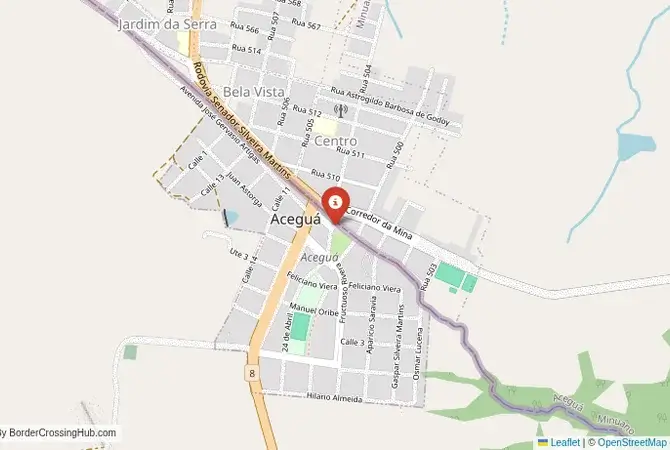
This checkpoint connects Brazil's Rio Grande do Sul state with the Cerro Largo Department of Uruguay. There is no single, mandatory checkpoint for moving between the two villages. People cross freely for daily life. However, formal, integrated immigration and customs offices (a joint facility) are located on the main road for travelers who need to officially enter or exit the country. This is a crucial step for anyone not just visiting for the day. The crossing is open 24/7, but the traffic is very light, consisting almost entirely of local residents and those involved in the agricultural economy.
A History of a Gaúcho Heartland
The history of this region is the history of the Pampa, the vast grasslands that are the heartland of the Gaúcho (Gaucho in Spanish) culture. This has been a land of cattle ranching and a contested frontier between the Spanish and Portuguese empires for centuries. The modern border was established in the 19th century, but the shared Gaúcho culture, with its traditions of horsemanship, barbecue (churrasco/asado), and mate (chimarrão/mate), has always transcended the political line. The two villages of Aceguá grew up together as small service centers for the surrounding large ranches (estâncias/estancias). The open border is a reflection of the deep, practical, and historical integration of the community.
Nearby Border Crossings



The Unique Border Procedure
The border crossing procedure is unique. For local movement, there are no checks. However, for foreign tourists or for anyone planning to travel further into either country, it is absolutely essential to stop at the integrated border post and get the proper entry and exit stamps. Failure to do so can result in significant fines and legal problems when you try to leave the country from another point. The open nature of the urban border can be deceptive; the formal requirements are still very much in place for international travelers. The joint border post is a model of efficient, modern border management.
The Surrounding Region: Brazil Side
On the Brazilian side, Aceguá is a small, quiet town that serves as a commercial center for the surrounding agricultural region. It is located near the major city of Bagé, the "Queen of the Frontier," which is a major center of the "Campanha Gaúcha." The region is known for its high-quality beef production, its fine-wool sheep, and its growing wine industry. The landscape is one of vast, open grasslands, dotted with large ranches and historic farmhouses. It is a paradise for those who love wide-open spaces.
The Surrounding Region: Uruguay Side
On the Uruguayan side, Aceguá is also a small, quiet town. Like other Uruguayan border towns, it has a number of duty-free shops ("free shops") which are an attraction for Brazilian shoppers, though on a much smaller scale than in cities like Rivera or Chuy. The crossing is a gateway to the Cerro Largo department, a region of rolling hills and cattle ranches. The nearby city of Melo is the main regional center, famous as the setting for the film "The Pope's Toilet" (El Baño del Papa).
Practical Travel Information
Practical planning is essential. Remember to get your passport stamped if you are traveling further into either country. The official currencies are the Brazilian Real (BRL) in Brazil and the Uruguayan Peso (UYU) in Uruguay. Services are limited in the small towns, so it is best to plan for fuel and major needs in the larger cities of Bagé or Melo. Vehicle insurance (Carta Verde) is mandatory for driving between the two countries. This is a very quiet and safe crossing, offering a relaxed alternative to the busier border posts.
Final Considerations
The Aceguá-Aceguá border crossing is a journey into the heart of the pampas. It is a symbol of the deep cultural integration between Brazil and Uruguay at its most local and authentic level. It is a quiet, peaceful hub of a shared Gaúcho culture. For the traveler, it offers a unique cultural experience, a glimpse into a world where two nations meet and merge on a single street in the middle of the vast, beautiful grasslands of South America.
View all border crossings between Brazil and UruguayHeading to Aceguá? Take this with you.
One page with the hours, waits, emergency numbers and coordinates. Works without signal.
Practical information
Fuel
Brazil: 2 km - Uruguay: 2 km
Currency
Limited BRL/UYU
Safety information
Rural area; wildlife risks
Connectivity
4G coverage
Have you crossed here?
Help other travelers by sharing your experience, wait times, and any updates.