Monthly Update (October 2026):
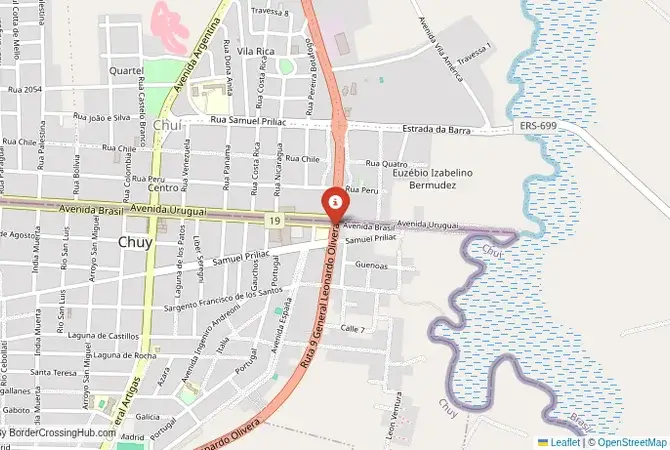
Chuí & Chuy continues to function as one of the region's most informal-looking international borders, with the two towns effectively blending into one urban area. There is no new closure or major restriction reported for October, while Uruguay's border-control system continues to list the Chuy control area for tourism, freight and road transport. For travelers, the main change is therefore simply seasonal movement rather than a new crossing procedure.
Driving there, or sending a driver? Send them this guide.
For reports and websites
Cite this page
Border Crossing Hub (2026). Chuí & Chuy Border Crossing. Updated October 2026. https://bordercrossinghub.com/chui-chuy-border-crossing/<a href="https://bordercrossinghub.com/chui-chuy-border-crossing/">Chuí & Chuy Border Crossing (Border Crossing Hub)</a>Put this crossing's card on your website
Free. It updates on its own when our information changes.
<iframe data-bch-card src="https://bordercrossinghub.com/chui-chuy-border-crossing/?bch_view=card" width="100%" height="980" scrolling="no" style="border:0;max-width:480px;display:block" loading="lazy" title="Chuí & Chuy border crossing information"></iframe>
<p style="font-size:12px;margin:4px 0 0">Crossing information: <a href="https://bordercrossinghub.com/chui-chuy-border-crossing/">Border Crossing Hub</a></p>
<script src="https://bordercrossinghub.com/?bch_embed_js=1" async></script>Paste it where you want the card. The last line (a script) only adjusts the height and can be left out.
About this crossing
Operational Details
This checkpoint connects Brazil's Rio Grande do Sul state with the Rocha Department of Uruguay. There is no single, mandatory checkpoint for moving between the city centers. People cross freely for shopping, work, and daily life. However, formal, integrated immigration and customs offices (a joint facility) are located on the main highway just outside the towns for travelers who need to officially enter or exit the country. This is a crucial step for anyone not just visiting for the day. For commercial freight, there are also dedicated customs terminals. The border is, for all intents and purposes, open 24/7 for local movement.
A History of a Southernmost Point
The history of this region is the history of the contested frontier between the Spanish and Portuguese empires. The Arroyo Chuí, a small stream that flows into the Atlantic, was established as the final border in the 19th century. The towns of Chuí and Chuy grew up on either side of this line. The Brazilian town is famous as the southernmost city in Brazil, a fact that is a major source of local pride and a popular photo opportunity for tourists at the marker for the Arroyo Chuí. In the late 20th century, the Uruguayan side, Chuy, developed into a massive hub for duty-free shopping, which has become the main engine of the local economy for both towns.
Nearby Border Crossings



The Unique Border Procedure
The border crossing procedure is unique. For a day trip of shopping in Chuy, most Brazilian and Uruguayan citizens simply cross without any checks. However, for foreign tourists or for anyone planning to travel further into either country, it is absolutely essential to stop at the integrated border post on the highway and get the proper entry and exit stamps. Failure to do so can result in significant fines and legal problems when you try to leave the country from another point. The open nature of the urban border can be deceptive; the formal requirements are still very much in place for international travelers.
The Surrounding Region: Brazil Side
On the Brazilian side, Chuí is a small town that is largely focused on supporting the cross-border economy. Its main claim to fame is its geographical location. The nearby Barra do Chuí is the southernmost beach in Brazil. The region is part of the "Taim" ecological station, a vast coastal wetland that is a paradise for birdwatchers. The historic city of Pelotas and the popular beach resort of Cassino, with the longest beach in the world, are a few hours' drive to the north.
The Surrounding Region: Uruguay Side
On the Uruguayan side, the city of Chuy is a bustling commercial center. The main avenue is lined with duty-free shops ("free shops") selling a wide range of goods, from perfumes and electronics to clothing and groceries. It is a major shopping destination for Brazilians. The crossing is also the gateway to the beautiful and wild Atlantic coast of Uruguay. The Santa Teresa National Park, with its massive historic fortress and beautiful beaches, and the trendy beach resort of Punta del Diablo are just a short drive away.
Practical Travel Information
Practical planning is essential. Remember to get your passport stamped if you are traveling further into either country. The official currencies are the Brazilian Real (BRL) in Brazil and the Uruguayan Peso (UYU) in Uruguay, but the US Dollar and the Brazilian Real are widely accepted in the duty-free shops of Chuy. Be aware of the customs limits for goods you can bring back into Brazil. Vehicle insurance (Carta Verde) is mandatory for driving between the two countries. The integrated border post is a model of modern, efficient border management.
Final Considerations
The Chuí-Chuy border crossing is a fascinating and unique place. It is a symbol of the deep economic and cultural integration between Brazil and Uruguay, and a testament to the unique character of a truly open border. It is a bustling, vibrant hub of commerce, a place that is both a shopper's paradise and a geographical landmark. For the traveler, it offers a unique cultural experience, a glimpse into a world where two nations meet and merge on a single street at the very edge of the continent.
View all border crossings between Brazil and UruguayHeading to Chuí & Chuy? Take this with you.
One page with the hours, waits, emergency numbers and coordinates. Works without signal.
Practical information
Fuel
Brazil: 300 m - Uruguay: 300 m
Currency
Nearby BRL/UYU
Safety information
Low risk; open border
Connectivity
Wi-Fi; 4G/5G
Have you crossed here?
Help other travelers by sharing your experience, wait times, and any updates.