Monthly Update (September 2026):
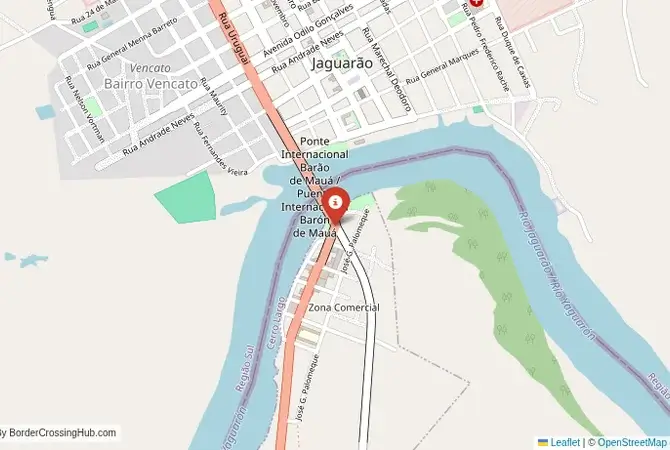
Jaguarão & Rio Branco is back to normal after the traffic restrictions caused by work on the historic Barão de Mauá Bridge earlier this year. The bridge fully reopened in May, so September travelers are no longer dealing with those works. A second bridge remains planned for the longer term, mainly to take heavier freight away from the historic structure, but it has not changed the route travelers use today.
Driving there, or sending a driver? Send them this guide.
For reports and websites
Cite this page
Border Crossing Hub (2026). Jaguarão & Rio Branco Border Crossing. Updated September 2026. https://bordercrossinghub.com/jaguarao-rio-branco-border-crossing/<a href="https://bordercrossinghub.com/jaguarao-rio-branco-border-crossing/">Jaguarão & Rio Branco Border Crossing (Border Crossing Hub)</a>Put this crossing's card on your website
Free. It updates on its own when our information changes.
<iframe data-bch-card src="https://bordercrossinghub.com/jaguarao-rio-branco-border-crossing/?bch_view=card" width="100%" height="980" scrolling="no" style="border:0;max-width:480px;display:block" loading="lazy" title="Jaguarão & Rio Branco border crossing information"></iframe>
<p style="font-size:12px;margin:4px 0 0">Crossing information: <a href="https://bordercrossinghub.com/jaguarao-rio-branco-border-crossing/">Border Crossing Hub</a></p>
<script src="https://bordercrossinghub.com/?bch_embed_js=1" async></script>Paste it where you want the card. The last line (a script) only adjusts the height and can be left out.
About this crossing
Operational Details
This checkpoint connects Brazil's Rio Grande do Sul state with the Cerro Largo Department of Uruguay. It is a major international crossing, open 24/7 to all passenger cars, buses, and commercial freight. The Baron of Mauá Bridge, inaugurated in 1930, carries the road, and the border and customs facilities are located at either end. The bridge itself is a national historic landmark of Brazil. The crossing is a vital link for trade and tourism, connecting southeastern Rio Grande do Sul with eastern Uruguay.
A History of a Landmark Bridge
The history of this crossing is the history of the Baron of Mauá Bridge. For decades, the only way to cross the river was by a small ferry. The construction of the bridge in the late 1920s was a major international project, a symbol of the close ties between the two nations. It was named after the Baron of Mauá, a 19th-century Brazilian industrialist and diplomat who was a great proponent of South American integration. The bridge was the first permanent land link between the two countries. During the years of military dictatorship in both countries, it was a place of strict control, but it has since returned to its original role as a bridge of friendship and commerce.
Nearby Border Crossings



Border Crossing Procedure
The border crossing procedure is a standard two-part process. You will first complete exit formalities at one country's checkpoint and then proceed across the bridge to the other country's checkpoint for entry inspection. You will need a valid passport or, for citizens of Mercosur countries, a national ID card. Vehicle registration and international insurance (Carta Verde) are also necessary. The process is generally straightforward, and the checkpoint is equipped to handle a steady flow of traffic. Queues can form, especially with freight traffic, but they are generally less severe than at the main coastal crossings.
The Surrounding Region: Brazil Side
On the Brazilian side, the city of Jaguarão is a national historic treasure. It has one of the best-preserved collections of 19th-century Luso-Brazilian architecture in the state, with beautiful colonial-style houses, a magnificent theater, and the ruins of an old infirmary. The city is a delight to explore on foot. The main attraction is the bridge itself, and the beautiful riverside promenade. The region is part of the "Campanha Gaúcha," the Brazilian pampas, an area of vast, open landscapes and large cattle ranches.
The Surrounding Region: Uruguay Side
On the Uruguayan side, the city of Rio Branco is a bustling commercial center. Like other Uruguayan border towns, it has a large number of duty-free shops ("free shops") that are a major attraction for Brazilian shoppers. The city is a gateway to eastern Uruguay, a region of vast cattle ranches and beautiful coastal lagoons, such as the Laguna Merín (Lagoa Mirim in Portuguese), the second-largest lagoon in South America, which is shared by the two countries.
Practical Travel Information
Practical planning for this route is straightforward. The main road is well-maintained. The official currencies are the Brazilian Real (BRL) in Brazil and the Uruguayan Peso (UYU) in Uruguay, but the US Dollar and the Brazilian Real are often accepted in the duty-free shops of Rio Branco. Services are available in the towns on both sides of the border. Ensure your vehicle's Carta Verde insurance is valid for both countries. Take the time to walk across the historic bridge to fully appreciate its architecture and the views of the river.
Final Considerations
The Jaguarão–Rio Branco border crossing is a journey through a landscape of deep history and architectural beauty. It is a busy, functional checkpoint that is defined by its magnificent centerpiece, the Baron of Mauá Bridge. It offers a passage through a shared landscape of the pampas and a deep, intertwined Gaúcho culture. For the traveler, it is a gateway to the historic treasures of Jaguarão and the commercial hub of Rio Branco, a chance to cross a border on a true work of art.
View all border crossings between Brazil and UruguayHeading to Jaguarão & Rio Branco? Take this with you.
One page with the hours, waits, emergency numbers and coordinates. Works without signal.
Practical information
Fuel
Brazil: <1 km - Uruguay: <1 km
Currency
Local BRL/UYU
Safety information
Crowded times; pickpockets
Connectivity
Wi-Fi; 4G
Have you crossed here?
Help other travelers by sharing your experience, wait times, and any updates.