Monthly Update (September 2026):
Wanpong-Kyainglap & Xiengkok remains unsuitable for ordinary international tourism. Although the crossing has historical importance as a Laos-Myanmar link, current information continues to indicate that foreign travelers cannot use it as a normal international land crossing, with security conditions on the Myanmar side further limiting its practical value. Myanmar and Laos have discussed improving movement through the Kenglek-Xiengkok area, but there is no September development indicating that unrestricted tourist crossing has resumed.
About this crossing
The Xiengkok Crossing: A Remote Mekong Outpost
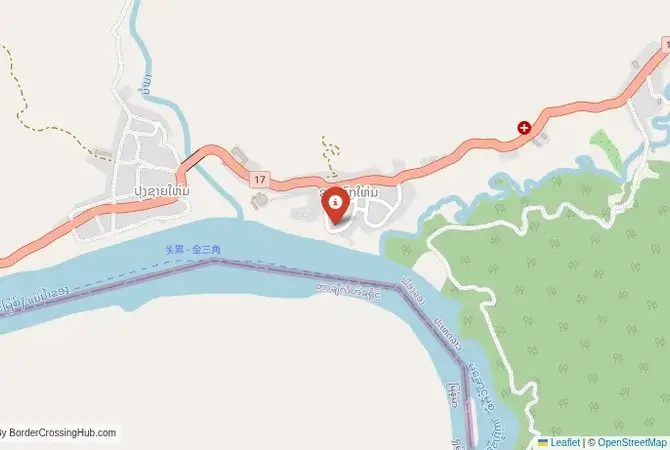
The village of Xiengkok in the Luang Namtha Province of Laos is a remote outpost on the upper Mekong River. It is situated at a point where Laos and Myanmar share a common border along the river, just before the river flows into the Golden Triangle heartland where Laos, Myanmar, and Thailand meet. The "crossing" here is not a bridge or a formal port, but simply a point on the river where small local boats can travel between the two countries. The area is known for its stunning, rugged scenery, with the Mekong carving its way through jungle-clad mountains. For the very few adventurous travelers who make the long journey to Xiengkok, it is a destination in itself, a chance to see the Mekong in its wild, untamed state. It is a place that feels like the edge of the map, a frontier that is defined more by the powerful river than by the political lines drawn upon it. The sense of isolation is profound, and the journey to reach this point is a significant part of the experience, often involving long boat trips or arduous road travel through the beautiful but undeveloped landscapes of northern Laos.
A History of the Golden Triangle's Upper Reaches
The history of this region is the history of the Golden Triangle. This has been a remote and largely ungoverned area for centuries, the domain of various ethnic groups like the Shan, Akha, and Lahu. In the 20th century, it became the world's epicenter of opium production, controlled by powerful warlords and insurgent armies. The Mekong River was a primary highway for smuggling opium, jade, and other illicit goods. The border between Laos and Myanmar in this region was, for all practical purposes, non-existent, controlled by local power brokers rather than by the central governments. In recent decades, both governments have made efforts to assert more control over the region. The Lao government has promoted eco-tourism in the Luang Namtha province, and the journey by slow boat down the Nam Tha river and then up the Mekong to Xiengkok has become a niche adventure trip. However, the Myanmar side of the border remains a highly sensitive and volatile "special region" of the Shan State, with a heavy presence of ethnic armed groups and the Myanmar military. The "Friendship Bridge" sometimes mentioned in relation to this area is a long-proposed project that has not materialized as a functioning international gateway for travelers.
Nearby Border Crossings




Border Procedures: Non-Existent for Travelers
As this is not an official international crossing, there are no legal procedures for foreigners to cross the border here. There are no Lao or Myanmar immigration offices to stamp passports or issue visas. Any attempt by a foreigner to cross the river from Xiengkok into Myanmar would be an illegal entry. You would be subject to immediate arrest by the Myanmar authorities or, perhaps worse, you could fall into the hands of one of the various armed groups that operate in the area. Similarly, the Lao authorities would not permit a foreigner to exit the country at this point. The crossing is strictly for local people from the immediate area, who may have special permits or traditional rights to cross, and this movement is still tightly monitored by the military on both sides. The lack of any formal infrastructure—no customs house, no immigration building, no official presence beyond military outposts—is the clearest sign that this is not a gateway for the outside world. Any traveler's passport would be useless here, as there is no one to legally process it.
The Regional Context: A Highly Sensitive Area
The journey to Xiengkok from within Laos is an adventure in itself. It typically involves a multi-day trip, often by boat, from Luang Namtha or Huay Xai. The area is beautiful but very remote, with limited infrastructure. The Myanmar side of the border, the Kyainglap area, is part of the Shan State Special Region 4, an area controlled by an ethnic armed group that has a ceasefire agreement with the central government but maintains its own army and administration. The region is known for its large casinos and special economic zones, often catering to Chinese interests. It is a complex and opaque region that is completely off-limits to independent travelers. The entire Golden Triangle remains a major center for the production and trafficking of synthetic drugs, and the security situation is unpredictable, with sporadic clashes between various armed groups and the Myanmar military as reported in 2025–2026. This is not a safe or stable region for tourism, and venturing off the established paths on the Lao side is strongly discouraged.
Final Contextual Note: A Journey to the River's Edge, Not Beyond
The village of Xiengkok is a fascinating and worthwhile destination for the intrepid traveler looking to experience the wild, upper reaches of the Mekong in Laos. It offers a glimpse into a remote and beautiful part of the country. However, it must be understood as a final destination, not as a transit point. The border with Myanmar here is, for the traveler, an impenetrable wall. It is a place to stand on the riverbank and gaze across at a different, inaccessible world. Any overland travel between Laos and Myanmar is not currently possible for tourists at any crossing. The Xiengkok border is a powerful reminder that some frontiers are truly closed, and that the allure of the unknown must be tempered with a respect for the complex political and security realities of the Golden Triangle. The journey ends at the water's edge.
View all border crossings between Laos and MyanmarPractical information
Currency
Limited exchange (LAK, MMK)
Safety information
Restricted, remote risks
Connectivity
Limited Wi-Fi, 3G
Have you crossed here?
Help other travelers by sharing your experience, wait times, and any updates.