Monthly Update (September 2026):
Ustyluh & Zosyn remains a practical passenger-car crossing between western Ukraine and Poland, with no significant September closure identified. Poland's September 4 border data showed no passenger-car queue at Zosin in the available outbound data, although freight waiting times were around one to two hours. This makes Zosin a useful alternative when larger crossings farther south are busy. Travelers should still check conditions shortly before departure because traffic at the Ukrainian frontier can change considerably during the day.
About this crossing
Operational Details
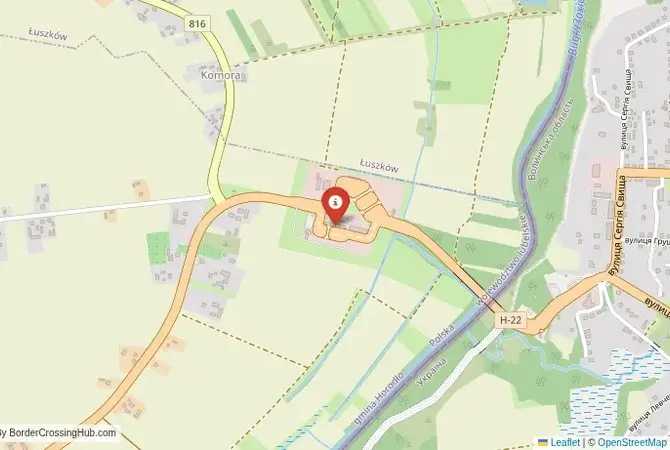
This checkpoint connects Ukraine's Volyn Oblast with Poland's Lublin Voivodeship. It is an international crossing, but with a key restriction: it is generally limited to passenger cars and small vans with a total weight of up to 3.5 tonnes. This exclusion of heavy freight traffic is what preserves its character as a quieter, more manageable crossing. It typically operates 24/7, but its primary value is as a release valve for the main crossing at Yahodyn, especially for travelers whose destinations are in the immediate border region.
A History of Volhynia
The history of this region is the history of Volhynia, a historic land that has been part of Kievan Rus', the Kingdom of Poland, the Polish-Lithuanian Commonwealth, the Russian Empire, and interwar Poland. It has long been a multicultural area, with Ukrainian, Polish, and Jewish communities living side-by-side. This shared existence was shattered during World War II by the Nazi Holocaust and the brutal ethnic conflicts between Poles and Ukrainians. The town of Ustyluh itself has a notable cultural history; it was the home of the composer Igor Stravinsky for several years before World War I, and a museum is dedicated to him there. The border drawn on the Bug River after the war formalized a painful separation. This crossing is one of the small bridges that helps to reconnect this historically intertwined land.
Nearby Border Crossings
Border Crossing Procedure
The border crossing procedure is a standard two-part process for entering the EU and the Schengen Area, but on a smaller scale than at the major crossings. You will first complete exit formalities at the Ukrainian checkpoint at Ustyluh. After crossing the bridge over the Bug River, you will arrive at the Polish checkpoint at Zosyn for a full EU entry inspection by the Polish Border Guard (Straż Graniczna) and Customs Service. You will need a valid passport, vehicle registration, and international insurance (Green Card). Because the crossing is limited to smaller vehicles, the process can often be significantly faster than at Yahodyn, but queues can still develop, especially when the larger crossings are blocked or heavily congested.
The Surrounding Region
The surrounding area is rich in history. On the Ukrainian side, Ustyluh, in addition to its Stravinsky museum, is near the ancient city of Volodymyr (formerly Volodymyr-Volynskyi), one of the most important historical capitals of the region, with beautiful medieval churches. On the Polish side, the crossing is near the town of Hrubieszów, another historic border town. The region is largely agricultural. For travelers, this crossing is a good choice if you are exploring the historic cities of Volhynia or heading towards the Polish city of Zamość, a stunning UNESCO World Heritage site renowned for its unique Renaissance architecture.
Practical Travel Information
Practical planning is key. The weight restriction is the most important factor to be aware of. The roads leading to the crossing are regional and can be of variable quality, particularly on the Ukrainian side. The official currencies are the Ukrainian Hryvnia (UAH) and the Polish Złoty (PLN). Services at the border are limited, so it is best to plan for fuel and currency exchange in the larger towns of Volodymyr or Hrubieszów. You will need the Polish `e-TOLL` system if you are driving a vehicle over 3.5 tonnes, though such vehicles are generally not permitted here.
Final Considerations
The Ustyluh–Zosyn border crossing is a valuable alternative for passenger car travel between Ukraine and Poland. It offers a potentially faster and less stressful experience than the major freight corridors. It is a journey through a region with a deep and poignant history, a passage that connects two nations at a more human scale. In the current climate, its role as a secondary artery has become even more important, providing a crucial link for families, aid workers, and all those whose journeys are part of the ongoing story of Ukrainian resilience and European solidarity.
View all border crossings between Ukraine and PolandPractical information
Fuel
Ukraine: <1 km - Poland: <1 km
Currency
Small exchangers; UAH, PLN
Safety information
Low crime; rural setting
Connectivity
4G/LTE
Have you crossed here?
Help other travelers by sharing your experience, wait times, and any updates.