Monthly Update (September 2026):
Ungheni, Iași Border Crossing remains an important Moldova-Romania connection, with the road crossing supplemented by the growing cross-border transport links around Ungheni. No significant September closure has been identified. Travelers should note that the wider Ungheni area is undergoing major infrastructure development connected with the new cross-border bridge and road links, so local traffic patterns can change as construction progresses. For normal road travelers, the crossing remains usable.
About this crossing
Operational Details
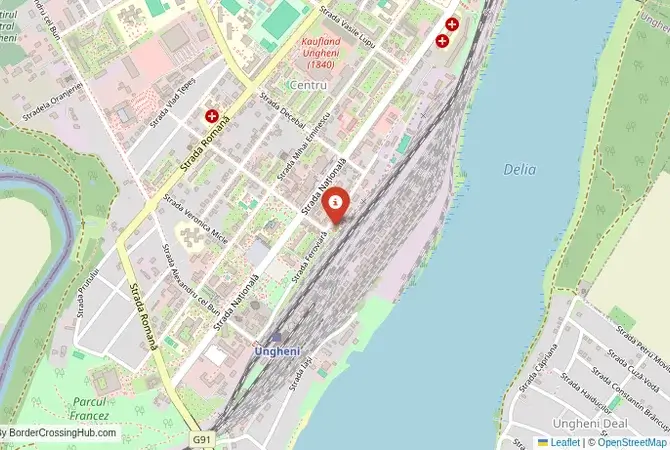
This checkpoint connects Moldova's Ungheni District with Romania's Iași County. It operates 24 hours a day, 7 days a week, and is equipped to handle passenger cars, freight, and railway traffic. The road crossing is a modern bridge built alongside the original railway bridge. The presence of the two bridges, old and new, side-by-side, tells a story of evolving transportation and enduring connection. The crossing is a popular alternative to the busier Leușeni-Albița checkpoint, especially for those traveling between Chișinău and Iași, as the route is often perceived as having more manageable queues.
A History Forged in Steel
The history of the crossing is dominated by the Eiffel Bridge. Commissioned by the Russian Empire to connect its railway network to the Romanian one, the bridge was designed by Gustave Eiffel's company and completed in 1877, just a few years before the Eiffel Tower would make him world-famous. It was a strategic project, inaugurated just days after Russia declared war on the Ottoman Empire, and it played a crucial role in the movement of Russian troops during the Russo-Turkish War that led to Romania's independence. The bridge survived two world wars and stands today as a testament to 19th-century engineering prowess. The border itself, drawn along the Prut, split the town of Ungheni, creating two separate entities in two different countries, forever linked by Eiffel's creation.
Nearby Border Crossings


Border Crossing Procedure
The border crossing procedure is a standard international process. As Moldova is a non-EU country, you will undergo full customs and immigration checks upon entering Romania. The process involves two separate checkpoints. You will first complete exit formalities with the Moldovan border police and customs in Ungheni, Moldova. After this, you will drive across the road bridge over the Prut River, with the historic railway bridge visible alongside you. On the Romanian side, you will arrive at the Ungheni checkpoint for a full EU entry inspection by the Poliția de Frontieră. You will need a valid passport, vehicle registration, and international insurance (Green Card). The checkpoint is busy, handling a mix of local cross-border traffic, international travelers, and freight. Queues can develop, especially on weekends and holidays, but they are generally less severe than at Leușeni. Recent data indicates minimal wait times for passenger vehicles.
The Gateway to Iași
The main attraction on the Romanian side is the city of Iași, which is just a short drive from the border. As the former capital of the Principality of Moldavia, Iași is a city steeped in history and culture. Its most famous landmark is the magnificent neo-Gothic Palace of Culture, which houses four major museums (History, Art, Ethnography, and Science). The city is also home to the oldest university in Romania, the beautiful "Three Holy Hierarchs" Monastery with its intricate stone lacework, the Metropolitan Cathedral, and a vibrant, youthful atmosphere fueled by its large student population. On the Moldovan side, Ungheni is a major industrial and railway hub. It has a pleasant central park and is known for its ceramics and carpet-making traditions. The city serves as a key administrative center for western Moldova.
Practical Travel Information
Practical planning is essential for a smooth journey. You must have the required vignettes for both countries: the Romanian `rovinietă` and the Moldovan road use vignette. Both can be purchased online. The official currencies are the Moldovan Leu (MDL) and the Romanian Leu (RON). You will find all necessary services, including petrol stations and currency exchange, in the cities of Ungheni and Iași. The road connection between Chișinău and Ungheni is a major highway, and the roads from the border to Iași are also in good condition. For those interested in rail travel, the journey over the Eiffel Bridge is a unique experience, but it involves the lengthy process of changing the train's wheelsets to adapt to the different track gauges.
Final Considerations
The Ungheni–Ungheni border crossing is a fascinating blend of history, engineering, and modern functionality. It is a reliable, 24/7 gateway that offers a practical alternative to the Leușeni-Albița crossing, especially for those destined for Iași and northern Romania. The presence of the Eiffel Bridge gives the journey a unique sense of occasion, transforming a routine border crossing into an encounter with a significant piece of European industrial heritage. It is a passage that truly connects two cities that share a name, a river, and a history forged in steel, with efficient passages reported in recent times.
View all border crossings between Moldova and RomaniaPractical information
Fuel
Moldova: 500 m - Romania: 500 m
Currency
Near Ungheni (MDL, RON)
Safety information
Busy, urban setting
Connectivity
Wi-Fi stations, 4G/5G
Have you crossed here?
Help other travelers by sharing your experience, wait times, and any updates.