Monthly Update (September 2026):
Albița, Drânceni & Leușeni remains one of the principal Moldova-Romania road crossings. Recent congestion at Giurgiulești-Galați has made the Moldova-Romania alternatives more relevant, although Moldovan authorities have specifically been directing some traffic toward Cahul-Oancea and Leova-Bumbăta rather than indicating a problem at Leușeni. No significant September closure has been identified, so travelers on the main Chișinău-Iași corridor can continue to use this crossing normally.
About this crossing
Operational Details and Congestion
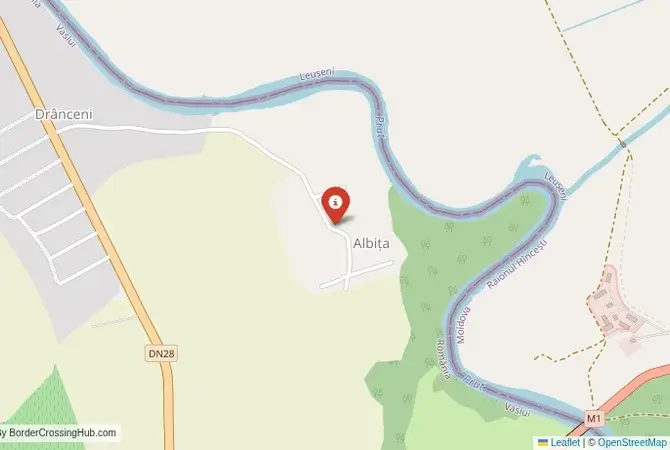
This major checkpoint connects Moldova's Hîncești District with Romania's Vaslui County. Its round-the-clock operation is essential, but its most defining feature for the traveler is the high potential for long queues. The sheer volume of traffic, especially freight, means that wait times can be significant. This is particularly true during peak holiday seasons like summer, Christmas, and Easter, when hundreds of thousands of Moldovans working or studying in the EU travel home. It is not uncommon for wait times for cars to stretch for many hours during these periods. Checking live traffic cameras and official border police websites for current wait times is not just a recommendation; it is an essential part of planning your journey through this crossing. Recent data shows average waits of 5 minutes or less for passenger vehicles in non-peak periods.
A History of Connection
The history of this route is tied to the deep cultural and linguistic bonds between Moldova and Romania. The Prut River, which the border follows, has historically been a unifier as much as a divider of the Romanian-speaking lands of historic Moldavia. After Moldova's independence from the Soviet Union, this crossing at Leușeni-Albița quickly became the most important symbol of the renewed connection between the two states. It has been progressively modernized and expanded over the years to cope with the ever-increasing flow of traffic, a physical manifestation of Moldova's westward orientation and its close relationship with Romania.
Nearby Border Crossings

Border Crossing Procedure
The border crossing procedure is a large-scale, methodical operation designed for high volume. As Moldova is not an EU member, you will undergo full customs and immigration checks as you enter the European Union. The process involves two large, separate checkpoint complexes on either side of the Prut River bridge. You will first complete exit formalities with the Moldovan border police and customs at Leușeni. This complex is large and can be confusing, so following the signs for cars (autoturisme) is crucial. After crossing the bridge, you will arrive at the even larger Romanian checkpoint at Albița for a full EU entry inspection by the Poliția de Frontieră. You will need a valid passport, vehicle registration, and international insurance (Green Card). Customs officials are very active here due to the high volume of commercial and personal goods being transported. Be prepared for questions about what you are carrying. The process can be slow and meticulous, so patience is a key requirement.
The Surrounding Region
The surrounding region is characterized by the rolling hills of the Moldavian Plateau. There are few major tourist attractions at the immediate border, as this is primarily a transit point. The nearest town of any size on the Moldovan side is Hîncești, which is home to the Manuc Bey Mansion, a beautifully restored 19th-century architectural complex with a museum, hunting lodge, and other historic buildings. On the Romanian side, the nearest major city is Huși, a historic center for viticulture, known for its high-quality white wines. Further on, the city of Iași, the former capital of the Principality of Moldavia, is a major cultural and academic hub with a stunning Palace of Culture, numerous monasteries, and a vibrant atmosphere.
Essential Practical Planning
Practical planning is absolutely critical for this crossing. You must purchase the Romanian `rovinietă` vignette and the Moldovan road use vignette. Both can be acquired online, which is the most convenient method. The official currencies are the Moldovan Leu (MDL) and the Romanian Leu (RON). You will find 24/7 petrol stations and currency exchange offices on both sides of the border, but it is wise to have some local currency and a full tank of fuel before entering the potentially long queue. Having water and snacks in the car is also a very good idea, especially if traveling with children. Given the potential for long waits, ensuring your travel plans have a significant buffer for the border crossing time is essential. Avoid crossing on the eve of major holidays if at all possible.
Final Considerations
The Leușeni–Albița crossing is the functional heart of the Moldova-Romania border. It is a necessary and unavoidable route for most travelers moving between the two capitals. While it can be a source of significant delays and frustration, its importance to the economies and people of both nations is undeniable. It is a border that operates under constant pressure, a place where patience is paramount. For the traveler, it is a rite of passage, a direct and powerful immersion into the realities of a major international EU border. Plan carefully, be prepared for waits, and you will successfully pass through this vital gateway, with quick passages in non-peak recent reports.
View all border crossings between Moldova and RomaniaPractical information
Fuel
Moldova: 500 m - Romania: 500 m
Currency
Near Leușeni (MDL, RON)
Safety information
Busy, low crime
Connectivity
Wi-Fi available, 4G/5G
Have you crossed here?
Help other travelers by sharing your experience, wait times, and any updates.