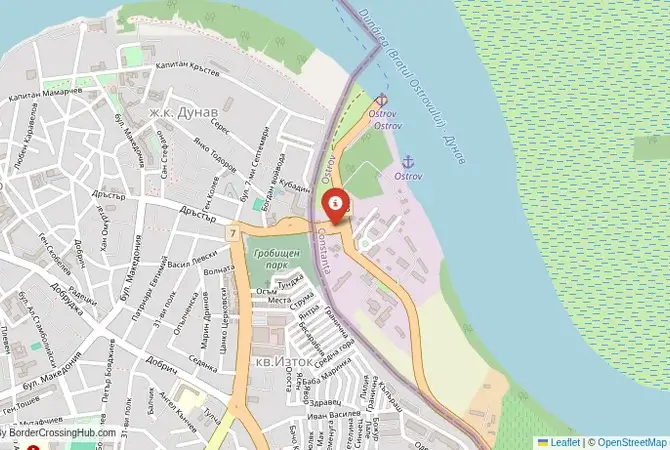
Monthly Update (September 2026):
Ostrov & Silistra remains affected by the suspension of the Călărași–Ostrov ferry. Romania's Border Police announced on August 13 that the ferry was temporarily stopped because low Danube levels made operation unsafe, with service to resume only when conditions permit. Bulgarian authorities are still listing normal traffic at the other Bulgaria-Romania crossings, so travelers should use a bridge crossing rather than arrive at Ostrov expecting the ferry to be running.
About this crossing
Operational Details
This checkpoint connects the Silistra Province of Bulgaria with Romania's Constanța County. It is a major regional crossing, open 24/7 to all passenger cars, buses, and commercial freight. The facility is located on the southern bank of the Danube, which forms the border for most of its length, but here the border cuts south across the land of Dobruja. The crossing is a vital link for the economies of the two regions, but travelers should be aware that to continue to Bucharest or most of Romania, a Danube ferry crossing from Călărași is necessary, which adds time and cost to the journey; post-Schengen land accession Jan 1, 2025, no systematic controls at the land checkpoint, only toll/random checks where applicable, with ferry-dependent additional waits per regional schedules.
A History of a Contested Land
The history of this region is the history of Dobruja, a land that has been a crossroads of civilizations for millennia. The city of Silistra is one of the oldest in Bulgaria, the site of the important Roman city of Durostorum, a major fortress on the Danubian Limes. The region has been part of the Roman, Byzantine, Bulgarian, and Ottoman Empires. In the modern era, the region of Southern Dobruja, including Silistra, was a major point of contention between Bulgaria and Romania, being awarded to Romania after the Second Balkan War, and returned to Bulgaria in 1940. This complex history has left a rich multicultural legacy in the region.
Nearby Border Crossings


The Simplified EU Border Procedure
Today, the border procedure is simplified due to both countries being in the EU and full Schengen land area since Jan 2025. You will stop for a check of your documents (passport or national ID card for EU citizens) by both Bulgarian and Romanian border police, who work in close proximity. Customs checks are focused on commercial freight. The process is generally quick and efficient, with the main delay being the subsequent ferry journey for those heading further into Romania; no systematic immigration/customs inspections for private travelers apply, with random checks possible.
The Surrounding Region: Bulgaria Side
On the Bulgarian side, the crossing is in the historic city of Silistra. The city has a magnificent riverside park, the ruins of the Roman fortress of Durostorum, and a well-preserved Ottoman fort. The main attraction is the late Roman Tomb of Silistra, a UNESCO World Heritage tentative site, with beautifully preserved 4th-century frescoes. The Srebarna Nature Reserve, a UNESCO World Heritage site and a vast wetland that is a paradise for birdlife, particularly the Dalmatian pelican, is also a short drive from the city.
The Surrounding Region: Romania Side
On the Romanian side, the crossing is in the village of Ostrov, which is known for its wine production. The area is part of the historic "Dobrogea" region of Romania. The road from the border leads to the major Danube port city of Călărași, where the ferry departs. The ultimate destination for most travelers on this route is the major port of Constanța on the Black Sea, with its ancient history as the Roman city of Tomis, its beautiful old town, and its bustling modern port, or the popular beach resorts of the Romanian Riviera.
Practical Travel Information
Practical planning for this route requires factoring in the Danube ferry. The ferry from Călărași to Silistra is a separate service with its own schedule and fees. The official currencies are the Bulgarian Lev (BGN) in Bulgaria and the Romanian Leu (RON) in Romania. You will need to purchase electronic vignettes for your vehicle for both countries if you plan to use the main road networks. These can be bought online in advance. Ensure your vehicle's Green Card insurance is valid for both countries; monitor politiadefrontiera.ro or regional port updates for current ferry status and waits.
Final Considerations
The Silistra–Ostrov border crossing is a journey through a land of deep and ancient history. It is a busy, functional checkpoint that serves as a gateway to the rich Roman and medieval heritage of Silistra and the Black Sea coast of Romania. The two-part nature of the journey, with the land crossing followed by the river crossing, makes it a unique and memorable experience. For the modern traveler, it is a fascinating passage through the historic and beautiful Dobruja region, a land shaped by empires and the enduring presence of the Danube River
View all border crossings between Bulgaria and RomaniaPractical information
Fuel
Bulgaria: 500 m - Romania: 500 m
Currency
Local exchange; BGN, RON, EUR
Safety information
Low congestion
Connectivity
Basic mobile
Have you crossed here?
Help other travelers by sharing your experience, wait times, and any updates.