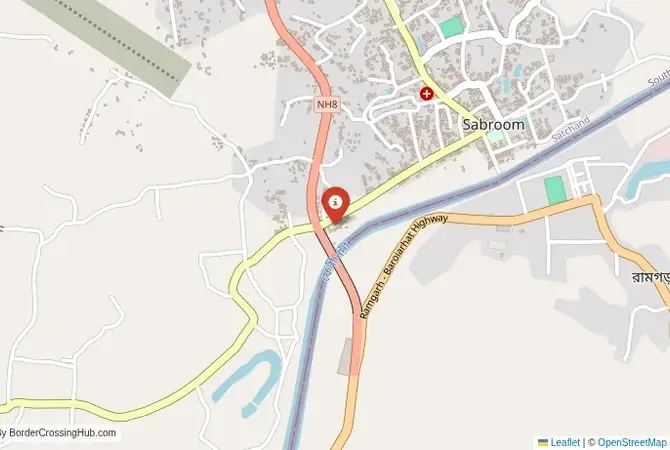
Monthly Update (September 2026):
Ramgarh & Sabroom remains an important emerging gateway between Bangladesh and India's northeastern region, linked by the Maitri Setu bridge over the Feni River. The crossing infrastructure is operational as a controlled border facility, but access to the bridge itself remains restricted rather than being an open tourist attraction. There is no significant September closure to report, while the route's longer-term importance is increasing as India-Bangladesh connectivity around Tripura develops.
About this crossing
The Maitri Setu: A Bridge to the Sea
The Ramgarh-Sabroom crossing is not just another border; it is a project of profound geopolitical and economic significance. The centerpiece is the Maitri Setu, a 1.9-kilometer-long bridge over the Feni River. Its purpose is to provide the landlocked states of Northeast India, particularly Tripura, with their most direct and efficient access to an international seaport. The Chittagong port in Bangladesh is only about 80 kilometers from the border at Ramgarh. This new link is poised to transform the economy of Tripura, turning it from a remote, isolated state into a major logistical gateway for the entire northeastern region of India. The atmosphere at this crossing is not one of ancient history, but of modern construction and future ambition. It is a clean, new, and large-scale project, a symbol of the "neighborhood first" policy of India and the growing strategic partnership with Bangladesh.
A History of Overcoming Isolation
The history behind the creation of this crossing is the history of Tripura's economic isolation. After the 1947 Partition of India, the state was surrounded on three sides by East Pakistan (now Bangladesh), cutting off its easy access to the sea and the rest of India. All goods had to be transported over a single, long, and difficult road through the hills and the narrow Siliguri corridor. This has been a massive bottleneck, driving up costs and hindering development for decades. The idea of using Bangladesh's Chittagong port was discussed for years, but it required a high degree of political trust and cooperation. The signing of the agreement to build the Maitri Setu and allow India access to the port was a landmark achievement in bilateral relations. It is a project that seeks to turn the geographical disadvantage of Tripura into an advantage, positioning it as a key hub in a new cross-border economic zone. The bridge is a physical manifestation of a new era of trust and shared economic vision.
Nearby Border Crossings



The Future Border Crossing Procedure
The Ramgarh-Sabroom crossing is now fully operational for passenger traffic and is one of the most modern and efficient in the region. The process is centered around the new Integrated Check Posts (ICPs) on both sides. The Process: Integrated Facilities: Travelers arrive at a large, modern ICP building that houses all necessary government departments immigration, customs, and security under one roof. This eliminates the need to go to multiple, separate offices. Immigration: Travelers proceed to an immigration counter where passports and visas are checked and stamped by an officer using a modern, computerized system. Customs: Travelers then move to the customs area, where luggage is scanned by X-ray machines, a much faster and more efficient process than the manual searches at older border posts. Crossing the Maitri Setu: After clearing the exit formalities on one side, travelers proceed by vehicle across the impressive Maitri Setu bridge to the ICP on the other side to complete the entry formalities in a similar, streamlined fashion. The entire experience is designed to be smooth, fast, and hassle-free, reflecting the importance of this new trade corridor, with no major reported delays or seasonal closures as of 2026.
Route, Regional Impact, and Onward Travel
The crossing is located at the southernmost tip of the Indian state of Tripura. On the Indian side, the town of Sabroom is being developed with a new Special Economic Zone (SEZ) and improved road and rail links to the state capital, Agartala. On the Bangladeshi side, the road from Ramgarh connects to the main highway leading to the port city of Chittagong. The opening of this route has been transformative. It not only benefits trade but has also created a new tourist circuit, allowing travelers to easily combine a visit to Tripura with a visit to the Chittagong Hill Tracts and the coastal areas of Bangladesh. It has created a new, direct axis of travel between Northeast India and Southeast Bangladesh, opening up new possibilities for regional tourism and cultural exchange.
Final Contextual Note: A Future Gateway
The Ramgarh-Sabroom crossing, with its magnificent Maitri Setu, is a symbol of a new, more connected future for the eastern subcontinent. It is a border that has been purposefully designed to overcome the divisions of the past and foster economic prosperity. Now a practical option for travelers, it marks a new chapter in India-Bangladesh relations and has fundamentally redrawn the transport map of the region. The Friendship Bridge stands ready, delivering on the promise of seamless journeys.
View all border crossings between Bangladesh and IndiaPractical information
Fuel
Bangladesh: <1 km - India: <1 km
Currency
Exchange near Ramgarh (BDT, INR)
Safety information
Safe, traffic moderate
Connectivity
Limited Wi-Fi, 4G
Have you crossed here?
Help other travelers by sharing your experience, wait times, and any updates.