Monthly Update (September 2026):
Lubok Antu & Nanga Badau remains a quieter Malaysia-Indonesia land crossing in Sarawak and West Kalimantan. There is no significant September closure or new passenger restriction to report. The broader Indonesia-Malaysia push to improve border trade could eventually benefit smaller crossings such as Badau, but the September 3 agreement specifically singled out Entikong-Tebedu rather than this route.
About this crossing
A History of Headhunters and a Divided People
The history of this border is the history of the Iban people. Famed for their past practice of headhunting and their communal longhouse way of life, the Iban migrated into this region over centuries. The Anglo-Dutch treaty of 1824, which first demarcated the border in Borneo, was a line drawn by colonial powers that had little relevance to the Iban, who continued to move freely through the jungle. The border region was a major flashpoint during the Indonesia-Malaysia Confrontation in the 1960s, with a number of cross-border raids and skirmishes taking place in the area. After the conflict, the border remained a remote and largely unpoliced frontier for many years. The recent construction of a new, modern Indonesian border post (PLBN) at Nanga Badau and the upgrading of the road is part of a major Indonesian government initiative to develop its remote border regions and to assert national sovereignty. It is an attempt to turn a porous, jungle frontier into a formal, modern gateway.
The Border Crossing Procedure: A Quiet and Formal Process
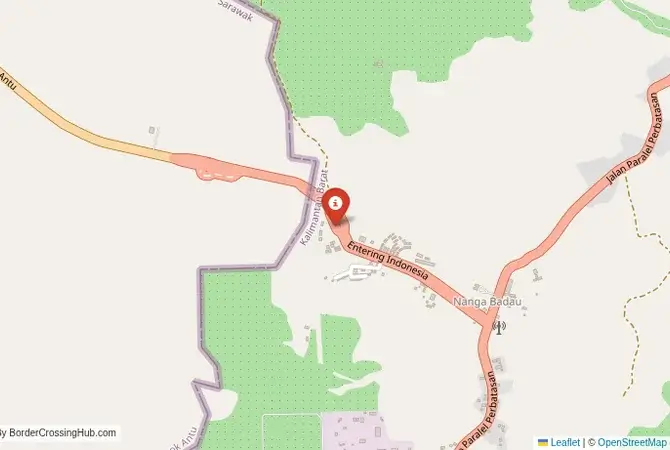
This is a very quiet border with very little traffic. The border is open during daylight hours. The new facilities make the process formal, but the lack of queues makes it quick. You must have a valid visa for the country you are entering if your nationality requires one. Since October 2025, international arrivals to Indonesia require completing the mandatory "All Indonesia" digital form (integrated immigration, customs, and health declaration) in advance via the official portal. Exiting Malaysia (Lubok Antu): The Malaysian immigration and customs post is a simple, functional facility in the small town of Lubok Antu. You will present your passport to the immigration officer and receive your exit stamp. The customs check is usually a very brief formality. The officials are professional but may be surprised to see foreign travelers. The No-Man's-Land: After clearing the Malaysian post, you will drive on a road that can be rough in places through the hilly, jungle-covered no-man's-land to the Indonesian side. Entering Indonesia (Nanga Badau): You will arrive at the brand new and very impressive Indonesian PLBN at Nanga Badau. The massive, modern building, decorated with traditional motifs, stands in stark contrast to the surrounding wilderness. You will go to the immigration hall. You must check the visa requirements for your nationality for this specific land border. The officer will check your passport and provide an entry stamp. After immigration, your luggage will be passed through an X-ray scanner for a customs check. The officials are proud of their new facility and are generally professional and welcoming.
Nearby Border Crossings



Route, Onward Travel, and Major Caveats
This crossing is for the dedicated overland traveler with their own robust vehicle, preferably a 4x4. There is no regular public transport across this border. On the Malaysian side, the road to Lubok Antu from the main Pan-Borneo Highway is paved but can be narrow and winding. The town of Sri Aman is the nearest major center. On the Indonesian side, the road from Nanga Badau leads south towards the Kapuas River basin. The road quality can be very poor and unpredictable, often turning into a muddy track in the rainy season. It is a long and arduous journey to the nearest major Indonesian towns. The main reason for a traveler to be in this region is to visit the Iban longhouses and to experience the incredible biodiversity of the Batang Ai National Park on the Malaysian side and the Betung Kerihun National Park on the Indonesian side. This crossing is the gateway to a deep, cross-border eco-tourism experience, but it requires extensive planning with local guides and operators.
Final Planning Advice for a Deep Borneo Adventure
The Lubok Antu-Nanga Badau crossing is an entry point to one of the wildest and most culturally authentic parts of Borneo. It is not a transit route but a destination for a specific type of adventure travel. The key to using this crossing is to have your own suitable vehicle and to be completely self-sufficient. You must check the visa requirements in advance and complete any mandatory digital arrival forms for Indonesia. The new Indonesian border post is a sign of the future, but the infrastructure in the surrounding region, especially the roads on the Indonesian side, is still very basic. This is a journey for the serious adventurer who is willing to trade comfort and convenience for a truly authentic experience in the Iban heartland. It is a passage through a landscape that is still wild, a border that is only just beginning to be tamed.
View all border crossings between Malaysia and IndonesiaPractical information
Fuel
Indonesia: <1 km - Malaysia: <1 km
Currency
Limited exchange (IDR, MYR)
Safety information
Safe, remote area
Connectivity
Limited Wi-Fi, 4G
Have you crossed here?
Help other travelers by sharing your experience, wait times, and any updates.