Monthly Update (October 2026):
Kasane & Ngoma remains a useful northern Namibia-Botswana gateway in October, with no significant closure reported. The crossing's daytime operating window remains the main practical constraint, while the surrounding Chobe and Victoria Falls tourism circuit keeps passenger traffic relevant during the dry-season travel period. Travelers should plan to reach Kasane & Ngoma comfortably before the evening cutoff.
About this crossing
A History on a Wilderness Frontier
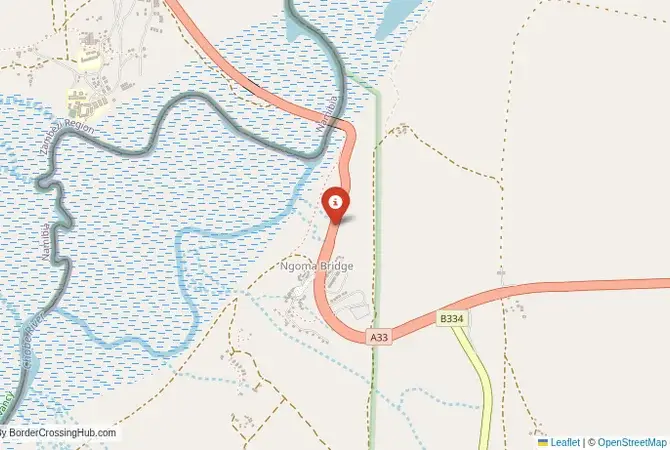
The history of this border is the history of the Caprivi Strip and the Chobe wilderness. The border is a colonial legacy, a line drawn by the British and Germans that cuts through the traditional lands of the Subiya people. For most of its history, this was a remote and undeveloped frontier, with no formal crossing. The only way to cross the Chobe River was by a small, unreliable pontoon ferry. The region was also a sensitive military zone during the Namibian War of Independence. The construction of the modern Ngoma Bridge was a major development, a project designed to boost tourism and to improve the connection between the two countries in this remote but vital corner of the Kavango-Zambezi Transfrontier Conservation Area (KAZA). The bridge has made it much easier for tourists to combine a visit to the Namibian side of the Chobe Riverfront (which is part of the Bwabwata National Park) with a safari in the more famous Chobe National Park in Botswana. It is a border that was built for tourism and conservation.
The Border Crossing Procedure: A Relaxed Bush Post
This is a very quiet border, and the process is informal and personal. The border is open only during daylight hours, from 07:00 to 18:00, and it is essential to check the current operating times before you travel. Exiting Namibia (Ngoma Bridge): The Namibian immigration and customs post is a small, simple building located on the western side of the bridge. You will present your passport and get your exit stamp. The process is very relaxed and friendly. The officials are accustomed to tourists and are often a good source of information about local road conditions. The Ngoma Bridge: You will then drive across the bridge over the beautiful Chobe River. This is the no-man's-land. Be sure to drive slowly and keep an eye out for wildlife on the floodplains below. The views are spectacular. Entering Botswana (Ngoma Gate): You will arrive at the Botswanan border post, which is also the official entrance gate to the Chobe National Park. You will go to the immigration office. For most nationalities, Botswana offers visa-free entry. The officer will stamp your passport. After immigration, you will proceed to the customs and road authority offices. If you are in a vehicle, you will need to pay a road tax. You will also need to have third-party insurance for Botswana. A key feature of Botswanan land borders is the veterinary control. You will have to walk through a foot-and-mouth disease control footbath, and your vehicle will have to drive through a disinfectant dip. You will also need to pay the daily park entry fees for the Chobe National Park here.
Nearby Border Crossings


Route, Onward Travel, and The Chobe Riverfront
This crossing is for the self-drive safari enthusiast. On the Namibian side, the road to Ngoma Bridge from the town of Katima Mulilo is a good, paved highway that runs along the edge of the Chobe River. On the Botswanan side, you are immediately inside the Chobe National Park. The main park road, which is a mix of paved and sandy tracks, runs along the Chobe Riverfront to the main town of Kasane. This is one of the most famous game drive routes in Africa, renowned for its massive herds of elephants and buffalo and its incredible density of predators. You must have a suitable vehicle, preferably a 4x4, for driving within the park. The journey from the Ngoma border to Kasane is a slow game drive that can take several hours. For those without a car, this is not a practical crossing. You would need to use the main crossing at Katima Mulilo/Sesheke (into Zambia) and then cross again at Kazungula (into Botswana).
Final Planning Advice for a Safari Crossing
The Ngoma Bridge crossing is a unique and incredible adventure, a border that is an integral part of the safari experience. The key to a successful journey is to have a suitable vehicle and to be prepared for a self-drive safari. You must check the operating hours of the border in advance. Have all your vehicle documents in order. Be prepared for the mandatory veterinary checks and to pay the park entry fees when entering Botswana. This is not a transit route; it is a destination. For the dedicated wildlife lover, it is one of the greatest border crossing experiences in the world, a seamless passage through the heart of a vast, unfenced wilderness that is one of the last great strongholds of African wildlife. It is a border that truly lives up to the ideal of a "peace park."
View all border crossings between Namibia and BotswanaPractical information
Fuel
Namibia: ~65 km - Botswana: ~55 km
Currency
Available near Ngoma (NAD, BWP)
Safety information
Generally safe, traffic moderate
Connectivity
Wi-Fi at checkpoints, 4G
Have you crossed here?
Help other travelers by sharing your experience, wait times, and any updates.