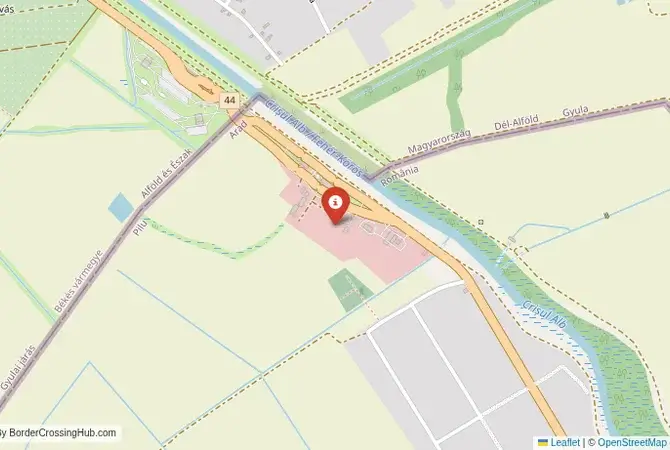
Monthly Update (September 2026):
Gyula & Vărșand Border Crossing remains a useful Hungary-Romania alternative to the busier motorway routes. Current Hungarian government information lists the crossing as open 24 hours and notes its direct connection toward the E671, making it particularly useful for regional and freight traffic. With routine Schengen border checks removed, travelers can generally pass without the former passport-control stop. No significant September disruption has been identified.
About this crossing
Operational Details
This international checkpoint connects Békés County in Hungary with Arad County in Romania and operates 24 hours a day, 7 days a week. It is open to all traffic, including passenger cars and heavy freight, making it one of the major conduits in the southern section of the border. Its reliability and capacity ensure it can handle the steady stream of commercial trucks moving goods alongside the seasonal waves of tourists heading to the spa.
Border Crossing Procedure
The crossing procedure is well-established for a high volume of traffic. Full document checks were previously required here, as Romania had not yet implemented the Schengen agreement for its land borders. Since January 1, 2025, with Romania's full accession to the Schengen Area, systematic border controls have been lifted at land crossings with Hungary. Travelers now cross without stopping for routine passport or ID checks, exit/entry stamps, or queues at booths. Random checks may still occur in the border area. A valid passport or EU ID card, along with vehicle documents, should still be carried. Customs checks are possible, and customs officers are a visible presence due to the freight traffic. The checkpoint has separate lanes for cars and trucks, which is crucial for keeping tourist traffic from getting stuck behind long lines of commercial vehicles. However, due to the mix of tourist and commercial traffic, you may experience some delays, particularly during the summer months and on holiday weekends. With Schengen integration, crossings are now seamless with minimal or no waiting times reported for passenger vehicles.
Nearby Border Crossings


From Spas to Plains
The main draw on the Hungarian side is undoubtedly Gyula. The Gyula Castle is one of the best-preserved medieval lowland brick castles in Central Europe. Its grounds host the Várfürdő, a popular and extensive thermal spa complex with a variety of indoor and outdoor pools, wellness services, and medical treatments. The town itself has a charming, relaxed atmosphere with riverside walks along the Fehér-Körös river, a famous centenary confectionery (the Százéves Cukrászda), and numerous restaurants. It is a town geared towards hospitality.
The Romanian Side
On the Romanian side, the crossing at Vărșand (Gyulavarsánd) leads you into the flat, fertile plains of Arad County. The nearest major city is Arad, a handsome city with impressive neoclassical and eclectic architecture, a sign of its importance during the Austro-Hungarian era. The crossing provides a direct route towards Arad and further south towards the city of Timișoara, another major cultural and economic center. The region is agricultural, and the drive from the border to Arad takes you through numerous small villages and wide-open fields.
Practical Travel Information
Practical information is key for a seamless experience. The crossing is well-signposted and accessible via main roads on both sides. Given its 24/7 international status, you will find amenities like currency exchange bureaus and petrol stations on both sides, though planning ahead is always wise. It is crucial to have the correct vignettes for your journey: the `e-matrica` for Hungary if you plan to use any motorways on your trip, and the `rovinietă` for Romania, which is required on all national roads. Both can be purchased online. The official currencies are the Hungarian Forint (HUF) and the Romanian Leu (RON).
Final Considerations
The Gyula–Vărșand crossing is a busy, functional checkpoint that serves as a primary link for both commerce and tourism. Its proximity to the significant attractions of Gyula makes it a popular choice for leisure travelers from Romania and beyond. While you should be prepared for potential traffic, its round-the-clock operation and robust infrastructure make it a reliable and straightforward passage. It is a border that successfully balances its role as a commercial artery with its function as a gateway to one of Hungary's most beloved spa towns, offering a journey that can be as much about the destination as the transit itself, now enhanced by seamless Schengen travel.
View all border crossings between Hungary and RomaniaPractical information
Fuel
Hungary: <1 km - Romania: <1 km
Currency
Near Gyula (HUF, RON)
Safety information
Rural, low crime
Connectivity
4G/5G coverage
Have you crossed here?
Help other travelers by sharing your experience, wait times, and any updates.