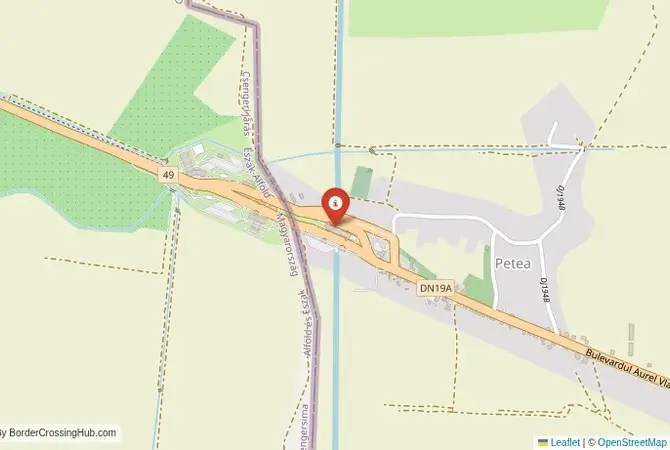
Monthly Update (October 2026):
The Csengersima & Satu Mare Border Crossing is currently seeing moderate traffic rather than the long queues once associated with this route. On October 6, live monitoring put the Hungary-to-Romania wait at around 45 minutes, with the crossing still serving as an important northern gateway toward Satu Mare. Since Romania is fully inside Schengen, routine passport controls are no longer the main source of delay; traffic levels are now the bigger factor.
About this crossing
Operational Details
This is a primary international crossing, operating 24 hours a day and open to all forms of traffic, from pedestrians to heavy freight. It connects the Szabolcs-Szatmár-Bereg County of Hungary with the Satu Mare County of Romania and is the busiest checkpoint in the northern section of the border. Its importance is underscored by its substantial infrastructure. Multiple lanes for both cars and trucks and the constant flow of vehicles at all hours. It is a critical link for trade, particularly for goods moving between northeastern Hungary and northern Romania, and a vital connection for the thousands of people who live in one country and work or shop in the other.
Border Crossing Procedure
The crossing procedure was designed to handle high volumes of traffic, but delays were a frequent occurrence. As Romania was not yet a full participant in the Schengen Area for land borders, systematic document checks were required. The process involved stopping at both Hungarian and Romanian checkpoints, located on their respective sides of the river. First, the Hungarian Police would conduct an exit check. Then, you would proceed across the bridge to the Romanian Border Police for their entry check. Customs officials are also present and may conduct inspections. Given its status as a major crossing, it is well-equipped, but this is a very busy checkpoint. You should be prepared for potential queues, especially during peak travel times like summer weekends and holidays when many Romanians working in Western Europe return home. Checking live traffic information online before you arrive can be beneficial. Since January 1, 2025, with full Schengen membership, systematic controls have been lifted, enabling free passage without routine stops, queues, or significant delays for most travelers.
Nearby Border Crossings



Satu Mare and the Someș Valley
The crossing is located right by the Someș (Szamos) River, which flows through the heart of Satu Mare. The city is a regional economic and cultural hub with a beautiful historic center, featuring landmarks like the artfully decorated Dacia Hotel (formerly the Pannonia), a masterpiece of Secessionist architecture. Other notable sights include the Firemen's Tower, which offers panoramic views, and the city's impressive Roman Catholic Cathedral. The region has a deeply intertwined Hungarian and Romanian history, which is evident in the bilingual signs and the local culture. The city had a large and vibrant Jewish community before World War II, and the Great Synagogue on Decebal Street stands as a beautiful and poignant reminder of this lost heritage.
The Hungarian Side and its Treasures
On the Hungarian side, the village of Csengersima itself is small, but it is home to a remarkable 13th-century church with a unique shingled roof and a beautifully painted interior wooden ceiling. This "barefoot" church, so named because of its simple, unadorned nature, is a stunning example of local medieval architecture and is well worth a visit if you have time. The wider Szabolcs-Szatmár-Bereg region in Hungary is known for its unique medieval churches, many with separate wooden bell towers and exquisitely painted interiors, particularly in the nearby villages of Tákos and Csaroda. A short tour of these churches can provide a deep insight into the history and folk art of the region.
Practical Advice for Travelers
The crossing is easily reached by main roads from both countries, such as Route 49 in Hungary and DN19A in Romania. Because of its high traffic volume, you will find all necessary amenities nearby, including 24/7 petrol stations and currency exchange offices with competitive rates, though better rates can often be found in the city center of Satu Mare. It is essential to have your road vignettes purchased in advance. For Hungary, you need the `e-matrica` if you plan to use motorways, and for Romania, the `rovinietă`, which is required for all national roads. Both can be acquired online. The official currencies are the Hungarian Forint (HUF) and the Romanian Leu (RON).
Final Considerations
The Csengersima–Satu Mare crossing is the main gateway to northern Romania. It is busy, efficient, and equipped to handle the large volume of traffic that passes through it daily. While you might face delays previously, its 24/7 operation and direct access to the city of Satu Mare make it the most practical and popular choice for travel in this part of the borderlands. It is a crossing that feels connected to the pulse of a major city, a dynamic entry point into the rich cultural landscape of northern Romania and the starting point for journeys into the traditional heartlands of Maramureș and Bucovina, now with seamless Schengen flow.
View all border crossings between Hungary and RomaniaPractical information
Fuel
Hungary: <1 km - Romania: <1 km
Currency
Near Csengersima (HUF, RON)
Safety information
Rural, low crime
Connectivity
4G/5G coverage
Have you crossed here?
Help other travelers by sharing your experience, wait times, and any updates.