Monthly Update (September 2026):
Bichigt & Zuun Khatavch remains a remote China-Mongolia crossing used mainly for freight, with only limited tourist traffic. Mongolia's current travel guidance confirms Bichigt as one of the China border points normally available to foreign travelers, unlike several smaller frontier gates restricted to Mongolian or Chinese citizens. No significant September closure has been reported, although the crossing's remote location and limited tourist infrastructure make advance planning particularly important.
About this crossing
The Bichigt-Zuun Khatavch Crossing: A Gateway to the Eastern Steppe
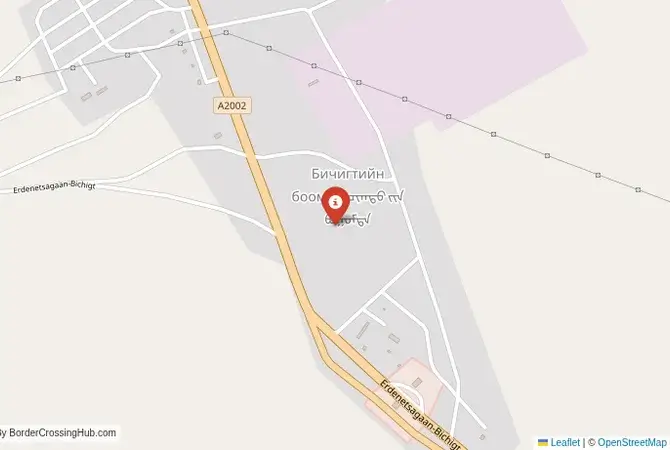
This border crossing is located in the heart of the great eastern steppe of Mongolia, one of the largest intact grassland ecosystems in the world. This is the fabled landscape of Genghis Khan, a vast, empty, and beautiful expanse of rolling grasslands that seems to stretch to infinity. The crossing is a quiet, functional outpost, a world away from the busy Trans-Mongolian corridor at Zamiin-Uud. Its purpose is purely economic, a conduit for the resources of the eastern aimags (provinces) to reach the markets of China's Inner Mongolia Autonomous Region. The atmosphere is one of profound isolation and industrial purpose, a place where the timeless landscape of the steppe meets the modern demands of the resource economy. The only significant traffic consists of heavy trucks laden with coal, a stark, modern intrusion into an ancient landscape. For the traveler, it is a point on the map that speaks to the vastness of Mongolia and the powerful economic pull of its southern neighbor.
A History of a Quiet Frontier
For most of history, this was an open and undefined frontier, the domain of nomadic herders who moved with their livestock across the vast grasslands, following the seasons without regard for modern political lines. The modern border was demarcated during the Soviet era but remained a quiet and largely undeveloped line, a soft frontier between two socialist allies. The development of the Bichigt-Zuun Khatavch crossing into a formal land port is a recent phenomenon, driven by the discovery of coal and other mineral deposits in Sukhbaatar province in the 21st century. Like the crossings in the west, this gateway was developed to facilitate the export of these resources to China. It does not follow an ancient trade route or connect major historical centers. It is a pragmatic creation, a logistical solution to the challenge of getting resources from the remote Mongolian interior to the nearest major market. Its history is short, functional, and directly tied to the commodity prices that drive the global economy. It is a border created by geologists and economists, not by soldiers or explorers.
Nearby Border Crossings



Border Procedures: Not Applicable for Most Tourists
As this is primarily a commercial port, procedures are geared toward freight and locals, with limited tourist processing. The crossing operates Monday to Friday from 8:00 AM to 5:00 PM, with a lunch break from 12:00 to 2:00 PM (year-round). You must have a valid visa for the country you are entering, obtained in advance. For a foreign traveler, entry is possible but not common due to remoteness and focus on trade; no visa on arrival or extensive facilities for tourists. The facilities handle passports for permitted crossings but prioritize commercial traffic. Any attempt without proper preparation would likely result in denial. The remote location means reaching this border requires travel on difficult and poorly maintained roads far from tourist infrastructure. It is not a practical or routine option for most international travelers. The security on both sides, while less focused on tourism, is still very much present.
The Regional Context: The Great Eastern Steppe
The crossing connects the Sukhbaatar province of Mongolia with the Xilingol League of Inner Mongolia in China. This is one of the most sparsely populated regions on earth. The landscape is a vast, treeless grassland, home to huge herds of Mongolian gazelles and the nomadic herders who have lived here for centuries. The main town on the Mongolian side is Baruun-Urt, the provincial capital, itself a remote and dusty outpost. On the Chinese side, the region is also a vast grassland, but it is being rapidly transformed by mining and industrial development. The journey to this border from either Ulaanbaatar or from a major Chinese city is a long and arduous one, through a very remote and undeveloped landscape. The main reason for any traffic on this route is the mining industry. It is a border that serves the needs of industry, not the needs of travelers. The beauty of the eastern steppe is immense, but it is a region that is best explored from within Mongolia, without the intention of crossing this remote frontier. The sense of isolation is both the region's greatest attraction and its greatest challenge.
Final Contextual Note: A Border for Industry, Not Individuals
The Bichigt-Zuun Khatavch crossing is a functional, modern border that serves a specific economic purpose. It is a vital link for the mining industry of eastern Mongolia. However, for the international overland traveler, it remains limited and off the main routes. It is not a hidden gem or an undiscovered shortcut; prioritize primary gateways like Zamiin-Uud-Erenhot for tourist crossings. The Bichigt crossing remains a fascinating example of how modern resource demands are creating new infrastructure in some of the most remote corners of the planet, but it is a border that is geared toward commerce rather than individual exploration. It is a place where the logic of global commerce has imprinted itself upon a wild and ancient land.
View all border crossings between China and MongoliaPractical information
Currency
Limited exchange (CNY, MNT)
Safety information
Safe, remote area
Connectivity
Limited Wi-Fi, 3G
Have you crossed here?
Help other travelers by sharing your experience, wait times, and any updates.