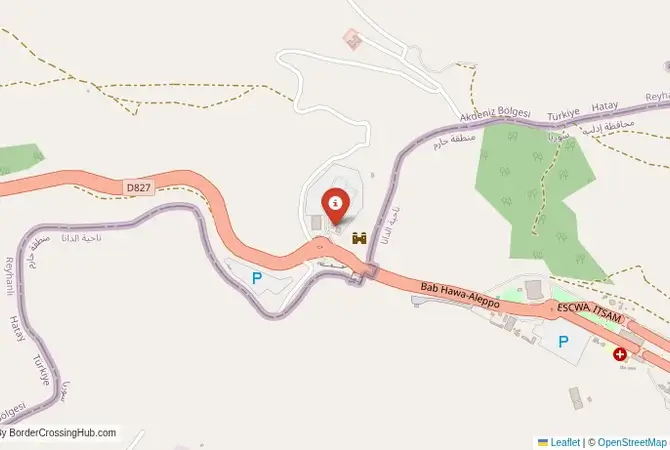
Monthly Update (September 2026):
Bab al-Hawa & Reyhanlı remains a functioning Turkey-Syria gateway, with the crossing continuing to handle passenger and humanitarian movement. The Bab al-Hawa administration reported current crossing-related decisions on September 3, including procedures affecting Syrians resident in Türkiye, showing that movement rules remain actively managed rather than static. Travelers should check the specific eligibility and permit requirements for their nationality before heading to the border, particularly if entering or leaving Syria rather than simply transiting Türkiye.
About this crossing
Operational Details
This checkpoint connects the Idlib Governorate of Syria with the Hatay Province of Turkey. Its operation is unique and governed by United Nations Security Council resolutions. For years, it was the only UN-authorized crossing for delivering cross-border humanitarian aid into opposition-held Syria. Its status is the subject of constant, high-stakes geopolitical negotiations, particularly with Russia, which has often threatened to veto the resolutions that keep it open. The crossing is controlled on the Syrian side by Hay'at Tahrir al-Sham (HTS), a Salafi-jihadist group, and on the Turkish side by the Turkish military and customs authorities. It is a place where international law and armed conflict meet in a tense, daily reality.
A History of a Conflict Frontier
The history of this crossing is the history of the Syrian Civil War. The border in this region, the Hatay Province, has been historically contested between Turkey and Syria. After the uprising against the Syrian government began in 2011, the Bab al-Hawa crossing was captured by rebel forces in 2012. It quickly became the main gateway for the opposition, a conduit for fighters, supplies, and, most importantly, a lifeline for the civilian population as the conflict intensified. It has been the scene of numerous battles, bombings, and political crises. Its continued operation has been essential to preventing an even greater humanitarian catastrophe in Idlib, a region that has become a final refuge for millions of displaced Syrians.
Nearby Border Crossings

The Border Crossing Procedure
There is no normal border crossing procedure for the public. The crossing is restricted to UN-authorized humanitarian aid convoys, accredited journalists, and aid workers with special permission. The process is extremely rigorous and dangerous. On the Turkish side, all aid trucks are meticulously inspected by Turkish customs and UN monitors to ensure that only humanitarian goods are entering. On the Syrian side, the convoys are received by the local authorities. The area is frequently targeted by airstrikes and shelling, making the crossing itself an extremely dangerous place to be. It is a logistical operation conducted in a war zone, a place of immense risk for the humanitarians who work there.
The Surrounding Region: Syria Side
On the Syrian side, the crossing is the gateway to the Idlib Governorate, the last major stronghold of the opposition to the Syrian government. The region is home to over three million people, the majority of whom are internally displaced persons who have fled from other parts of Syria. The area is under constant threat of a major military offensive and suffers from a severe humanitarian crisis, with high levels of poverty, food insecurity, and a collapsed healthcare system. The historic "Ancient Villages of Northern Syria," a UNESCO World Heritage site, are located in this region but have been heavily damaged by the war, a casualty of the cultural destruction that has accompanied the human tragedy.
The Surrounding Region: Turkey Side
On the Turkish side, the crossing is in the Hatay Province. The nearby town of Reyhanlı has been profoundly affected by the war, hosting a huge population of Syrian refugees and serving as the main logistics hub for the cross-border aid operation. The city has also been the target of terrorist attacks linked to the conflict. The provincial capital, Antakya (the ancient Antioch), is a city of immense historical and religious importance, but it was devastatingly destroyed by the massive earthquake that struck the region in February 2023, adding another layer of tragedy to this already suffering land. The recovery from this natural disaster has further complicated the massive humanitarian effort based in the region.
Practical Travel Information
Travel on this route is impossible for independent travelers. The entire region is an active conflict zone. The official currencies are the Syrian Pound (SYP) in Syria (though the Turkish Lira is widely used in the opposition-held areas) and the Turkish Lira (TRY) in Turkey. Any travel would have to be part of an accredited international aid organization and would involve extreme security precautions, including armored vehicles and security details. The risks of kidnapping, shelling, and airstrikes are constant.
Final Considerations
The Bab al-Hawa border crossing is a journey into the heart of the Syrian tragedy. It is a place where the best and worst of humanity are on display every day: the immense suffering of a displaced population and the heroic efforts of the aid workers who risk their lives to help them. It is a border that is not a gateway for tourists, but a lifeline for millions. Its continued existence is a matter of life and death, a fragile symbol of the world's commitment to humanitarian principles in the face of a brutal and unrelenting war. It is a place where the abstract language of UN resolutions becomes the concrete reality of food and medicine for a desperate people.
View all border crossings between Syria and TurkeyPractical information
Fuel
Syria: <1 km - Turkey: <1 km
Currency
Near crossing; SYP, TRY
Safety information
Sensitive zone; strict checks
Connectivity
Wi-Fi, 4G/5G
Have you crossed here?
Help other travelers by sharing your experience, wait times, and any updates.