Monthly Update (September 2026):
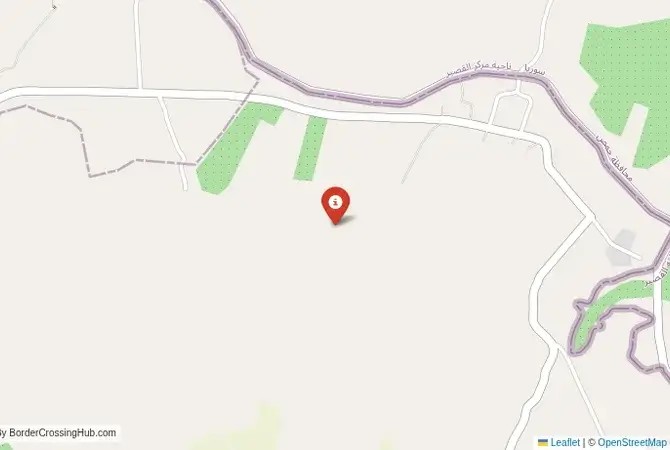
Homs & Matraba remains a highly restricted Syria-Lebanon crossing rather than a normal international route for independent travelers. There is no significant September reopening or new passenger access identified. Travelers should use the established passenger crossings such as Masnaa or Qaa instead of assuming that smaller local border posts are available for ordinary international travel.
About this crossing
A History of Local Ties and Strategic Overflows
The area around Matraba has always been defined by its remoteness from the central governments in both Beirut and Damascus. Life for the local tribes and clans often involved ignoring the formal border, with families and allegiances spanning both sides. The region's geography, characterized by arid mountains and hidden valleys, made it a natural corridor for smuggling long before the war. When the Syrian conflict erupted, this dynamic intensified. The crossing and the surrounding unofficial routes became channels for fighters, weapons, and goods, making the entire Hermel-Homs frontier a zone of significant security concern for the Lebanese state. The Lebanese Army maintains a heavy presence in the area to assert state authority and curb the spillover of violence. The crossing itself represents a formal point of control in an otherwise largely uncontrolled landscape.
Crossing Procedures: A Formality in a High-Security Zone
The operational status of the Matraba crossing is often uncertain and subject to the prevailing security situation, with reports indicating it remains closed or damaged from prior conflict as of early 2025, though rehabilitation efforts have been noted at some northern crossings; it is not intended for use by foreigners. For the local Lebanese or Syrian nationals who might be authorized to use it, the process would be heavily scrutinized by security and intelligence agencies on both sides. A pre-obtained Syrian visa would be an absolute requirement, along with legitimate and verifiable reasons for travel, though recent transitional changes have simplified some entry processes without full visa issuance in certain contexts; confirm current status. The procedure would involve multiple, thorough checks of personal identification, vehicle documents, and goods. Given the nature of the region, anyone crossing here would be subject to intense questioning regarding their affiliations and the purpose of their journey. The formalities exist, but they are secondary to the intense security imperatives that govern movement in this area.
Nearby Border Crossings
The Regional Environment: Hermel and Rural Homs
On the Lebanese side, the crossing is situated in the Hermel District, the northernmost and one of the most impoverished parts of the Beqaa Valley. The region is known for its stark natural beauty, including the source of the Orontes River, but also for its history of lawlessness and the strong influence of Hezbollah. The Lebanese Army has established numerous checkpoints and bases throughout the district to maintain stability. The journey to Matraba from within Lebanon is through isolated territory on roads that may not be well-maintained. On the Syrian side, the crossing leads into the rural western part of the Homs Governorate. This area has seen significant conflict and remains a high-security zone under the control of the Syrian government and its allies. Infrastructure is likely to be damaged, and the presence of various militias and military units is a given. The entire frontier is considered a military operational area.
Final Contextual Note
The Matraba border crossing is fundamentally a product of its environment. It is a minor checkpoint in a rugged, strategic, and volatile borderland. It is not part of the network of crossings used for regular civilian or commercial travel. Its existence and operation are dictated entirely by the security concerns of the Lebanese and Syrian states as they attempt to manage a difficult and historically porous frontier. It serves as a clear example of how a border's function can be completely reshaped by regional conflict, turning from a local passage into a sensitive security chokepoint. It is a location that should only be studied from a distance, as any approach would be fraught with extreme and unjustifiable risk.
View all border crossings between Lebanon and SyriaPractical information
Fuel
Lebanon: <1 km - Syria: <1 km
Currency
Near Matraba; LBP, SYP
Safety information
High risk; active conflict zone and security threats
Connectivity
Limited Wi-Fi, 3G
Have you crossed here?
Help other travelers by sharing your experience, wait times, and any updates.