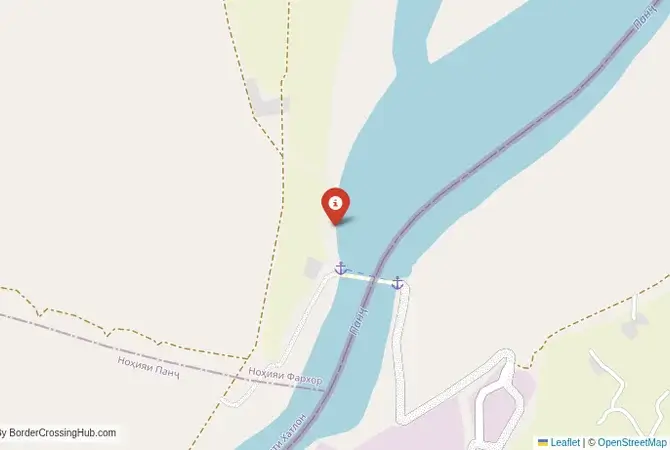
Monthly Update (November 2026):
There has been no reopening of the Ai Khanoum–Kokul crossing for ordinary travelers this November. The river border in this part of northeastern Afghanistan remains highly restricted, with no confirmed international passenger service or new crossing arrangement. Security concerns along the wider Tajikistan–Afghanistan frontier have continued following incidents earlier in the year, but no specific November development has changed access at Kokul. The route remains unavailable as a practical tourist crossing.
Driving there, or sending a driver? Send them this guide.
For reports and websites
Cite this page
Border Crossing Hub (2026). Ai Khanoum & Kokul Border Crossing. Updated November 2026. https://bordercrossinghub.com/ai-khanoum-kokul-border-crossing/<a href="https://bordercrossinghub.com/ai-khanoum-kokul-border-crossing/">Ai Khanoum & Kokul Border Crossing (Border Crossing Hub)</a>Put this crossing's card on your website
Free. It updates on its own when our information changes.
<iframe data-bch-card src="https://bordercrossinghub.com/ai-khanoum-kokul-border-crossing/?bch_view=card" width="100%" height="980" scrolling="no" style="border:0;max-width:480px;display:block" loading="lazy" title="Ai Khanoum & Kokul border crossing information"></iframe>
<p style="font-size:12px;margin:4px 0 0">Crossing information: <a href="https://bordercrossinghub.com/ai-khanoum-kokul-border-crossing/">Border Crossing Hub</a></p>
<script src="https://bordercrossinghub.com/?bch_embed_js=1" async></script>Paste it where you want the card. The last line (a script) only adjusts the height and can be left out.
About this crossing
The Ai Khanoum Crossing: A Ghostly Ferry on a Lost Frontier
The border crossing point near the archaeological site of Ai Khanoum in Afghanistan, which connects to the Kokul area in the Farkhor district of Tajikistan, is not a formal international gateway. It is, at best, an informal, local ferry or barge crossing over the Amu Darya (Panj River). This is not a place with customs buildings, immigration officers, or paved roads. It is a simple river transit point used by local villagers, and its operation is entirely dependent on the local security situation, which is perilous. The immense significance of this location comes not from the crossing itself, but from what lies nearby on the Afghan side: the ruins of Ai Khanoum, a complete Greek city from the 3rd century BCE, a legacy of Alexander the Great's conquest of Central Asia. The crossing is a humble, dangerous ferry route operating in the shadow of a lost wonder of the ancient world.
A History of a Lost Greek City and a Modern War
The discovery of Ai Khanoum in the 1960s was one of the most spectacular archaeological finds of the 20th century. French and Afghan archaeologists unearthed a complete Hellenistic city, with temples, a gymnasium, a theater, and administrative buildings, all built in a classical Greek style. It was a stunning testament to the deep influence of Greek culture in Central Asia after Alexander's campaigns. The city was a thriving metropolis for two centuries before it was overrun and destroyed. The archaeological work came to an abrupt halt with the Soviet invasion of Afghanistan, and the site was extensively looted and damaged during the subsequent decades of war. The informal river crossing nearby has existed for centuries, a simple way for local communities to traverse the river. In the modern era, its proximity to the provinces of Kunduz and Takhar has placed it squarely in a major conflict zone. The region is a stronghold for various insurgent groups, making any travel to the area, let alone an attempt to cross the river, impossible and extremely dangerous.
Border Procedures: Non-Existent for Travelers
There are no formal border procedures at this location for international travelers. It is not an official port of entry into either Tajikistan or Afghanistan. There are no immigration or customs officials stationed here. Any foreigner attempting to use this crossing would be breaking the law of both countries by entering or exiting through an unofficial point. On the Tajik side, the border is a heavily patrolled military zone, and any unauthorized person approaching the river would be immediately detained by Tajik border guards. On the Afghan side, the area is controlled by a patchwork of local militias and insurgent groups. There is no state authority to process a traveler. An outsider arriving here would be viewed with extreme suspicion and would be in immense danger of being kidnapped or killed. This is not a border crossing; it is a point on the river in a war zone.
The Regional Context: A High-Intensity Conflict Zone
The Farkhor district of Tajikistan and the corresponding Dashti Qala district of Afghanistan are at the epicenter of one of the country's most volatile regions. The area is a major transit route for narcotics and has a heavy presence of the Taliban and other militant groups, including factions affiliated with ISIS. The security situation is not merely unstable; it is one of active, ongoing conflict. The proximity to Kunduz, a city that has been repeatedly contested and captured by insurgents, means the entire region is a high-security area for the Tajik military and a battlefield on the Afghan side. The dream of visiting the magnificent ruins of Ai Khanoum is, for the foreseeable future, impossible due to this overwhelming insecurity. The archaeological site itself is in a perilous location, and no responsible person would attempt to reach it.
Final Contextual Note: A Crossing in Imagination Only
The Ai Khanoum-Kokul river crossing is a poignant reminder of what has been lost to conflict. It is a humble ferry point next to the ghost of a great city. It represents a connection to a deep and fascinating history that is currently inaccessible due to the dangers of the present day. For the historian, the archaeologist, and the traveler, Ai Khanoum is a place of immense fascination. However, it must remain a place visited through books and photographs. The border crossing nearby is not a hidden gem or a secret passage; it is an informal ferry in a deadly conflict zone. It is a place to be marked on a map as a point of historical interest and as a stark warning of the dangers of modern Afghanistan.
Nearby Border Crossings



Heading to Ai Khanoum & Kokul? Take this with you.
One page with the hours, waits, emergency numbers and coordinates. Works without signal.
Practical information
Fuel
Tajikistan: 2 km - Afghanistan: 2 km
Currency
Limited exchange; TJS, AFN
Safety information
Restricted area
Connectivity
2G, limited Wi-Fi
Have you crossed here?
Help other travelers by sharing your experience, wait times, and any updates.