Monthly Update (November 2026):
The Narva–Ivangorod crossing faces a possible full shutdown from December 1 after Estonia announced plans on November 15 to close its Russian border checkpoints. The crossing is currently limited to pedestrians, and a separate November update indicated that reconstruction of the Russian vehicle checkpoint may not finish until the end of 2027. The proposed December closure would also stop pedestrian movement, removing the direct crossing between Narva and Ivangorod. The government has not yet finalized the decision, but it is the most important recent development for travelers using this route.
Driving there, or sending a driver? Send them this guide.
For reports and websites
Cite this page
Border Crossing Hub (2026). Ivangorod & Narva Border Crossing. Updated November 2026. https://bordercrossinghub.com/ivangorod-narva-border-crossing/<a href="https://bordercrossinghub.com/ivangorod-narva-border-crossing/">Ivangorod & Narva Border Crossing (Border Crossing Hub)</a>Put this crossing's card on your website
Free. It updates on its own when our information changes.
<iframe data-bch-card src="https://bordercrossinghub.com/ivangorod-narva-border-crossing/?bch_view=card" width="100%" height="980" scrolling="no" style="border:0;max-width:480px;display:block" loading="lazy" title="Ivangorod & Narva border crossing information"></iframe>
<p style="font-size:12px;margin:4px 0 0">Crossing information: <a href="https://bordercrossinghub.com/ivangorod-narva-border-crossing/">Border Crossing Hub</a></p>
<script src="https://bordercrossinghub.com/?bch_embed_js=1" async></script>Paste it where you want the card. The last line (a script) only adjusts the height and can be left out.
About this crossing
What to expect at the crossing
The headline for the coming months is a closure. On 20 November 2026 Estonia's government decided to suspend crossings at all five of its road checkpoints with Russia (Narva-1, Narva-2, Koidula, Luhamaa and Saatse) from 1 December 2026. The Estonian press reported a 07:00 start. The suspension runs for six months, after which the government will assess whether the restriction needs to change. The Police and Border Guard Board announcement says the decision covers the movement of people and vehicles through the road checkpoints and lists no exemptions. Interior Minister Igor Taro made the consequence for Narva-1 explicit ahead of the decision: crossing on foot will no longer be possible either. The Narva railway crossing initially stays open on the Estonian side, but no passenger trains run on it.
The government gave national security and public order as the reasons. Rail freight is not covered and continues under strict customs controls. The government has said it will discuss measures for residents of south-eastern Estonia and Ida-Viru County, the area most affected, but no details have been given. Estonians in Russia were advised to plan their return early, since alternative routes may be longer and more expensive.
Before the suspension, Narva-1 was already a crossing with short hours. Estonian border and customs control runs 07:00–19:00 (Estonian time). The shorter schedule applied from 15 June 2026, and Estonia's tax and customs board made it permanent from 1 September 2026, so there is no late evening crossing.
Why only pedestrians
Cars have not crossed since February 2024, and the Estonian side has said they will not return while the war in Ukraine lasts. In September 2025 the Police and Border Guard Board said the bridge would stay closed to motor traffic until the war ends. That is a political decision, not a matter of the road: on the Russian side, a contractor said in early 2026 that the rebuild of the Ivangorod checkpoint would be finished by the end of 2026, with a bigger vehicle lane count and more bridge capacity, but Estonia's position does not depend on it.
How the crossing works on foot
Until the suspension starts, the walk is short and has a fixed order.
- Estonian border control at Narva-1 on the Narva side.
- Walk across the bridge over the river.
- Russian border and customs control at Ivangorod.
Foreign visitors entering Russia here need a visa. The Ivangorod pedestrian crossing is one of the checkpoints open to holders of the Russian e-visa, which is single-entry, allows stays of up to 30 days and is applied for through the Russian foreign ministry's portal or app, with processing of up to four days. Carrying euro banknotes into Russia is prohibited, according to one bus operator, and only a small amount of coins is allowed.
Tallinn–St Petersburg buses do not cross with passengers aboard. They run from Tallinn at 06:50 and 23:50, and the journey takes about seven and a half hours depending on border control. Passengers get off at the Peetri plats stop in Narva, clear Estonian control and walk over. A second bus waits on the Russian side in the car park opposite the Ivangorod bus station, about 950 metres from the border on foot. According to one operator, it waits about two hours, or longer if queues are long. Direct bus routes to Russia ended on 1 February 2024, when the bridge closed to vehicles, which is why the bus chain now involves a walk. The operator's own notice now says all crossings between Estonia and Russia close for six months from 1 December 2026.
Narva and Ivangorod
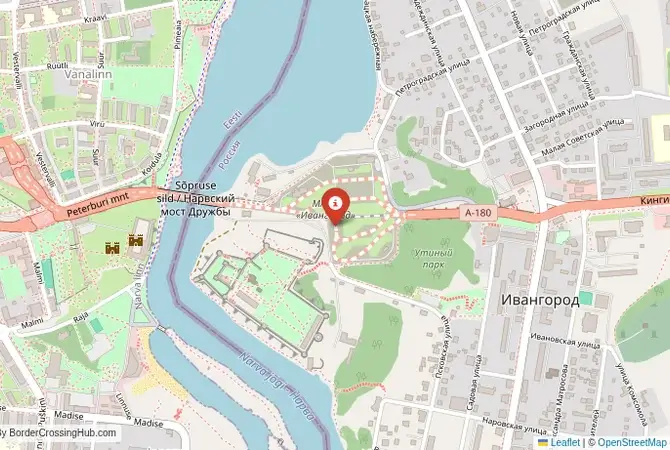
Few borders put two fortresses so close together. Hermann Castle on the Estonian bank was begun by the Danes in the 13th century and passed to the Livonian Order in 1346. It is dominated by its 51-metre Pikk Hermann tower, which the Order completed after the Russian fortress went up across the river. Ivan III of Moscow built Ivangorod Fortress opposite it in 1492. It was raised in a single summer, has walls about 14 metres high and now serves as a museum. Ivangorod's suburb Jaanilinn was part of Narva until January 1945, when Soviet authorities transferred it to Leningrad Oblast.
Narva itself has about 51,000 residents and is overwhelmingly Russian-speaking: about 95.7 per cent of residents are native Russian speakers. The city has a station on the Tallinn–Narva rail line, with five daily domestic trains to Tallinn, some express services taking about 2.5 hours, and a central bus station beside it. Passenger trains between Estonia and Russia have not run since 2020.
On the Russian side, Ivangorod has a station on the Tallinn–St Petersburg line, with infrequent suburban trains to St Petersburg's Baltiysky station. The A180 highway links the town to St Petersburg, about 159 km east, and Tallinn lies about 218 km west.
The line itself is still disputed on paper. Estonia's 1992 constitution recognises the 1920 Treaty of Tartu border, Russia recognises the 1945 one, and the border treaties signed in 2005 and 2014 were never ratified by both parliaments.
Nearby Border Crossings



Heading to Ivangorod & Narva? Take this with you.
One page with the hours, waits, emergency numbers and coordinates. Works without signal.
Practical information
Fuel
Russia: <1 km - Estonia: <1 km
Currency
Available near Narva (RUB, EUR)
Safety information
Generally safe, traffic moderate
Connectivity
Wi-Fi at checkpoints, 4G
Have you crossed here?
Help other travelers by sharing your experience, wait times, and any updates.