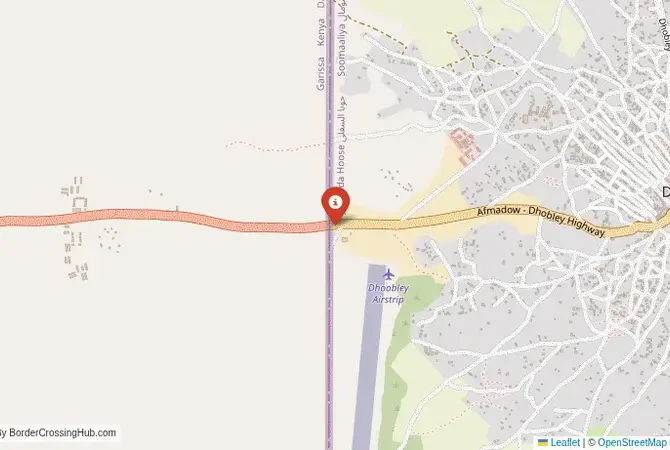
Monthly Update (August 2026):
Dhobley–Liboi remains a relatively quiet and remote Kenya–Somalia crossing, with movement largely tied to local communities and regional trade. There has been no major recent change making it a more practical route for international travelers. The security situation around the Kenya–Somalia border and the long, sparsely developed approach remain more important to the journey than queues at the crossing itself.
About this crossing
The Dhobley-Liboi Crossing: The Gateway to the Dadaab Camps
The border crossing that connects the Somali town of Dhobley in the Lower Juba region with the Kenyan town of Liboi in Garissa County is the main southern gateway between the two countries. This is not a tourist or commercial crossing in any normal sense. It is a major strategic and humanitarian corridor, a place defined by two powerful forces: the war against Al-Shabaab and the world's largest refugee complex. The landscape is a flat, arid, and unforgiving semi-desert of thorn scrub. The crossing itself is a heavily fortified and militarized outpost. The atmosphere is one of high security, military tension, and the immense, decades-long human tragedy of the Somali refugee crisis. For the international community, this border is a major logistical hub for humanitarian aid and a key frontline for the Kenyan Defence Forces (KDF) in their long-running intervention in Somalia. It is a border that represents the epicenters of both conflict and refuge.
A History of a Refugee Crisis and a Military Intervention
The history of this border is the history of the collapse of the Somali state. After the fall of Siad Barre in 1991 and the descent of Somalia into civil war, a massive wave of refugees fled across the border into Kenya. The UNHCR, with the Kenyan government, established the Dadaab refugee camps near the town of Liboi. These camps, intended to be temporary, have now existed for over three decades and have grown into a sprawling, city-like complex housing hundreds of thousands of Somalis. The rise of the Al-Shabaab insurgency in the 2000s added a new, violent dimension to the border. The region became a major area for Al-Shabaab recruitment and infiltration into Kenya. In 2011, after a series of cross-border kidnappings and attacks, the Kenyan army invaded Somalia through this very crossing, launching "Operation Linda Nchi" (Protect the Country). The town of Dhobley became a major forward operating base for the KDF and the African Union Mission (AMISOM/ATMIS). The border has been a hard, militarized frontline ever since.
Nearby Border Crossings





Border Procedures: A Military and Humanitarian Gateway
The border is officially closed to all civilian and tourist traffic in 2025–2026 with only humanitarian and military access permitted. The procedures that exist are for the military and for the managed repatriation of refugees.The Process: The crossing is controlled by the Kenyan military on one side and by a combination of Somali government-aligned forces and international peacekeepers on the other. Movement is by armed convoy only. The primary traffic is military supply trucks, armored personnel carriers, and the vehicles of UN agencies and NGOs that are permitted to operate in the region. There are no facilities for processing international tourists. Any foreigner in this region would need to be embedded with a military or major aid organization and would be subject to their extremely strict security protocols.For a foreign traveler, there is no legal or practical way to cross here. It is a restricted military zone. Any unauthorized person would be immediately detained and treated as a major security risk.
The Regional Context: A High-Risk Zone
The crossing connects the Lower Juba region of Somalia with the Garissa County of Kenya. Both are extremely dangerous areas. The Lower Juba region is one of the main battlegrounds in the war against Al-Shabaab. The town of Dhobley is a fortified garrison, but the surrounding countryside is highly insecure. Garissa County in northeastern Kenya is a vast, arid, and underdeveloped region. It has been the site of some of the most horrific terrorist attacks in Kenya's history, including the 2015 Garissa University attack. The Dadaab refugee camps, while a place of sanctuary, also have their own complex security and social problems. The entire border region is subject to a heavy security force presence, frequent counter-terrorism operations, and a very high risk of attack by Al-Shabaab. The roads are poor and are frequently targeted with improvised explosive devices (IEDs).
Final Contextual Note: A Border of War and Refuge
The Dhobley-Liboi crossing is a place that embodies the profound and devastating consequences of the Somali conflict. It is a border that is simultaneously a hard military frontline and a vital humanitarian corridor. It is a place where the international community has invested billions of dollars to both fight a war and to care for its victims. For the traveler, the message is absolute and unequivocal: this is a no-go zone of the highest order. It is not a place for adventure but a place of extreme and unpredictable danger. The story of this border is a powerful and sobering lesson in the complexities of modern conflict, counter-terrorism, and the immense challenge of managing one of the world's most protracted refugee crises.
View all border crossings between Somalia and KenyaPractical information
Fuel
Somalia: <1 km - Kenya: <1 km
Currency
Limited exchange (SOS, KES)
Safety information
Restricted, security risks
Connectivity
Limited Wi-Fi, 2G
Have you crossed here?
Help other travelers by sharing your experience, wait times, and any updates.