Monthly Update (October 2026):
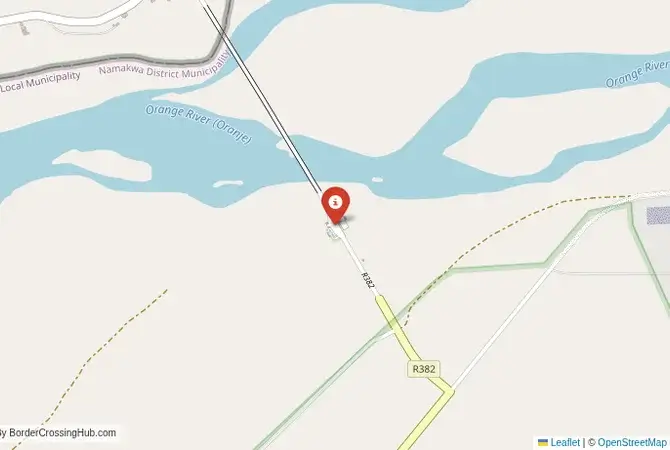
In October 2026, Alexander Bay & Oranjemund continues to operate as a quieter Namibia–South Africa crossing over the Ernest Oppenheimer Bridge at the mouth of the Orange River. South African authorities list opening hours of 06:00–22:00. Plan around these hours, as the crossing is closed overnight.
About this crossing
A History of a Forbidden Zone
The history of this border is the history of diamonds. In the early 20th century, vast alluvial diamond deposits were discovered along the coast of what was then German South West Africa. The German colonial authorities declared the entire area a "Sperrgebiet" to maintain a state monopoly on the diamonds. After World War I, South Africa took control of the territory, and the diamond mining operations were consolidated under the control of the De Beers company. The towns of Oranjemund on the Namibian side and Alexander Bay on the South African side were built as high-security company towns, exclusively for the mine workers. The entire area was a massive security zone, and the border was sealed to all but official mine traffic. After Namibian independence, the mining operations continued under a joint venture, Namdeb. It was only in 2017 that the town of Oranjemund was finally proclaimed an open town, and the border crossing was opened to the general public and tourists. It is a border that has been transformed from a secret, corporate security gate into a public international gateway.
The Border Crossing Procedure: A Modern and Quiet Process
The border is open during daylight hours only (typically 6:00 AM to 10:00 PM). The facilities on both sides are modern, and the process is generally very smooth and quiet due to the low volume of traffic. Exiting Namibia (Oranjemund): You will arrive at the Namibian border post, located just outside the town of Oranjemund. You will go to the immigration hall and get your passport stamped for exit. The customs process for vehicles is a brief formality. The officials are professional and the process is usually very quick. The Ernest Oppenheimer Bridge: You will then drive across the modern bridge over the beautiful Orange River estuary. The view of the wetlands and the Atlantic Ocean in the distance is spectacular. This is the no-man's-land. Entering South Africa (Alexander Bay): You will arrive at the South African border post. You will go to the immigration hall. For most nationalities, South Africa offers visa-free entry. The officer will check your passport and provide an entry stamp. After immigration, you will proceed to the customs office. The officials will check your vehicle's documents. The entire process is well-organized and can often be completed in under 30 minutes.
Nearby Border Crossings

Route, Onward Travel, and The Diamond Coast
This crossing is on the main coastal road. On the Namibian side, the road from the main B1 highway to the town of Rosh Pinah and on to Oranjemund is now a good, paved highway. The town of Oranjemund itself is a fascinating place to visit, a perfectly preserved mid-century company town in the middle of the desert, famous for the gemsbok (oryx) that wander freely through its streets. On the South African side, the road from Alexander Bay connects to the town of Port Nolloth and the main N7 highway. The region is known as the Diamond Coast and is part of the Namaqualand floral kingdom. This crossing is the perfect gateway for a road trip exploring the remote and beautiful west coasts of both countries. It also provides a crucial link for travelers exploring the Ai-Ais/Richtersveld Transfrontier Park, as it connects the southern end of the park with the main road network.
Final Planning Advice for the Sperrgebiet Gateway
The Oranjemund-Alexander Bay crossing is a new, exciting, and beautiful border. It is a fantastic option for the overland traveler looking to explore the remote and historic Diamond Coast. The key to a successful crossing is to have all your documents in order, especially your vehicle registration if you are driving. It is also essential to check the operating hours of the border, as it is not a 24-hour crossing. The journey it enables, into a land that was forbidden for a century, is a unique and memorable one. It is a border that tells a powerful story of secrecy, wealth, and the recent opening up of one of the world's most restricted landscapes. It is a passage into a forgotten world, a true journey of discovery for the modern explorer.
View all border crossings between Namibia and South AfricaPractical information
Fuel
Namibia: <1 km - South Africa: 2 km
Currency
Exchange near Alexander Bay / Oranjemund (NAD, ZAR)
Safety information
Safe, desert area
Connectivity
Wi-Fi at checkpoints, 4G
Have you crossed here?
Help other travelers by sharing your experience, wait times, and any updates.