Monthly Update (September 2026):
Pasir Mas & Tak Bai remains a security-sensitive crossing because Tak Bai is in Narathiwat, one of Thailand's southern provinces affected by the ongoing insurgency. Malaysia has increased intelligence gathering and border controls following recent attacks, while current UK travel advice continues to recommend against all but essential travel in Narathiwat and other parts of the southern border region. The crossing should therefore be treated as a route requiring extra caution rather than an ordinary tourist border.
About this crossing
The East Coast Crossings: Rantau Panjang and Tak Bai
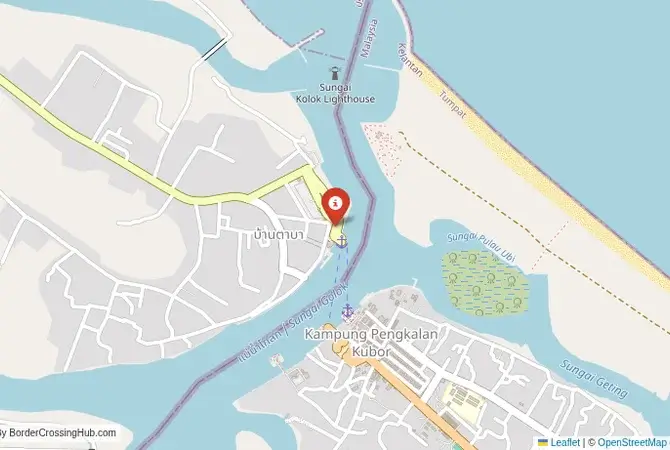
The border on the east coast between the Malaysian state of Kelantan and the Thai province of Narathiwat is defined by the Golok River. There are two main international crossings in this area. The primary crossing is the Harmony Bridge, which connects Rantau Panjang in Malaysia with Sungai Kolok in Thailand. A secondary, smaller crossing is the ferry at Pengkalan Kubor in Malaysia, which connects to the Tak Bai district in Thailand. This guide will focus on the main Rantau Panjang-Sungai Kolok bridge crossing, as it is the primary gateway, but will also mention the Tak Bai ferry as a local alternative. These crossings are the main links for trade and travel between the culturally rich state of Kelantan and southern Thailand. The atmosphere is that of a classic Southeast Asian border, a vibrant and sometimes gritty mix of commerce, local life, and a heavy security presence. It is a border that feels deeply connected to the local Malay culture that straddles the political line.
A History of a Shared Culture and a Troubled Frontier
The history of this border is the history of the Malay people. The state of Kelantan in Malaysia and the southern provinces of Thailand have been part of the same cultural and historical sphere for centuries, a region where the majority of the population is ethnically Malay and Muslim. The 1909 Anglo-Siamese Treaty, which established the modern border, divided this single cultural region. This historical division is one of the root causes of the ongoing separatist insurgency in southern Thailand. The Golok River crossings have always been a key point of connection for the Malay communities on both sides, a place for family visits and trade. However, the conflict has also made it a sensitive security point. The border is heavily patrolled by both Thai and Malaysian security forces to prevent the movement of insurgents and smugglers. It is a border that is both a bridge for a shared culture and a frontline in a long-running conflict.
Nearby Border Crossings


The Rantau Panjang-Sungai Kolok Bridge Crossing Procedure
This is the main crossing, and it is open during daylight hours, typically from 6:00 AM onward (with early openings implemented for certain enforcement periods). The process is well-established but can be crowded with local traffic. You must have a valid visa for the country you are entering if your nationality requires one. Exiting Malaysia (Rantau Panjang): You will arrive at the large Malaysian ICQS (Immigration, Customs, Quarantine and Security) complex in Rantau Panjang. You will go to the immigration counter, where the officer will check your passport and provide an exit stamp. After immigration, you will go through a customs check. The Harmony Bridge: You will then walk or take a motorbike taxi across the bridge over the Golok River. The bridge is the no-man's-land and is usually busy with pedestrians and motorcyclists. Entering Thailand (Sungai Kolok): On the other side of the bridge, you will arrive at the Thai immigration and customs offices. You will present your passport to the immigration officer. For most nationalities, Thailand offers a visa exemption stamp. The officer will stamp your passport, and you are officially in Thailand. The customs check is usually a brief formality.
Route, Onward Travel, and The Tak Bai Ferry
On the Malaysian side, the nearest major city and transport hub is Kota Bharu, the capital of Kelantan state, which is about a 45-minute to 1-hour bus or taxi ride from Rantau Panjang. Kota Bharu is a fascinating city, considered the cradle of Malay culture. On the Thai side, Sungai Kolok has a railway station which is the southern terminus of the State Railway of Thailand's southern line, with connections to Hat Yai and Bangkok. This makes it a convenient crossing for those traveling by train. The Tak Bai ferry crossing is a smaller, more local alternative located further downriver, near the coast. It is a simple passenger ferry. The procedures are similar but the facilities are more basic. It is less commonly used by foreign travelers but is a viable option if you are in the immediate coastal area. It connects Pengkalan Kubor in Malaysia with the Tak Bai district in Thailand.
Final Planning Advice for the East Coast Route
The Rantau Panjang-Sungai Kolok crossing is the main gateway to the east coast of Malaysia. The crossing process itself is relatively straightforward. However, the primary consideration for any traveler must be the security situation in the southern provinces of Thailand. It is absolutely essential to check the latest government travel advisories before planning your trip, as the area remains under heightened security with risks of attacks. If the situation is deemed safe for travel, this border offers a fascinating entry point into the culturally rich state of Kelantan. The train connection to Sungai Kolok on the Thai side is a major advantage. By being well-informed about the security context and having all your documents in order, you can navigate this complex and interesting frontier and begin your exploration of a different side of Malaysia.
View all border crossings between Malaysia and ThailandPractical information
Fuel
Malaysia: <1 km - Thailand: <1 km
Currency
Exchange near Pasir Mas (MYR, THB)
Safety information
High-risk area due to regional insurgency; exercise extreme caution
Connectivity
Wi-Fi at checkpoints, 4G
Have you crossed here?
Help other travelers by sharing your experience, wait times, and any updates.