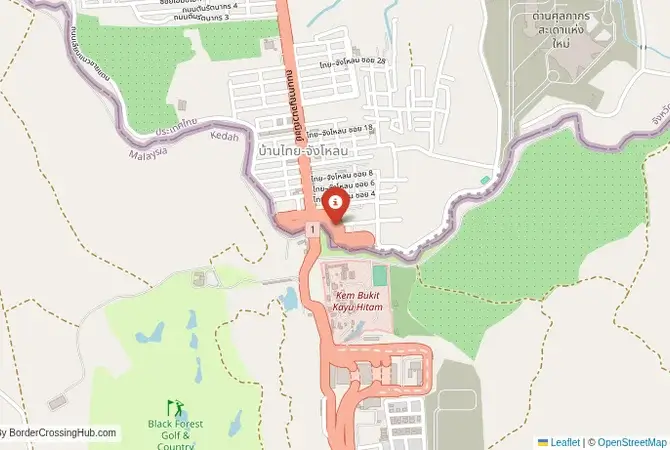
Monthly Update (November 2026):
The new road connection between Bukit Kayu Hitam and Sadao is now well established after opening in July, with earlier reports showing smoother freight movement and less pressure on the old approach roads. No major new restriction has been identified in November, and the improved layout continues to benefit drivers using this busy Thailand–Malaysia gateway. The main practical change compared with the beginning of 2026 is the upgraded road access rather than a new immigration procedure.
Driving there, or sending a driver? Send them this guide.
For reports and websites
Cite this page
Border Crossing Hub (2026). Bukit Kayu Hitam & Sadao Border Crossing. Updated November 2026. https://bordercrossinghub.com/bukit-kayu-hitam-sadao-border-crossing/<a href="https://bordercrossinghub.com/bukit-kayu-hitam-sadao-border-crossing/">Bukit Kayu Hitam & Sadao Border Crossing (Border Crossing Hub)</a>Put this crossing's card on your website
Free. It updates on its own when our information changes.
<iframe data-bch-card src="https://bordercrossinghub.com/bukit-kayu-hitam-sadao-border-crossing/?bch_view=card" width="100%" height="980" scrolling="no" style="border:0;max-width:480px;display:block" loading="lazy" title="Bukit Kayu Hitam & Sadao border crossing information"></iframe>
<p style="font-size:12px;margin:4px 0 0">Crossing information: <a href="https://bordercrossinghub.com/bukit-kayu-hitam-sadao-border-crossing/">Border Crossing Hub</a></p>
<script src="https://bordercrossinghub.com/?bch_embed_js=1" async></script>Paste it where you want the card. The last line (a script) only adjusts the height and can be left out.
About this crossing
A History of a Strategic Corridor
The history of this border is the history of the Malay Peninsula itself, a land of ancient kingdoms, trade routes, and colonial influence. The modern border was established by the Anglo-Siamese Treaty of 1909. The Sadao-Bukit Kayu Hitam crossing grew in importance throughout the 20th century as the road network was developed. It became the primary commercial link between the industrial and agricultural heartlands of Malaysia and the markets of southern Thailand. The crossing is also located in a region with a complex security history, including the Malayan Emergency and the presence of communist insurgents who used the porous border as a sanctuary. This has led to a strong security presence on both sides. In recent years, both Thailand and Malaysia have invested hundreds of millions of dollars in upgrading the border complex, building massive new Integrated Check Posts to handle the ever-increasing volume of traffic and to streamline the customs and immigration procedures. It is a border that reflects both the deep economic integration and the underlying security concerns of the region.
The Border Crossing Procedure: A Modern, Drive-Through Process
The border is open from 6:00 AM to midnight (Malaysian time; 5:00 AM to 11:00 PM Thai time) for passenger vehicles and pedestrians. The new facilities are designed to be highly efficient, with drive-through lanes for cars and motorcycles, separating them from the heavy truck traffic. The process is professional and can be very quick during off-peak hours, but can still involve long waits during holiday periods or weekends. Exiting Thailand (Sadao): You will arrive at the massive new Thai border complex. You will drive your vehicle to a passport control booth. You will need to hand over your passport and the TM.6 departure card. The officer will stamp your passport. You will then proceed to a customs booth, where your vehicle's documents may be checked. The entire exit process can often be completed without leaving your car. The No-Man's-Land: After clearing the Thai post, you will drive a short distance through a wide, well-lit no-man's-land to the Malaysian facility. Entering Malaysia (Bukit Kayu Hitam): You will arrive at the equally large and modern Malaysian Integrated Immigration, Customs, Quarantine and Security (ICQS) complex. You will again drive to a passport control booth. You must check the visa requirements for your nationality; many can enter Malaysia visa-free. The officer will scan your fingerprints and stamp your passport. You will then proceed to the customs area. If you are driving a foreign-registered vehicle, you will need to have your vehicle's registration card and may need to purchase Malaysian vehicle insurance if your policy is not valid. You will also need to get a "Touch 'n Go" card, an electronic payment card that is required to pay tolls on Malaysian highways. The customs inspection is usually quick for tourists.
Route, Onward Travel, and Logistics
The crossing is on the main North-South Expressway, the best and most modern highway in Southeast Asia. On the Thai side, the road connects to the city of Hat Yai, the main commercial hub of southern Thailand. On the Malaysian side, the expressway leads directly to the capital, Kuala Lumpur, and on to Singapore. The road quality is excellent. For those without their own vehicle, there are numerous direct bus services that run from Hat Yai in Thailand to various destinations in Malaysia, including Penang and Kuala Lumpur. These buses handle the border crossing as part of their journey, making it a very convenient option. There are also shared and private taxis available on both sides of the border. The nearest major Malaysian city is Alor Setar, the capital of Kedah state.
Final Planning Advice for the Main Highway
The Sadao-Bukit Kayu Hitam crossing is the most efficient and straightforward land border between Thailand and Malaysia. It is a modern facility that is designed for high-volume traffic. The key to a smooth crossing is to have all your documents in order: passport, visas (if required), and, for drivers, vehicle registration and insurance. The drive-through process is very convenient. If you are traveling by public transport, the direct bus services from Hat Yai are an excellent and hassle-free option. This crossing is a perfect example of a modern, functional border, a seamless gateway that allows for easy travel between the vibrant culture of southern Thailand and the modern, developed landscape of Peninsular Malaysia.
Nearby Border Crossings

Heading to Bukit Kayu Hitam & Sadao? Take this with you.
One page with the hours, waits, emergency numbers and coordinates. Works without signal.
Practical information
Fuel
Thailand: <1 km - Malaysia: <1 km
Currency
Exchange near Sadao (THB, MYR)
Safety information
Safe, traffic congestion
Connectivity
Wi-Fi at checkpoints, 4G
Have you crossed here?
Help other travelers by sharing your experience, wait times, and any updates.