
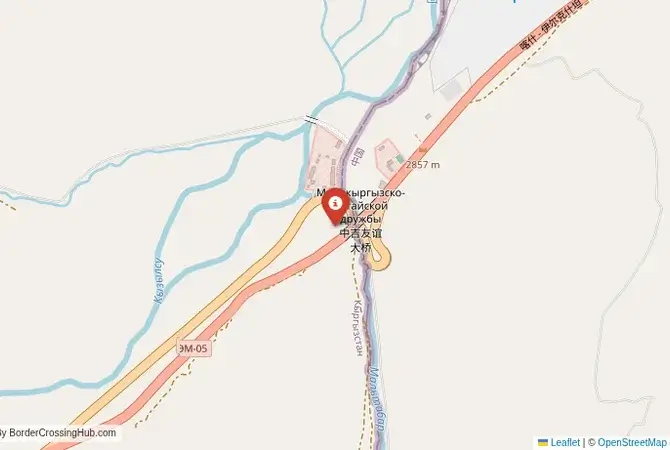
Monthly Update (October 2026):
Irkeshtam had a temporary closure at the beginning of October for China's National Day holiday, with passage suspended from 22:00 on October 1 until 08:00 on October 4. It has since resumed, and Irkeshtam remains the more practical of Kyrgyzstan's two China gateways for independent overland travelers, although commercial traffic and Chinese border procedures can still make the crossing a lengthy affair.
About this crossing
A History of Commerce and Strategic Position
The route over the Irkeshtam Pass has been a southern branch of the Silk Road for centuries, a more direct route to the Fergana Valley than the higher passes to the north. Its modern importance, however, is a product of the post-Soviet era. As China's economy boomed and its "Go West" policy took shape, the need for efficient land routes to Central Asia became paramount. The Irkeshtam crossing was identified as a key strategic link. Both China and Kyrgyzstan have invested in upgrading the road and the border facilities to handle a significant volume of freight. It is now a critical artery for Chinese goods entering Central Asia and for regional resources flowing back to China. Unlike the tourist-focused, seasonal mountain crossings elsewhere, Irkeshtam is a year-round commercial workhorse, a testament to the powerful economic forces reshaping the ancient geography of the Silk Road. It is a border defined by the rumble of trucks and the pragmatic demands of international trade.
The Border Crossing Procedure: A Long and Methodical Day
Crossing at Irkeshtam is a full-day endeavor that requires patience and an early start. The border has a long lunch break, and the entire process can take anywhere from six to ten hours. The procedure involves multiple checkpoints over a vast distance. The Kyrgyz Side: The journey begins from the village of Sary-Tash in Kyrgyzstan's Alay Valley. From here, it is a drive of about an hour to the first Kyrgyz checkpoint, where your documents are checked. You then continue to the main Kyrgyz immigration and customs post. Here, you will get your passport stamped for exit. The process on the Kyrgyz side is generally straightforward and relatively quick. The No-Man's-Land: After clearing the Kyrgyz post, you enter a long stretch of no-man's-land. You will need to take a shared taxi or a pre-arranged vehicle for this part of the journey. The drive is through a stunning, rugged canyon. The Chinese Side: This is where the real process begins. You will first arrive at a preliminary Chinese checkpoint where your passports and visas are inspected. You then continue for many more kilometers to the main, massive Chinese immigration and customs port. The process here is extremely thorough.
Nearby Border Crossings



Transportation, Logistics, and Planning
The most common way for independent travelers to manage this crossing is by using a combination of shared taxis. From Osh or Sary-Tash in Kyrgyzstan, you can hire a taxi to the Kyrgyz border. You will then need to find a vehicle to take you through the no-man's-land to the Chinese post. On the Chinese side, you will need to find another taxi or bus for the long journey to Kashgar. Some direct buses may run from Osh to Kashgar, which simplifies the logistics, but you must confirm their schedule and availability in advance. It is essential to have a Chinese visa arranged long before your trip. You must also be prepared for the security checks on your electronics by "cleaning" them of any content that might be deemed controversial by Chinese authorities. Arrive at the border as early as possible to maximize your chances of completing the crossing in one day. Bring plenty of food and water, as there are no services available during the long process.
Final Advice for the Southern Gateway
The Irkeshtam crossing is a serious undertaking, but it is the most feasible option for overland travel between southern Kyrgyzstan and China. It is a true adventure that rewards the patient and well-prepared traveler with an unforgettable journey through the stunning landscapes of the Alay and Tian Shan mountains. The key to success is meticulous preparation: get your visa early, prepare your electronics, pack food and water, and adopt a mindset of patient compliance with the rigorous security procedures on the Chinese side. It is a border that provides a stark and immediate introduction to the realities of travel in modern Xinjiang, but it is also a gateway to the incredible history and culture of Kashgar and the ancient Silk Road.
View all border crossings between Kyrgyzstan and ChinaPractical information
Fuel
Kyrgyzstan: <1 km - China: <1 km
Currency
Exchange near Irkeshtam (KGS, CNY)
Safety information
High-altitude road hazards
Connectivity
Limited Wi-Fi, 3G
Have you crossed here?
Help other travelers by sharing your experience, wait times, and any updates.