Monthly Update (September 2026):
Dustlik & Osh remains one of the main Uzbekistan-Kyrgyzstan crossings and is receiving attention as the two countries try to make cross-border travel easier for tourists. Uzbekistan and Kyrgyzstan are considering an expedited border-crossing mechanism at Dustlik specifically for organized tourist groups, alongside a similar measure at Uchkurgan-Kensai. The proposal is part of a broader push to develop combined Uzbekistan-Kyrgyzstan travel routes. For ordinary travelers, there is no significant September closure reported, but the planned faster processing could eventually make this busy southern corridor more convenient.
About this crossing
A History of a Divided Valley
The Fergana Valley's borders are one of the most convoluted legacies of the Soviet Union. Stalin's cartographers drew the lines in the 1920s, deliberately weaving the borders of Uzbekistan, Kyrgyzstan, and Tajikistan through the valley in a way that divided ethnic groups and created a complex patchwork of enclaves and exclaves. For decades, this was irrelevant under a single Soviet state. After 1991, these lines became hard international borders. The Dustlik-Dostuk crossing became a point of friction. It was closed unilaterally by Uzbekistan for many years following ethnic clashes in southern Kyrgyzstan in 2010 and the general atmosphere of regional suspicion. The closure caused immense hardship for the local communities, severing family ties and crippling local trade. The grand reopening of the border in 2017 was a landmark event, a powerful symbol of Uzbekistan's new "good neighbor" policy and a cause for massive celebration on both sides. It has since been modernized to handle the enormous pent-up demand for cross-border movement.
The Border Procedure: An Intense Pedestrian Experience
This crossing is overwhelmingly used by pedestrians. While vehicles can cross, the queues are notoriously long, and most travelers find it far more efficient to cross on foot and take transportation on the other side. Be prepared for large crowds and a potentially chaotic but ultimately manageable process. The crossing can take one to three hours, with pedestrian lanes often moving faster due to recent expansions and dedicated processing. Exiting Uzbekistan (Dustlik): You will approach the Uzbek terminal, which is often thronged with people. You will first show your passport to a guard to enter the facility. Inside, you will queue for an immigration booth. The officer will check your passport and your hotel registration slips. This is very important in Uzbekistan. After getting your exit stamp, you will proceed to the customs check. Your bags will be X-rayed, and you may be questioned about how much currency you are carrying. Be polite and patient with the officials. Entering Kyrgyzstan (Dostuk): After leaving the Uzbek side, you will walk across a short bridge over a canal that marks the border. You will then enter the Kyrgyz terminal. The atmosphere on the Kyrgyz side is generally more relaxed. For most nationalities, Kyrgyzstan offers visa-free entry for up to 60 days. You will present your passport at an immigration booth, and the officer will stamp it with an entry stamp. There is no migration card to fill out. The customs check on the Kyrgyz side is typically much less intensive for tourists than the Uzbek exit check. Once stamped in, you are free to exit the terminal.
Nearby Border Crossings

Route, Transportation, and the Fergana Valley
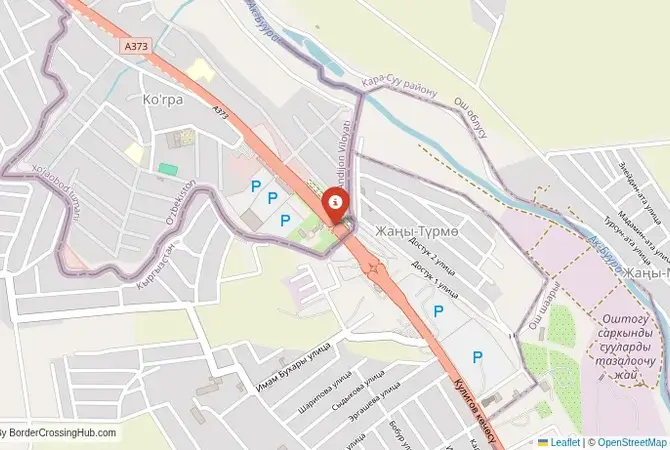
The crossing lies directly between Andijan and Osh. From the Uzbek side, a taxi from the center of Andijan takes about 20 minutes. From the Kyrgyz side, shared taxis and marshrutkas (minibuses) wait just outside the terminal to take you the 15-minute journey into the center of Osh. You will be swarmed by drivers; it is best to walk a little away from the gate to negotiate a better price. The Fergana Valley itself is a fascinating destination. It is the agricultural heartland of Central Asia, a lush, green basin surrounded by high mountains. Osh is one of the oldest cities in the region, boasting the UNESCO-listed Sulaiman-Too Sacred Mountain, while the Uzbek side offers craft centers in cities like Margilan (famous for silk) and Rishton (famous for ceramics).
Final Advice for the Friendship Bridge
Crossing at Dustlik-Dostuk is a quintessential Central Asian travel experience. The key is to be mentally prepared for the crowds. Do not be intimidated by the seeming chaos; the queues move, and the process is well-established. The most critical piece of preparation is having your Uzbek hotel registration slips in perfect order. For a smoother entry into Kyrgyzstan, knowing the approximate taxi fare to Osh will help you in your negotiations. By embracing the energy of the place and having your documents ready, you can successfully pass through this historic and vital gateway, a true crossroads of Central Asian cultures.
View all border crossings between Uzbekistan and KyrgyzstanPractical information
Fuel
Uzbekistan: 500 m - Kyrgyzstan: 500 m
Currency
Exchange near Dustlik (UZS, KGS)
Safety information
Safe, traffic moderate
Connectivity
Wi-Fi at checkpoints, 4G
Have you crossed here?
Help other travelers by sharing your experience, wait times, and any updates.