Monthly Update (September 2026):
Navoi & Saryagash remains the main temporary passenger alternative while the larger Gisht-Kuprik/Jibek Joly crossing undergoes reconstruction. Uzbekistan lists Navoi-Kaplanbek as an international checkpoint, while Kazakhstan's border authorities previously confirmed that the route was opened specifically to handle passenger vehicles and buses during the Gisht-Kuprik works. Kazakhstan and Uzbekistan are also preparing to reopen the rebuilt Gisht-Kuprik crossing in September, which could eventually shift some traffic away from Kaplanbek. Travelers using Navoi-Kaplanbek should therefore expect it to remain an important route until the larger crossing is officially back in service.
About this crossing
A History of Overflow and Regulation
Like all borders in the region, Navoi-Kaplanbek was once just a point on an internal Soviet road. After independence in 1991, as the main Jibek-Zholy crossing became increasingly congested, Kaplanbek emerged as a natural relief valve. Its history is one of regulation and adaptation. At times of tense relations between Uzbekistan and Kazakhstan, it was one of the first to be restricted, with authorities funneling all international traffic through the main, more easily controlled Jibek-Zholy post. In times of better relations, it has been opened more widely to ease the burden on the main crossing. It is, therefore, a barometer of the political and economic climate between the two nations. Its primary function has always been to serve the dense, cross-border population of the Tashkent and Saryagash regions, rather than long-distance international travelers.
The Border Procedure: Quieter but Still Meticulous
If you are eligible to use this crossing, you will find the process similar to the main border but with significantly fewer people. The facilities are smaller and may seem less modern, but the procedural steps are the same. Expect the crossing to take less time than at Jibek-Zholy, perhaps 60-90 minutes, but the checks will be no less thorough. Exiting Uzbekistan (Navoi): You will approach the Uzbek post and present your passport for inspection. An immigration officer will check your documents and stamp your passport. They will be just as interested in your hotel registration slips as at the main border, so have them ready. A customs official will then inspect your vehicle and luggage. Because this crossing is less accustomed to foreign tourists, you may find the officials more curious and the inspection more detailed. They will be particularly focused on ensuring you are not illegally exporting currency or antiques. Entering Kazakhstan (Kaplanbek): After leaving the Uzbek post, you will proceed to the Kazakh facility. You will need to meet Kazakhstan's visa requirements (many nationalities are visa-free for up to 30 days). An immigration officer will stamp your passport and issue you the mandatory white migration card, which you must keep until you leave the country. A customs check will follow. As this crossing is also a significant route for commercial trucks, customs officials are experienced in inspecting vehicles and goods. Be prepared for a professional and systematic, if not overly friendly, process.
Nearby Border Crossings

Route and Accessibility for Foreigners
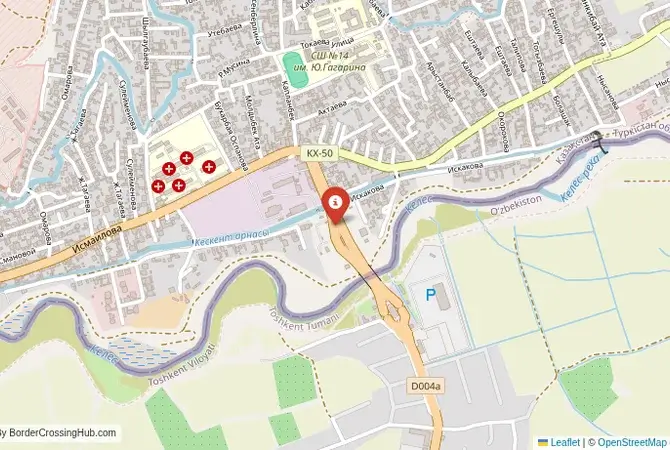
The crossing is located just a few kilometers from the main Jibek-Zholy post, in the same cluster of suburbs north of Tashkent. The key issue for a foreign traveler is confirming its current status. This information can be difficult to find online and is often best obtained from local sources, such as hotel staff or taxi drivers in Tashkent, who will have up-to-date knowledge. If you arrive and are turned away, the main Jibek-Zholy crossing is a short drive away, so the detour is not a major loss of time. If you do cross here, you will find yourself on the same main road network connecting to Shymkent. The advantage is not a different route but a potentially shorter wait time.
Final Considerations
The Navoi-Kaplanbek crossing is a good example of a secondary border post. It offers a potentially quicker, less crowded alternative to the main international gateway, but this comes with a degree of uncertainty for foreign travelers. For those driving their own vehicle, it can be an attractive option to avoid the long vehicle queues at Jibek-Zholy. The best strategy is to do some on-the-ground research in Tashkent before you head to the border. If you get reliable information that it is open to your nationality, it could save you considerable time. If not, you can proceed with the certainty of using the main Jibek-Zholy crossing. In either case, the same rules of preparation apply: have your passport, visa, and all registration documents in perfect order.
View all border crossings between Uzbekistan and KazakhstanPractical information
Fuel
Uzbekistan: 2 km - Kazakhstan: 2 km
Currency
Exchange near Navoi (UZS, KZT)
Safety information
Safe, traffic moderate
Connectivity
4G mobile network coverage
Have you crossed here?
Help other travelers by sharing your experience, wait times, and any updates.